CHAPTER 04 · 1898 — 1903
He gave the sky an address.
Failure, repair, and the extraordinary journey around the Eiffel Tower.
SAINT-CLOUD · PARIS · MONACO
A balloon that could choose its way
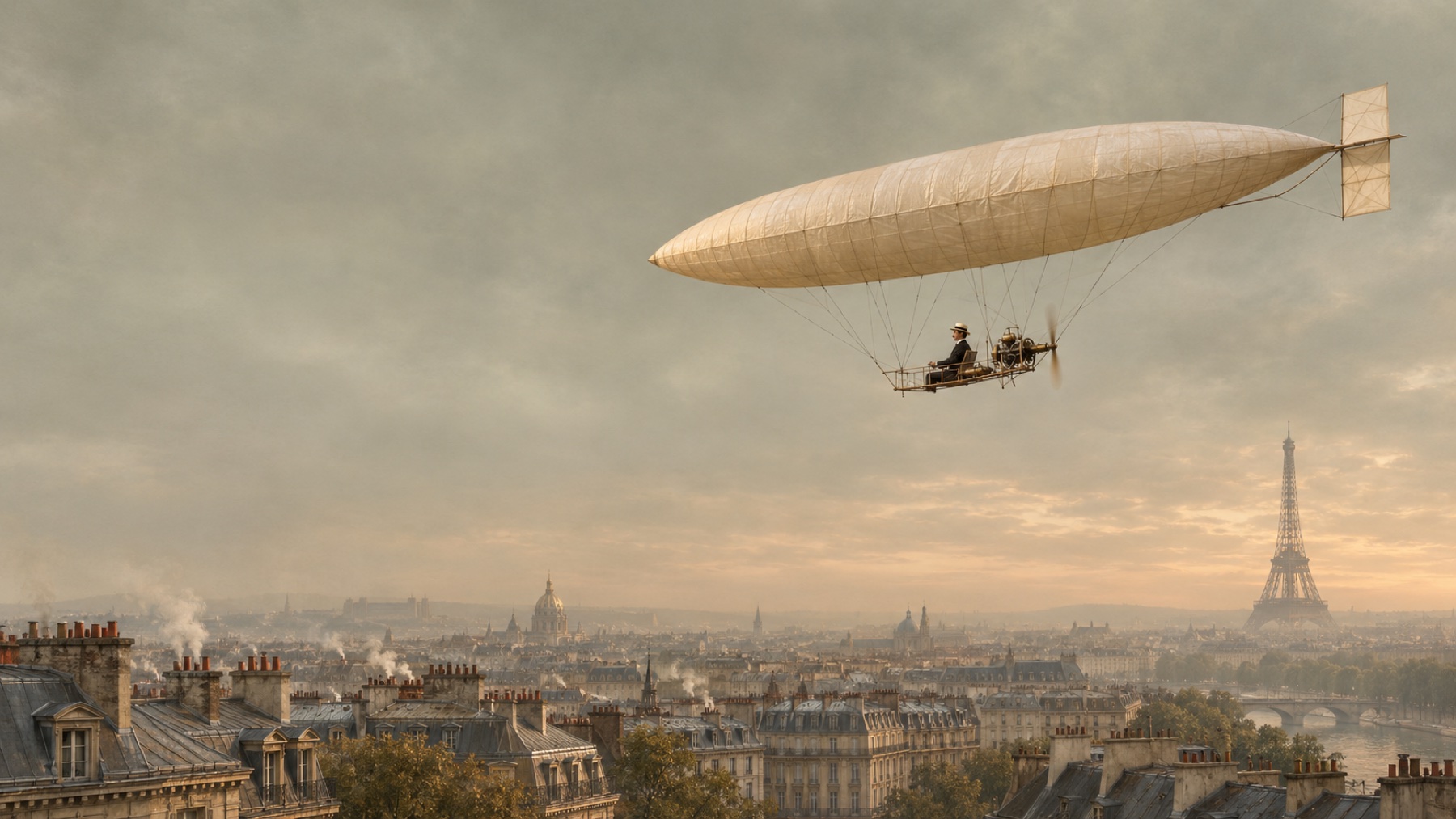
The difference begins with the return journey. A spherical balloon can carry a person over a wonderful landscape, but the wind chooses where the journey leads. To leave a place, travel toward a destination, and return to the starting point requires another kind of machine. Alberto wanted that freedom. A propeller and rudder promised a way to pursue it, provided their weight could be carried into the air.
In 1898, after gaining experience in free balloons, he began building powered dirigibles. The envelope became elongated, giving the machine a recognizable direction. Below it hung an engine, a propeller, and the place from which the pilot would control the whole assembly. It was an aircraft made of relationships: the lifting gas above, the suspended weight below, and thrust acting through a structure light enough to rise.
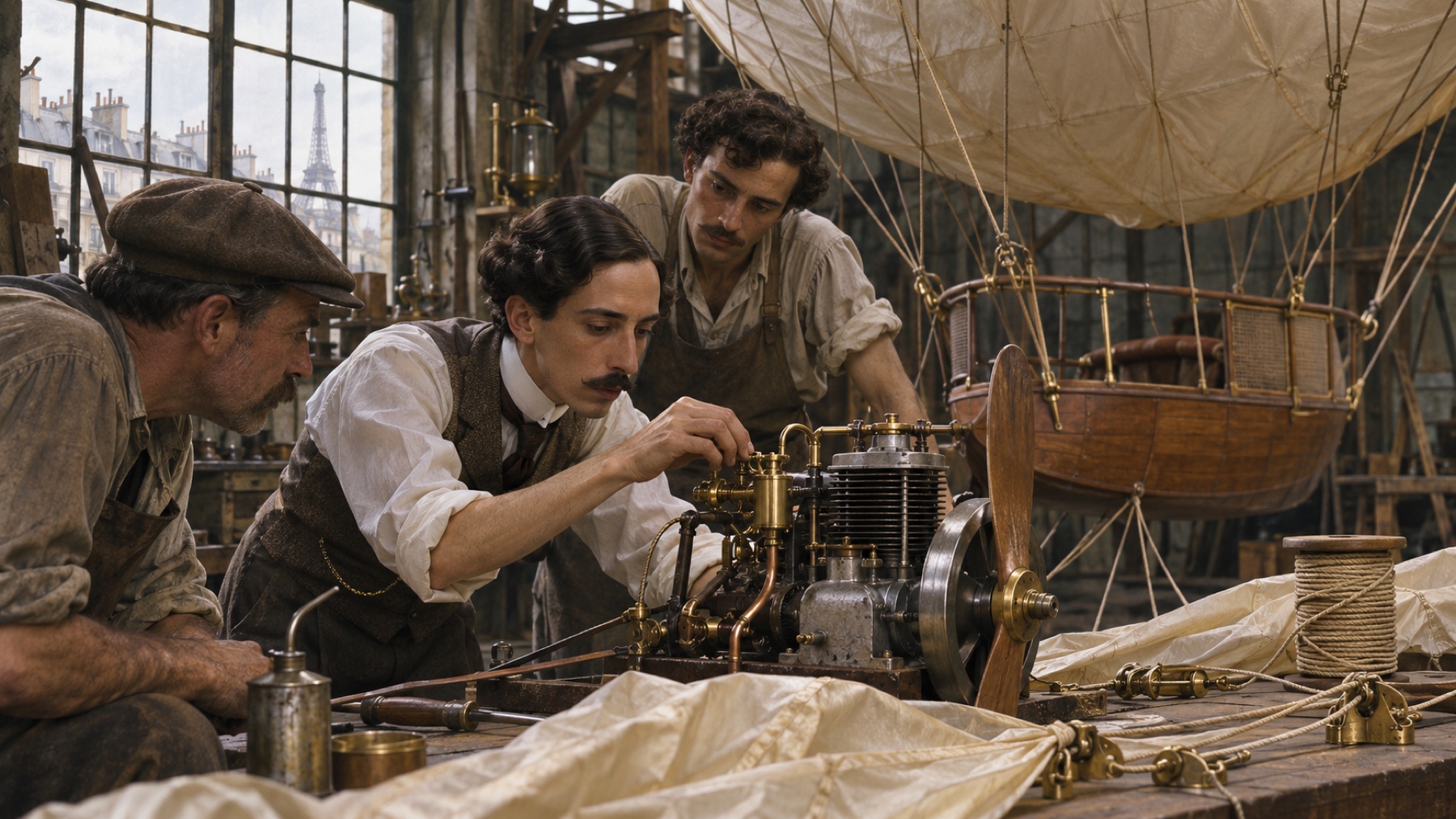
Go back into the workshop before looking at the skyline. The engine must be mounted. Fuel has to reach it. Cables must carry loads without reaching the turning propeller. The gas envelope must retain a usable shape. Every attractive line in a photograph conceals a decision about one of those problems. To steer through Paris, he first had to make these different materials work together.
No. 1: the shape begins to fail
The first numbered airship was exceptionally slender. Its small petrol engine made powered movement possible, but propulsion was only one difficulty. When the pressure and shape of the envelope changed, the long balloon could bend. The suspension system then had to carry its loads in a geometry for which it was no longer properly arranged.
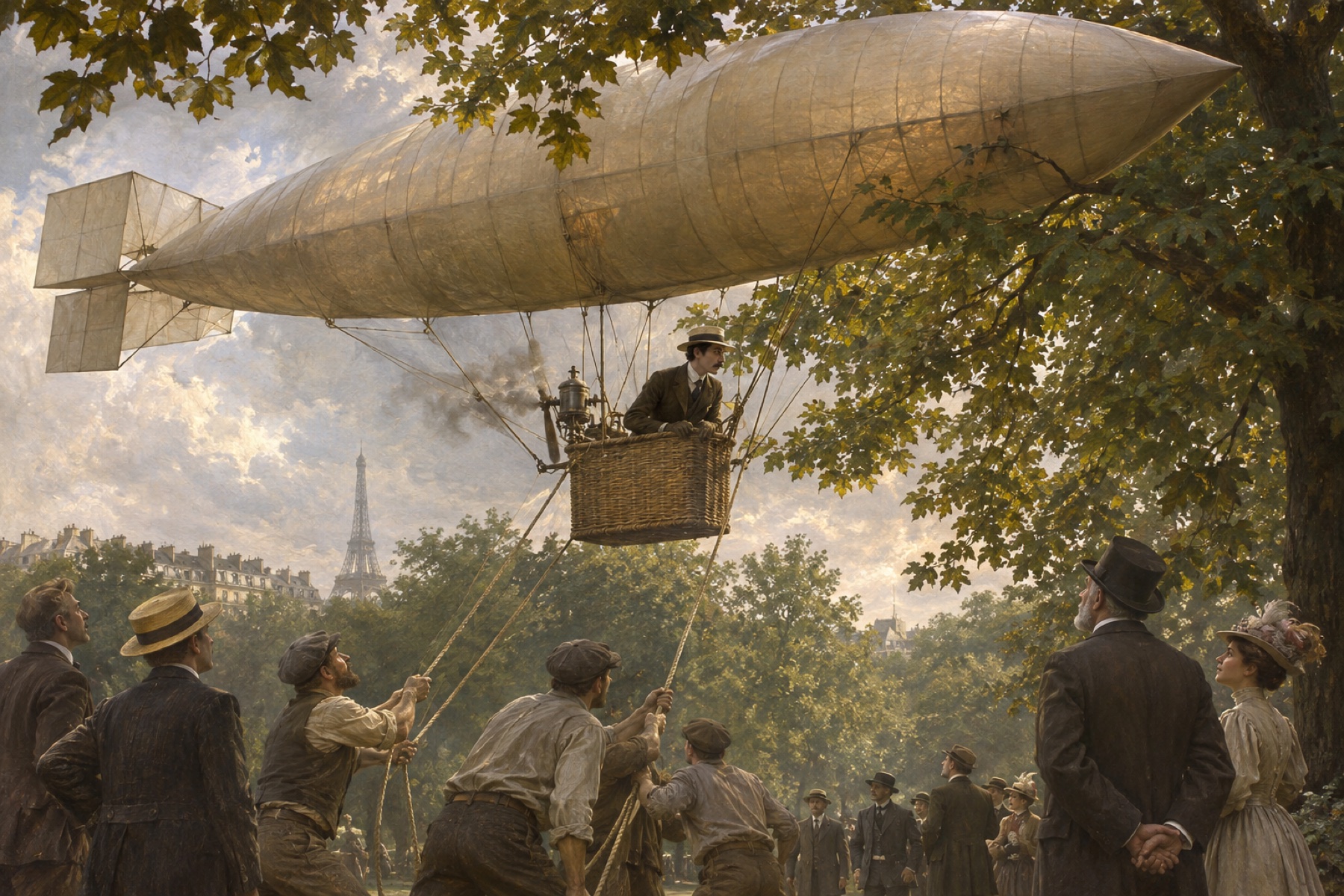
During the 1898 trials, Alberto encountered this weakness directly. The airship could cease to behave like the clean, elongated shape imagined by its maker. Near the ground, a failing envelope and surrounding trees became an immediate problem of landing and rescue. Early success in making a propeller move an aircraft did not settle the question of keeping that aircraft manageable.
This was the beginning of a repeated pattern: a flight exposed a relationship that a drawing had not made sufficiently clear; repairs and another design followed. Increasing the engine's power could not substitute for maintaining the envelope's shape. Making something stronger might also make it heavier. The constraints pulled against one another, and he had to learn inside them rather than wish them away.
The sky becomes a workshop
The next machines explored different proportions, volumes, and arrangements. No. 3 had a fuller envelope than its predecessors. No. 4 made the pilot's exposure particularly striking, with a bicycle-like seat in place of the comforting picture of an enclosed cabin. He was not refining one finished product. He was trying ways of making the load, the gas, and the motor cooperate.
The numbered sequence can hide this if it is read too quickly. One number is not simply one more success. It represents a configuration tested against practical experience, sometimes followed by a costly repair or another configuration. The city watching him saw repeated ascents; the inventor experienced a continuous set of decisions about weight, pressure, stability, and control.
Free-balloon experience remained useful. Ballast, valves, and the approach to a landing were already part of his knowledge. Powered flight added the ability to act on the horizontal journey, together with the consequences of carrying fuel and machinery. He became pilot and engine attendant at once. There was nobody else in the basket to take over while he concentrated on a fault.
A course Paris could understand
In 1900, Henri Deutsch de la Meurthe offered a prize with a wonderfully legible course. An airship was to leave the Aéro-Club's grounds at Saint-Cloud, go around the Eiffel Tower, and return within thirty minutes. The journey was roughly eleven kilometres. The tower was both a navigational mark and an object the public could immediately recognize.
The challenge demanded something more revealing than a favourable straight run. Wind that helped on one leg could oppose the aircraft on the other. The machine needed useful speed through the air, controllability around the turning point, and sufficient reliability to keep its motor working throughout. A failure halfway home could undo an excellent outward time.
Look at the course from Alberto's position. Saint-Cloud is the place he wants to reach again. Between it and the tower lie the river, the Bois de Boulogne, rooftops, and the edges of the city. The destination is enormous and visible, but it is also a solid obstacle. The same landmark that makes the experiment understandable gives the pilot a reason to be careful. The public can watch a feat whose hardest problems remain almost invisible from the ground.
July: the return takes too long
On 13 July 1901, he made a prize attempt with No. 5. The outward journey looked promising: in his account he reached the tower in about ten minutes. The return met a headwind, and he arrived back at Saint-Cloud far beyond the limit. Then the engine stopped. The airship drifted into a chestnut tree on Edmond de Rothschild's property.
The episode has a human detail that survives in his memoir. Princess Isabel, living nearby in exile, sent lunch while he dealt with the stranded machine. Later she sent a medal of Saint Benedict with a letter expressing concern for his safety. He explained that the chain seen on his wrist was associated with wearing that medal. A small object connected a conspicuously modern experiment with an older language of care and protection.
The July flight showed exactly why returning mattered. He had reached the great landmark, yet that was not the task completed. Nor did crossing back into familiar territory make a motor failure harmless. An experimental airship needed a safe relationship with the ground at every stage, including the last few minutes when the watching crowd might already assume the difficult part was over.
8 August: a spring, a leak, a roof
The next serious attempt brought a far more dangerous accident. On 8 August, No. 5 rounded the tower, but a valve was allowing hydrogen to escape. As the envelope lost its shape, the suspension wires sagged toward the propeller. Alberto stopped the engine to prevent it from cutting them. That decision also removed his powered means of resisting the wind.
The airship descended toward the Trocadéro hotels. Part of the envelope struck a roof and burst; the keel became braced against the buildings, leaving him suspended in his basket above a courtyard. Firemen from Passy came to his rescue. The machine had become a wreck while the man remained alive.
The full sequence deserves its own story, because it was more than a dramatic interruption between two successful dates. The failure connected a small valve, the shape of a large envelope, the path of the suspension wires, and the engine's other duties. Back on the ground, the next design would have to answer that chain of events.
FOLLOW THIS MOMENT · 8 MIN READThe morning the sky gave way. ↗No. 6: keeping the envelope in shape
The new airship was No. 6, approximately thirty-three metres long, with an envelope of about 630 cubic metres and a twelve-horsepower engine. The figures describe a machine, but the important change lies in how its parts were expected to protect one another. Alberto gave renewed attention to the arrangement that kept the envelope properly filled out as conditions changed.
Inside the outer envelope was an air compartment, or ballonet. As the lifting gas occupied less volume, air could enter this compartment and help preserve the outer shape. Valves relieved pressure in a controlled order. The system did not make hydrogen inexhaustible or eliminate risk. It addressed a specific operational need: an elongated airship must continue to hold a shape compatible with its suspended structure and propeller.
There was still practice and damage before victory. September brought further mishaps and repairs. The machine that emerged for the decisive attempt was the product of those intervening days, not simply a sketch made after a dramatic rescue. Workers sewed fabric, fitted mechanisms, checked assemblies, and returned equipment to service. The familiar name on the aircraft carried work done by many hands.
19 October: leaving Saint-Cloud
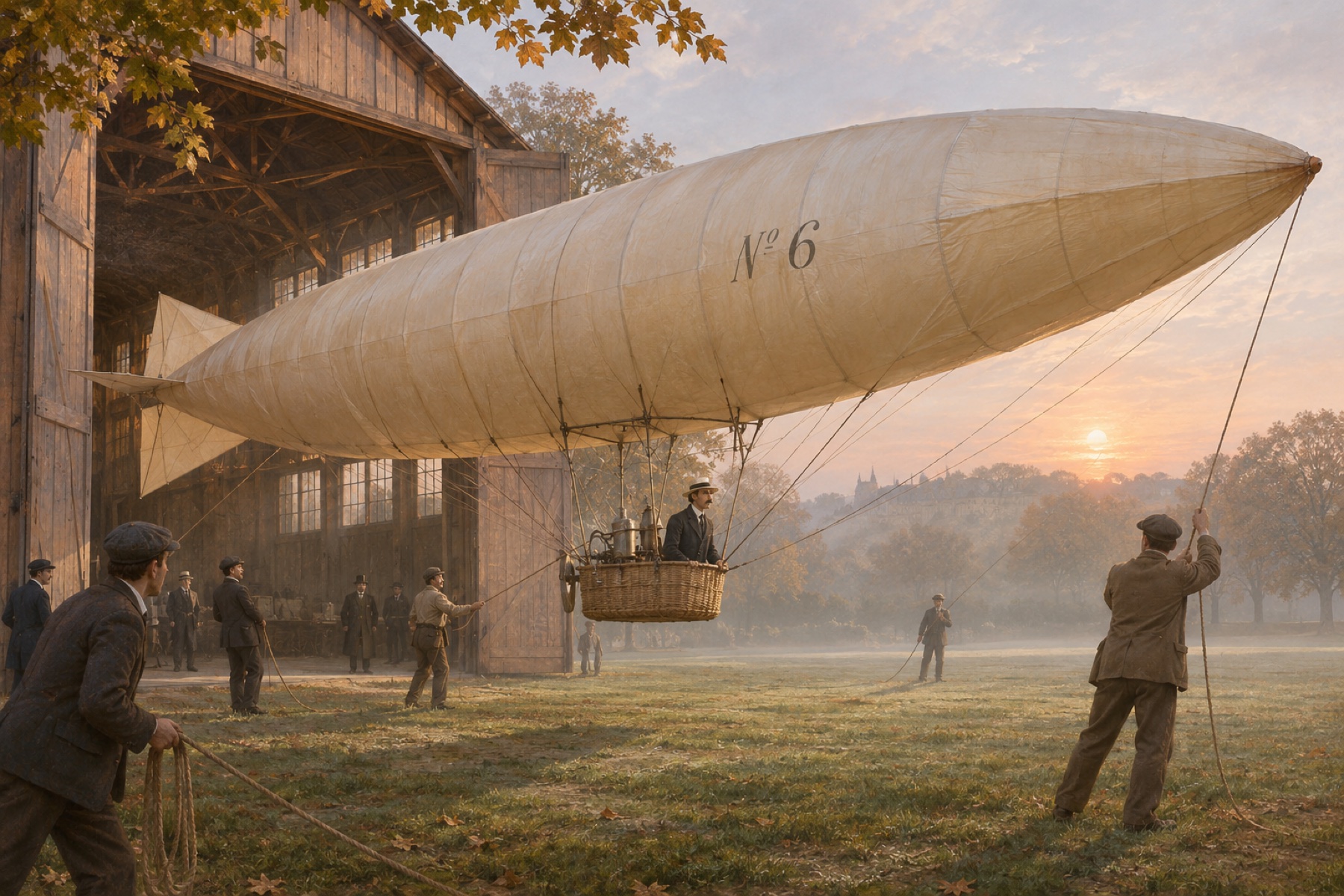
On 19 October 1901, No. 6 set out again. Picture the crew near the ground, hands attending to a machine that can be pulled sideways by the same air in which it must navigate. Above them stretches an envelope large enough to lift a person and an engine, yet made of fabric. Below it, Alberto has the controls and the responsibility for deciding when to proceed.
His published account gives a start shortly before 2:42 in the afternoon. Soon the familiar ground recedes and the outward leg becomes a succession of reference points. The time limit is running. The aircraft must make progress toward the tower while preserving enough reliability for the return, when the helpful part of the wind will no longer be helpful.
It is easy to imagine the pilot as a figure admiring the view. His description is much more concentrated. On the outward flight, he was occupied with the goal. He had to attend to direction, machinery, and altitude. The machine did not possess a separate navigator, flight engineer, or observer. All those tasks gathered around one small place beneath the silk.
The Eiffel Tower fills the view
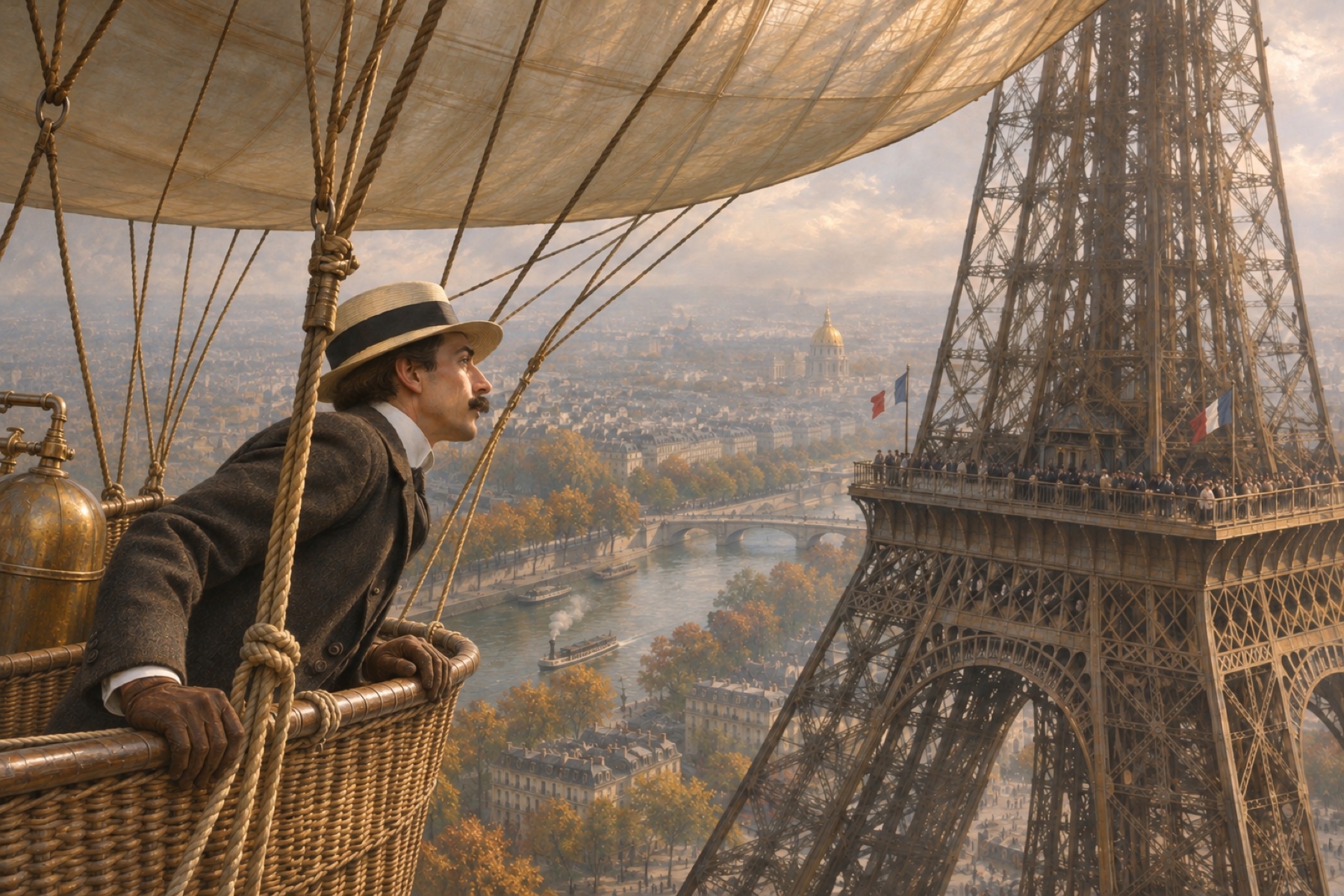
The turn came after roughly nine minutes. From the ground, the tower offered a magnificent way to see whether the airship had truly gone around its destination. From the aircraft, its size imposed a different meaning. Iron was now close to an envelope whose shape depended on gas, fabric, and valves. A change of wind or a stopped motor could narrow the pilot's options very quickly.
Alberto later described the tower as the chief danger he anticipated in these attempts. The risk was not an abstract fear of height. It was the possibility of being carried against a structure he could not move, while flying an aircraft whose engine was not completely dependable. He had to make a controlled path around it and then establish the return course.
Let the image bring the landmark near, but keep the practical work in view. The basket is not an observation terrace. There are lines, controls, and a running engine beside the pilot. Paris spreads below, yet the immediate problem is to leave the tower safely behind. When he completes the turn, the famous silhouette is no longer the destination. Saint-Cloud is.
The engine falters on the way home
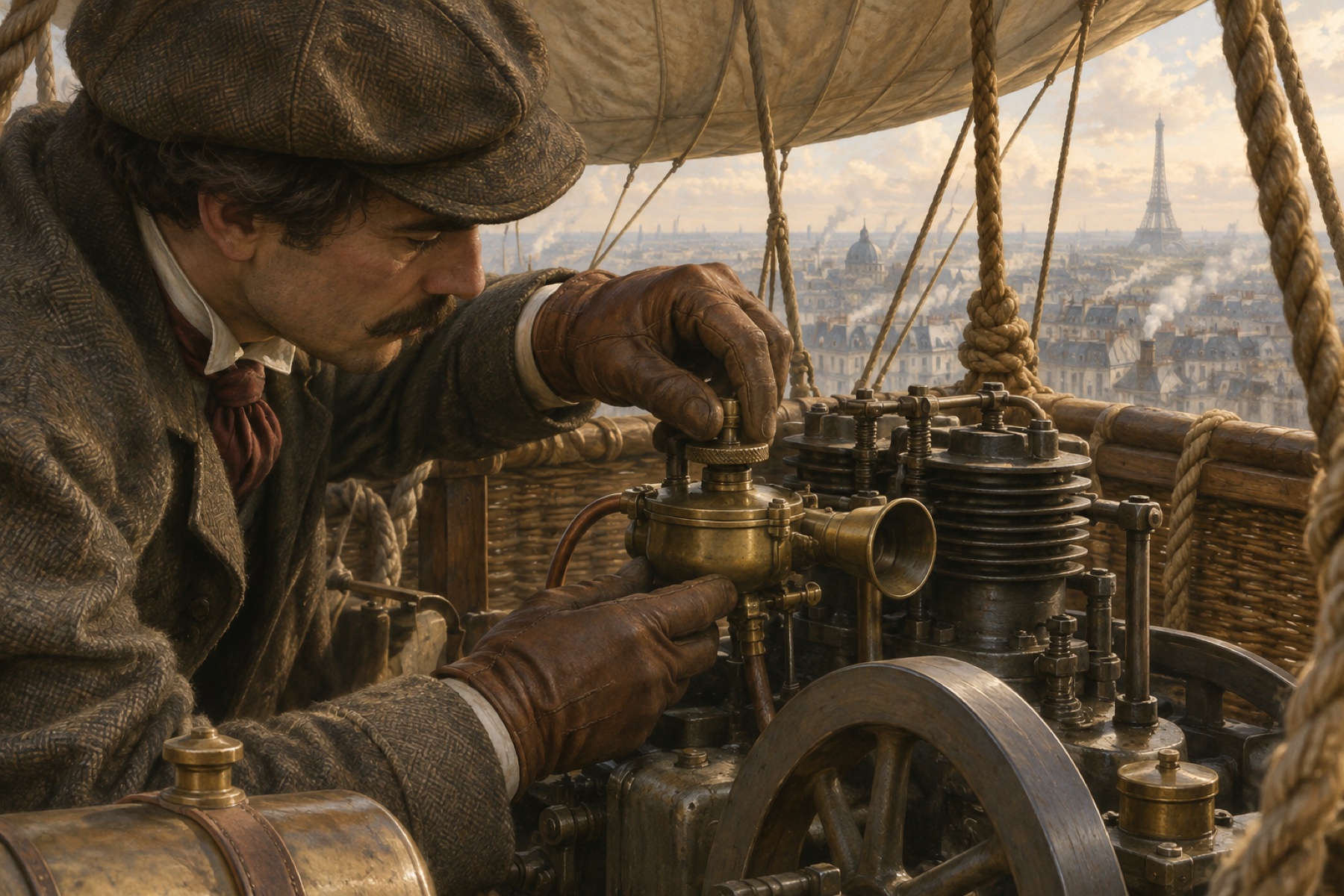
The return was not an uninterrupted triumph. Alberto reported that the motor nearly stopped soon after the turn. To attend to it, he had to divide his attention between the controls and the machinery. A carburettor adjustment belongs at the centre of the story because it could determine whether the aircraft continued making useful progress.
Over the Bois de Boulogne, altitude and trim became another complication. He moved weights and the guide rope aft to bring the airship's nose upward. When the engine recovered its full power, that upward attitude became more pronounced. The crowd below saw an alarming climb; the pilot had to move the weights forward again to restore a more suitable attitude.
This is the flight at its most physically intelligible. A shift of weight changes the direction in which thrust carries the aircraft. A mechanism recovering from a fault can create a new problem if the rest of the machine has already been adjusted around its weakness. The pilot is continually meeting the consequences of his last decision. The grass at Saint-Cloud is near, but reaching it still demands work.
Two finishing moments, one famous argument
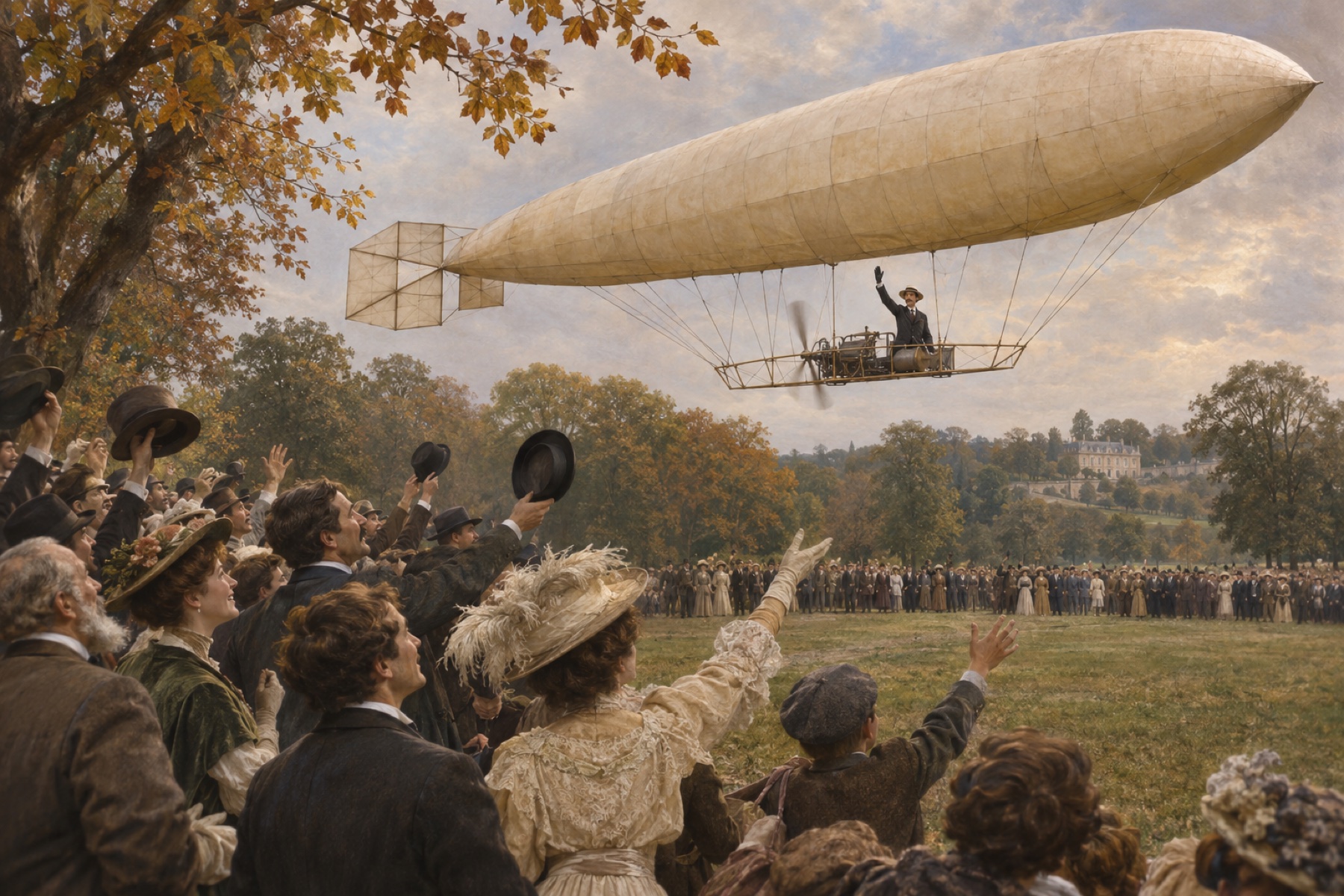
He passed above the timekeepers at Saint-Cloud after twenty-nine minutes and thirty-one seconds, according to his memoir. He then turned back to let the ground crew catch the guide rope and bring him down. That happened after the thirty-minute limit. The two moments produced an argument over what counted as completion: returning across the finishing point, or being physically brought to earth.
For a short time, the uncertainty followed him onto the ground. The spectators' excitement and the officials' interpretation were different parts of the event. He had made the circuit in less than half an hour; the award still needed to be settled. The prize was ultimately granted, and 19 October became the date attached to the achievement.
The disagreement gives the scene texture. A technological demonstration must be performed, witnessed, timed, and interpreted. Even when an aircraft has visibly done something extraordinary, the terms of a competition can matter. Santos Dumont's flight was public enough to generate both acclaim and scrutiny. That visibility helped turn an experimental journey into a story that travelled far beyond the people standing in the field.
The prize leaves his hands
The prize money ultimately amounted to 125,000 francs. In his account, Alberto gave 75,000 francs through the Paris prefect of police for people in need and distributed the remaining 50,000 among his employees. The allocation placed the mechanics and other workers within the celebration. Their contribution had continued through the days when there was no triumphant crowd to watch them.
Fame now moved faster than the airship. His name and appearance became recognizable, the flights entered illustrated publications, and the slender machine became a symbol of a city imagining its aerial future. That public presence brought opportunities, but it also created an image simpler than the labour behind it: the elegant man, the improbable craft, the Eiffel Tower.
The deeper story retains the things the icon leaves out. A small spring could compromise the whole machine. A motor needed attention in the air. A prize could remain disputed after the flight was over. The triumph belonged to a man capable of continuing through that untidy reality, supported by people who could turn the next set of drawings into something that might rise.
Beyond the tower: Monaco and a smaller airship
The Eiffel Tower flight did not end the experiments. Monaco offered a different setting in 1902, with Prince Albert I's support and a hangar near the water. The sea changed the problem of operating near the ground. Wind, waves, boats, and the possibilities of rescue became part of the apparatus around the aircraft. The familiar Paris skyline had been replaced by a coast.
By 1903, the small No. 9 suggested a more intimate use for powered flight. It was a runabout, an aircraft Santos Dumont used for short journeys rather than a large machine built around a prize course. Its surviving Clément engine gives that idea a material presence in the Smithsonian's collection: modest machinery connected to a very ambitious freedom of movement.
Then another person took the controls. Aída de Acosta learned to operate No. 9 and flew it alone on 29 June 1903. Her flight carries the story beyond the inventor's own performances. An aircraft he had developed could now become someone else's experience of the air. Follow her journey in the companion story, before returning to the very different challenge that awaited him at Bagatelle.
FOLLOW THIS MOMENT · 8 MIN READHe showed her the controls. She took the sky. ↗EXPLORE THE SOURCES
[1]Alberto Santos-Dumont · My Airships (1904) ↗[5]Smithsonian Institution ↗[8]Mauricio Pazini Brandão · ITA / ICAS (2018) ↗[16]Smithsonian · National Air and Space Museum ↗[21]Henrique Lins de Barros · CBPF ↗[22]Past & Present · Oxford University Press ↗[23]Museu de Astronomia e Ciências Afins · Part II ↗[27]Journal de Monaco · 18 November 1948 ↗[37]Smithsonian · Clement V-2 Engine ↗All illustrations are AI interpretations. Sensory invitations are atmosphere, not recorded thoughts or dialogue.