A CLOSER LOOK · 8 AUGUST 1901
The morning the sky gave way.
A leaking valve, a stopped propeller, and a basket suspended above a courtyard. The accident that No. 6 had to answer.
SAINT-CLOUD · TROCÁDÉRO, PARIS
The tower is only halfway
On the morning of 8 August 1901, Santos Dumont left Saint-Cloud in No. 5 for another attempt at the Deutsch prize. The task was familiar: round the Eiffel Tower and return within half an hour. Familiarity did not make it safe. An earlier attempt in July had ended with the machine in a tree after a difficult return.
He reached the tower in roughly nine minutes, according to his later account. That was a promising outward time. It also left him on the wrong side of a problem he had already begun to notice. Hydrogen was escaping from the balloon. The machine that had to carry him home was changing while he flew it.
The tower could be rounded quickly and the attempt still fail. The return demanded a functioning envelope, a working engine, and enough controllability to deal with the wind. The moment of apparent progress was therefore also the moment in which a prudent decision about a developing fault became most difficult.
He notices the leak—and continues
Alberto's account is unusually frank about this decision. He said he had perceived the gas loss before reaching the tower and would ordinarily have landed to examine it. The prize attempt and his good speed encouraged him to continue. We do not need to invent a private monologue; he later identified the choice himself.
A weakened spring in one automatic valve was allowing the escape. The component was small, but the function was central. Gas was not simply a consumable that could be replaced later without other effects. As its volume and the envelope's condition changed, the shape supporting the whole arrangement began to deteriorate.
The pilot could see the consequences, but he could not step outside the aircraft to inspect and repair the valve. The workshop and the ground were now destinations rather than resources within reach. Whatever he did next had to be done from his place in the suspended structure, with the city and the wind around him.
The wires enter the propeller’s path
As the envelope sagged, some suspension wires approached the propeller. Alberto saw the rotating blades catching and cutting them. The source of thrust had become a direct threat to the structure carrying him. Continuing to run the engine risked destroying connections on which the aircraft depended.
He stopped the motor. That removed the immediate action of the propeller against the wires, but it also removed powered resistance to the wind. The airship was losing lift and being carried back toward the tower. In his account, the forward end rose as the partly empty envelope distorted the balance of the machine.
This was not a single isolated break. It was a sequence in which one failure changed the conditions of another component. The wires were no longer where a working propeller required them to be. The pilot's necessary response then changed the aircraft's movement through the air. What had appeared to be separate engineering problems had become one emergency.
Why the envelope could not recover
The motor had another duty: driving the ventilating arrangement intended to help maintain the envelope's form through the interior air compartment. Stopping the engine interrupted that assistance too. The system that should have helped with shape could no longer be treated independently of the machinery he had just shut down.
He later considered whether the inner compartment had failed to open properly because its varnish had not dried before assembly. That was a hypothesis in his account, not a conclusion we can independently certify from the wreckage. The distinction matters. A responsible reconstruction can explain what he suspected without turning suspicion into a laboratory result.
The broader lesson was unmistakable enough to guide his next machine: pressure management, valves, and the shape of a long envelope were essential to the safety of everything below it. A visibly enormous aircraft could be compromised by a small piece of hardware or an assembly detail that a spectator would never have noticed.
The roofs come into the descent
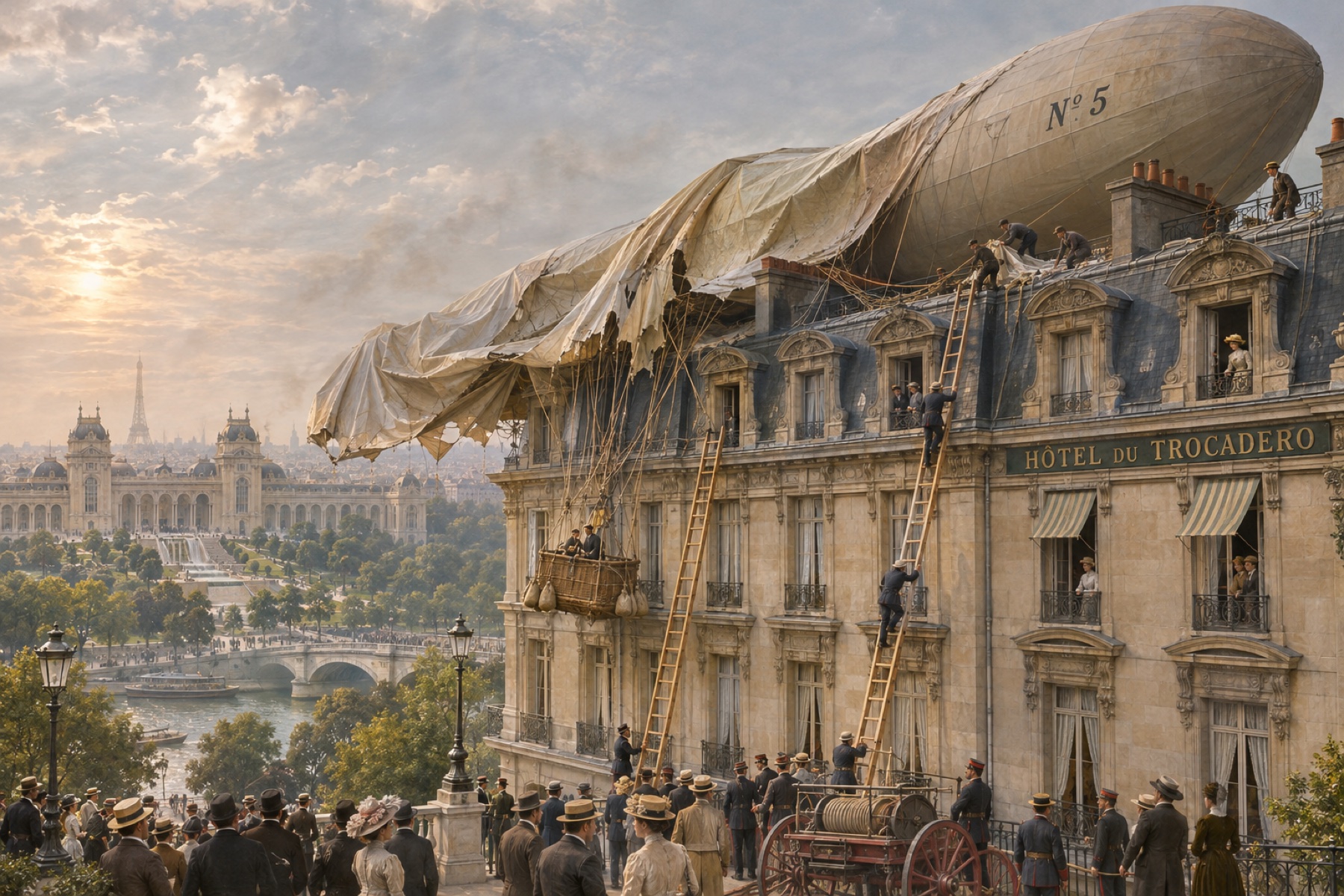
He expected the wind to carry him clear toward the Seine embankment. It did not carry him quite far enough. The basket and keel passed the Trocadéro buildings, but the part of the balloon still holding gas struck a roof. The envelope burst with a loud report.
Alberto distinguished that noise from a combustion explosion. His account compares the effect to the bursting of an inflated bag. It is a useful correction to an otherwise tempting dramatic image: the danger was real without adding a fireball that the record does not support.
The keel became braced at an angle between parts of the buildings. His basket hung high in the courtyard, held by a light structure that had survived the impact. For a moment the materials he had trusted in the air were supporting him in an entirely unintended way. The aircraft was no longer navigable. Survival depended on the remaining structure and the people who could reach him.
The people who came from Passy
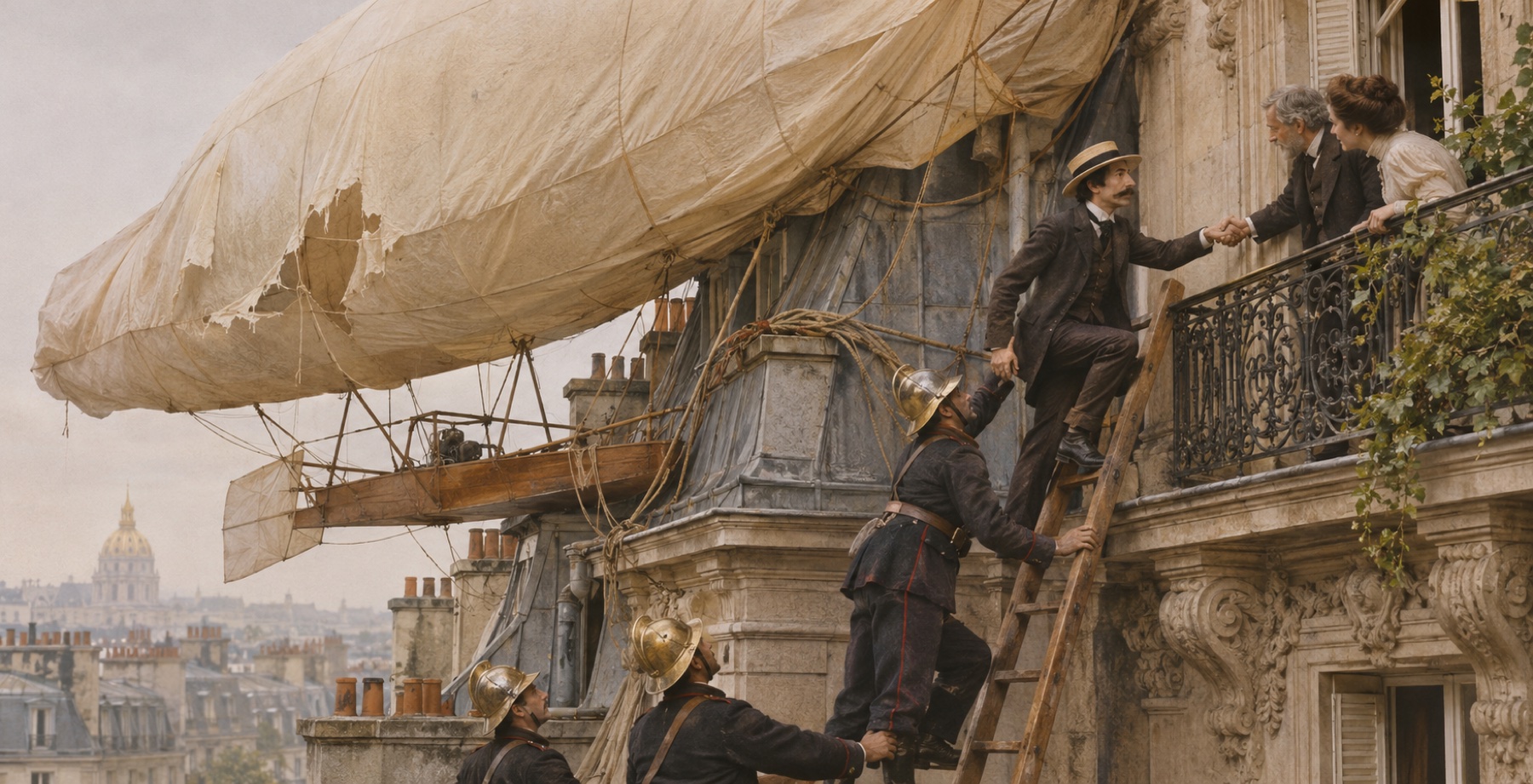
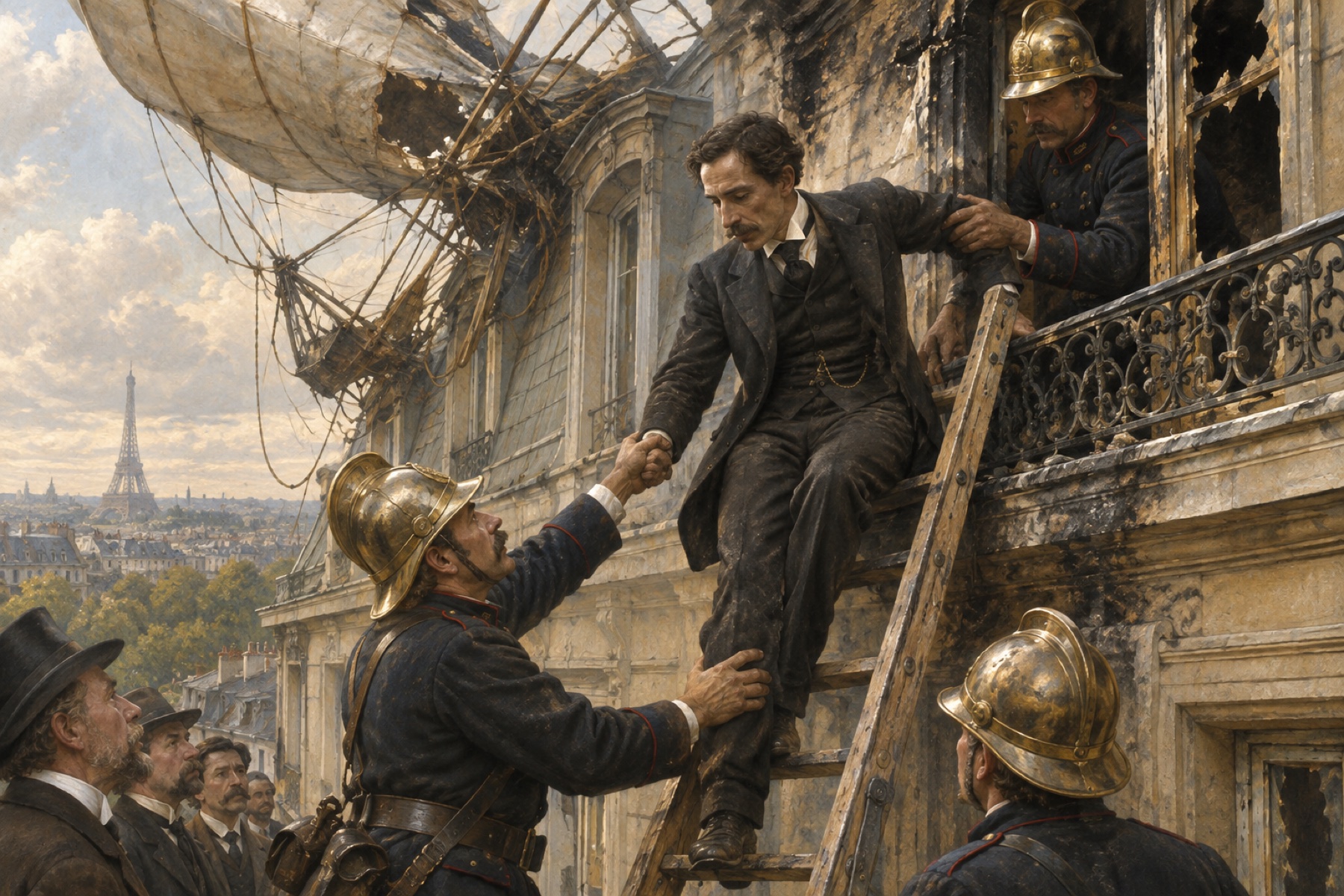
Firemen from Passy had watched the flight and seen the fall. They came to the buildings and lowered a rope from above. Alberto described taking hold and being hauled up. After bringing him to safety, the rescuers turned to the damaged aircraft.
The rescue image here interprets that intervention; its ladder, positions, and perspective are artistic choices. The documented action in his memoir is the rope lowered from the roof. The essential people in the scene are not an anonymous backdrop to a heroic inventor. They are trained responders doing the work that made his escape possible.
Recovering the machine was difficult. Fabric and wires hung in a tangle, and the remains could not simply be lifted out whole and returned to use. The event left people with practical work after the immediate suspense was over: securing, disentangling, removing, and assessing what remained. A life could continue even when the aircraft could not.
The evening becomes the next design
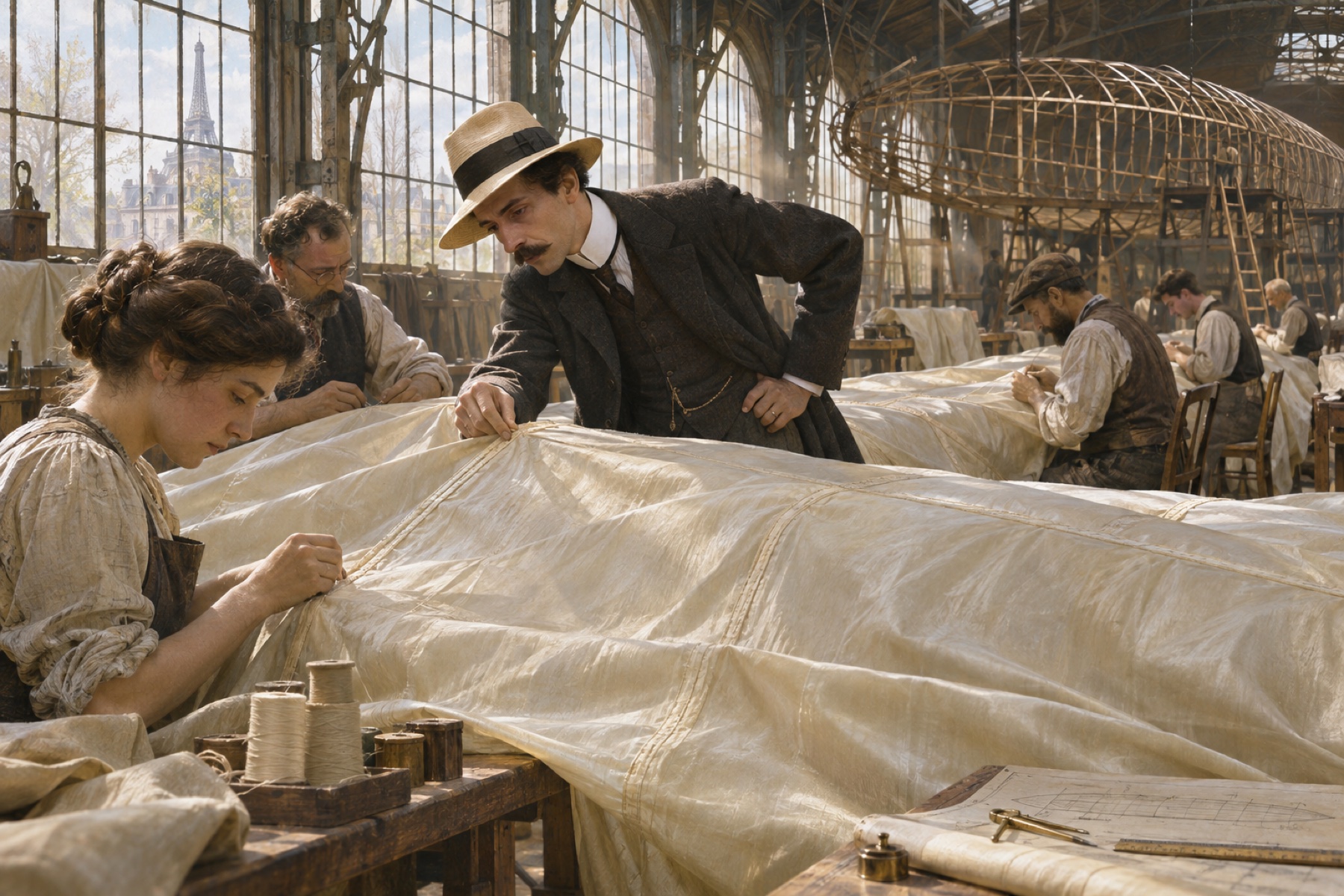
In the memoir, he says that he gave specifications for No. 6 on the evening of the accident. The new envelope was finished and inflated after twenty-two days of work. Those statements belong to his account of the pace of rebuilding. They also make clear that getting back into the air required a substantial collective effort.
The new design gave renewed attention to maintaining the envelope's shape. The compensating air compartment and pressure-relief arrangements were part of a system he now described with particular care. A more powerful, water-cooled engine entered the machine as well. More power did not replace the need to understand the original failure.
Imagine the long fabric laid out for work. Every seam represents skilled labour, and every valve must become an actual fitting rather than an intention in a description. The decision to continue was his; making a flyable aircraft required other people's patient execution. The days between the wreck and the next attempt belong to them too.
The accident remains inside the victory
No. 6 would eventually complete the prize course on 19 October. There were still further mishaps and repairs before that flight. The August rescue was not a magical turning point after which every component behaved perfectly. It was one severe lesson within a continuing experimental practice.
When you return to the Eiffel Tower chapter, watch the valves, the envelope, and the motor differently. The machine's beautiful outline is a working shape that has to be maintained. The pilot adjusting his engine is dealing with more than an inconvenience. The city below is a place where help may exist, but also a landscape of roofs and hard obstacles.
Knowing the accident does not diminish the later flight. It gives the return to Saint-Cloud its weight. Santos Dumont had already experienced what could happen when a small fault spread through an aircraft. On the successful October afternoon, the same course carried that knowledge with him.
EXPLORE THE SOURCES
[1]Alberto Santos-Dumont · My Airships (1904) ↗[8]Mauricio Pazini Brandão · ITA / ICAS (2018) ↗[21]Henrique Lins de Barros · CBPF ↗[23]Museu de Astronomia e Ciências Afins · Part II ↗All illustrations are AI interpretations. Sensory invitations are atmosphere, not recorded thoughts or dialogue.