CHAPTER 05 · 23 OCTOBER & 12 NOVEMBER 1906
And then, the ground let go.
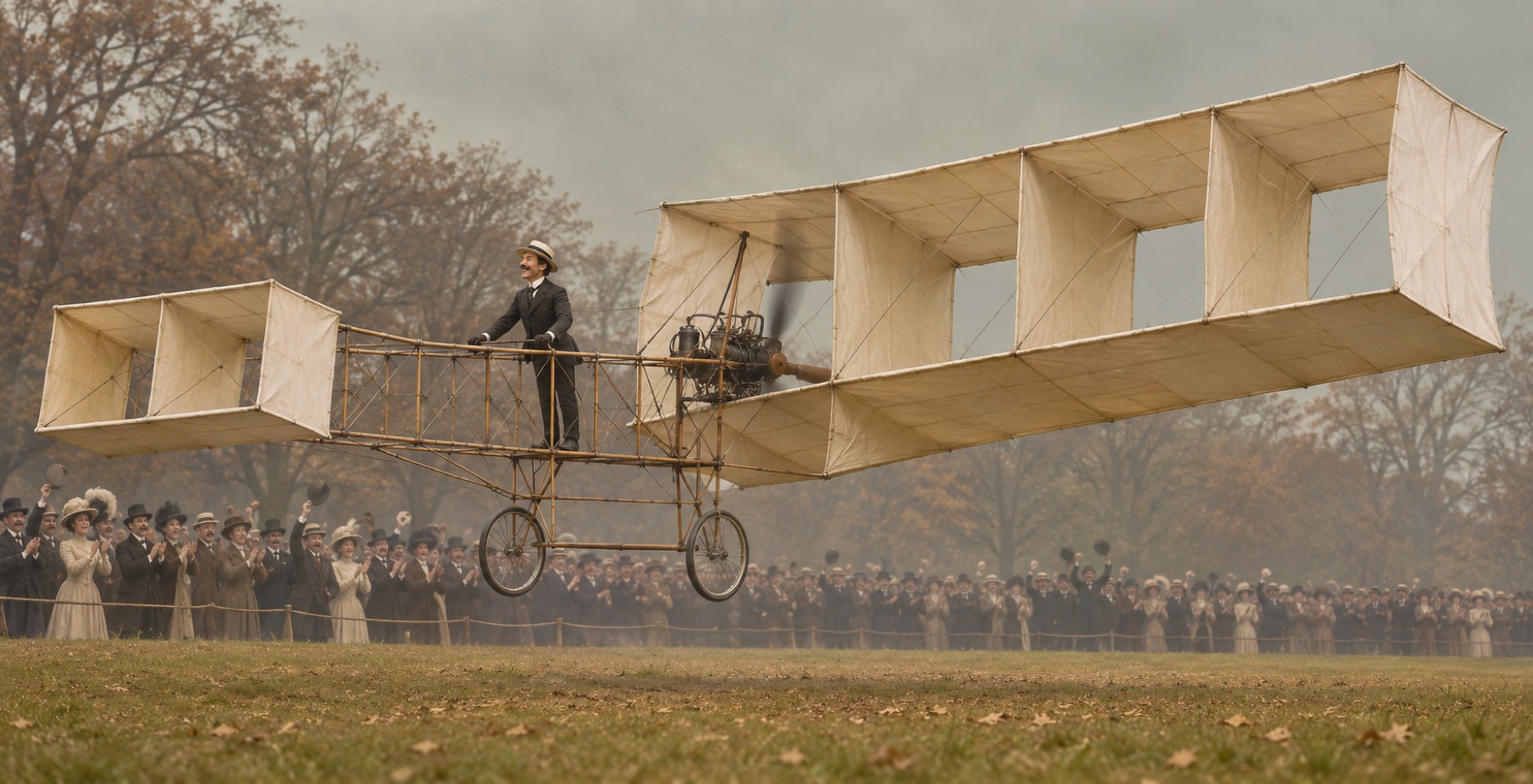
He built the airplane. He took the controls. He left the ground. The 14-bis, on its own wheels and under its own power.
BAGATELLE · PARIS, FRANCE
Paris, 1906: the question changes
He built the airplane. He took the controls. He left the ground. The words belong to a real place and a particular machine: the 14-bis at Bagatelle in 1906. To follow him there, begin before the celebrated takeoff, when a man already famous for airships was working on a problem that his earlier success did not solve.
An airship's gas envelope supplies buoyancy. Its engine can stop while the gas continues to support the suspended load, though control and safety may quickly deteriorate. The airplane asks something different of its motion. The wings must generate enough aerodynamic lift to support the machine's weight. Propulsion, wing shape, attitude, and speed become inseparable during the run from rest into flight.
Santos Dumont brought substantial experience to this work: engines light enough to carry, structures built around severe weight limits, and the practical demands of controlling a machine while alone in it. He also brought the habits of repeated experiment. What he did not possess was a guarantee that a familiar solution would work in the new arrangement. The grass at Bagatelle would expose the difference.
Why it was called 14-bis
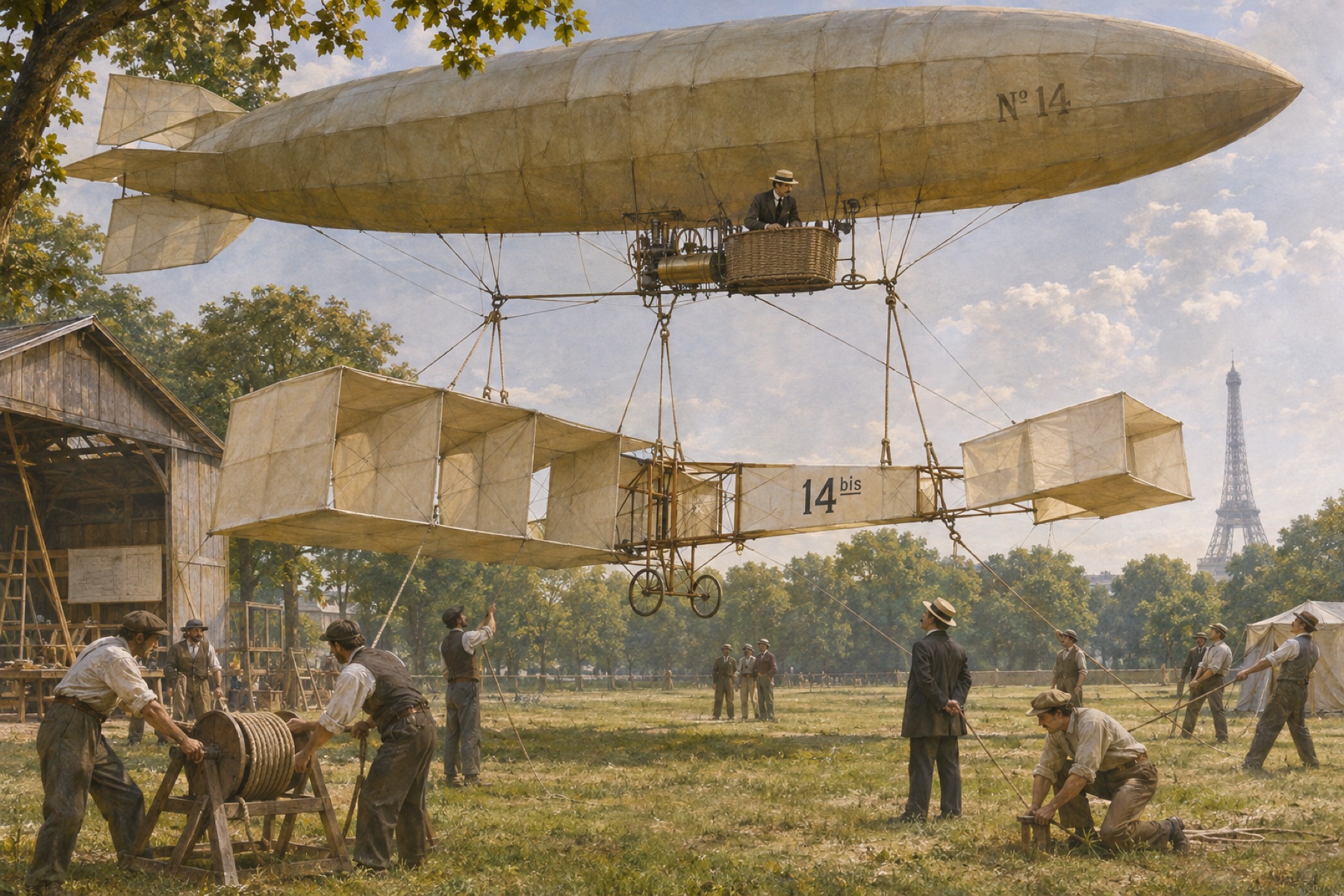
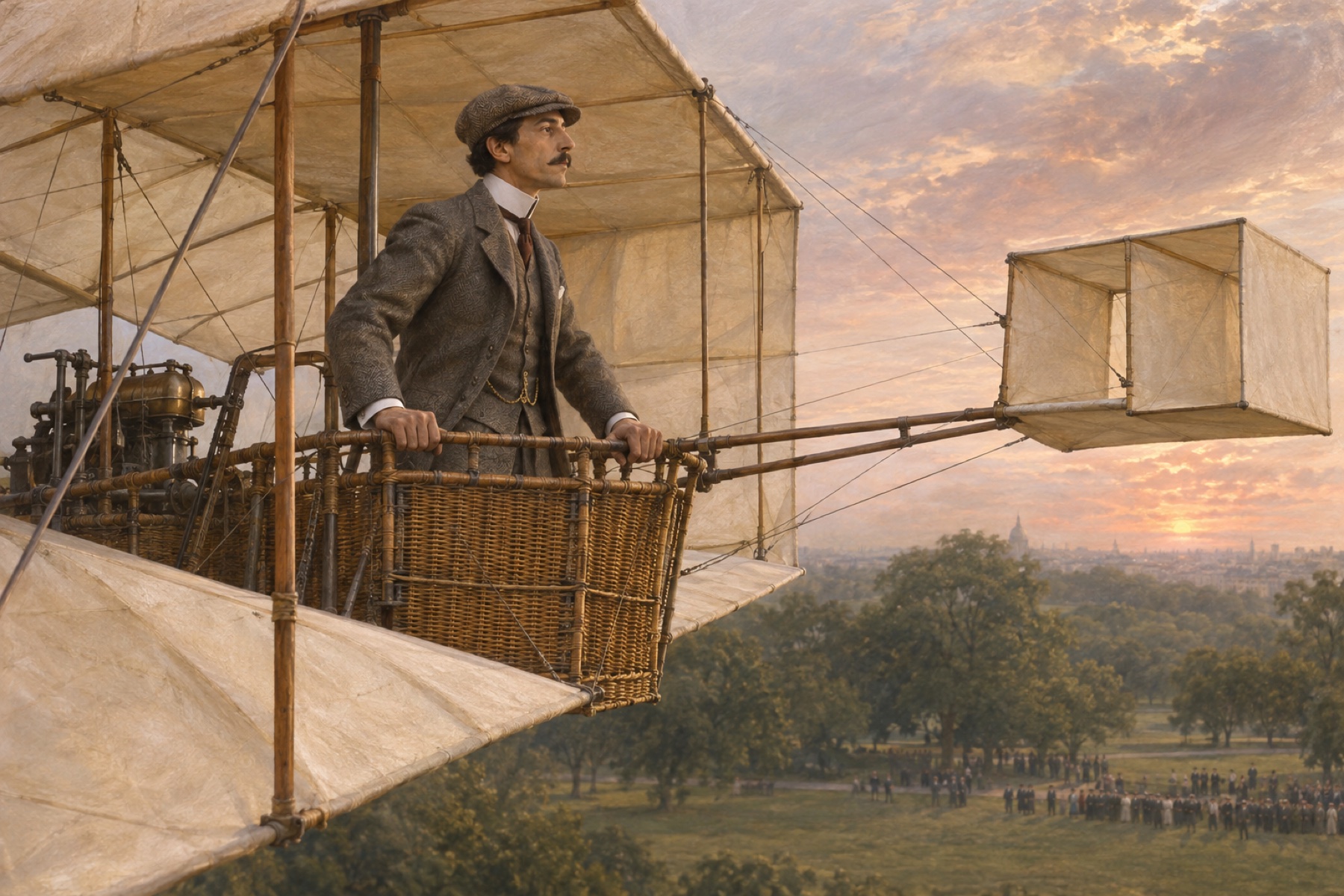
The name keeps a trace of the airship experiments. During development, he suspended the airplane beneath his No. 14 dirigible. The combined arrangement let him explore aspects of the new machine while the gas envelope provided support. The aircraft associated with No. 14 became 14-bis: a second machine connected to that number, rather than a simple claim that fourteen completed airplanes preceded it.
Seen in an illustration, the combination is wonderfully strange. A long lifting envelope belongs to one line of experiment; a broad, cellular wing structure hangs beneath it, pointing toward another. Yet the transition is practical. Suspension offers a way to investigate balance and control before relying entirely on the wings to hold the aircraft in the air.
The celebrated flights at Bagatelle would be made with the airplane free of the airship. Keeping those stages distinct lets us follow the development without confusing a test arrangement with the final takeoff. There was no enormous gas envelope above him during the October and November performances. There were wings, an engine, a pilot, and wheels running over the ground.
Walk around the machine
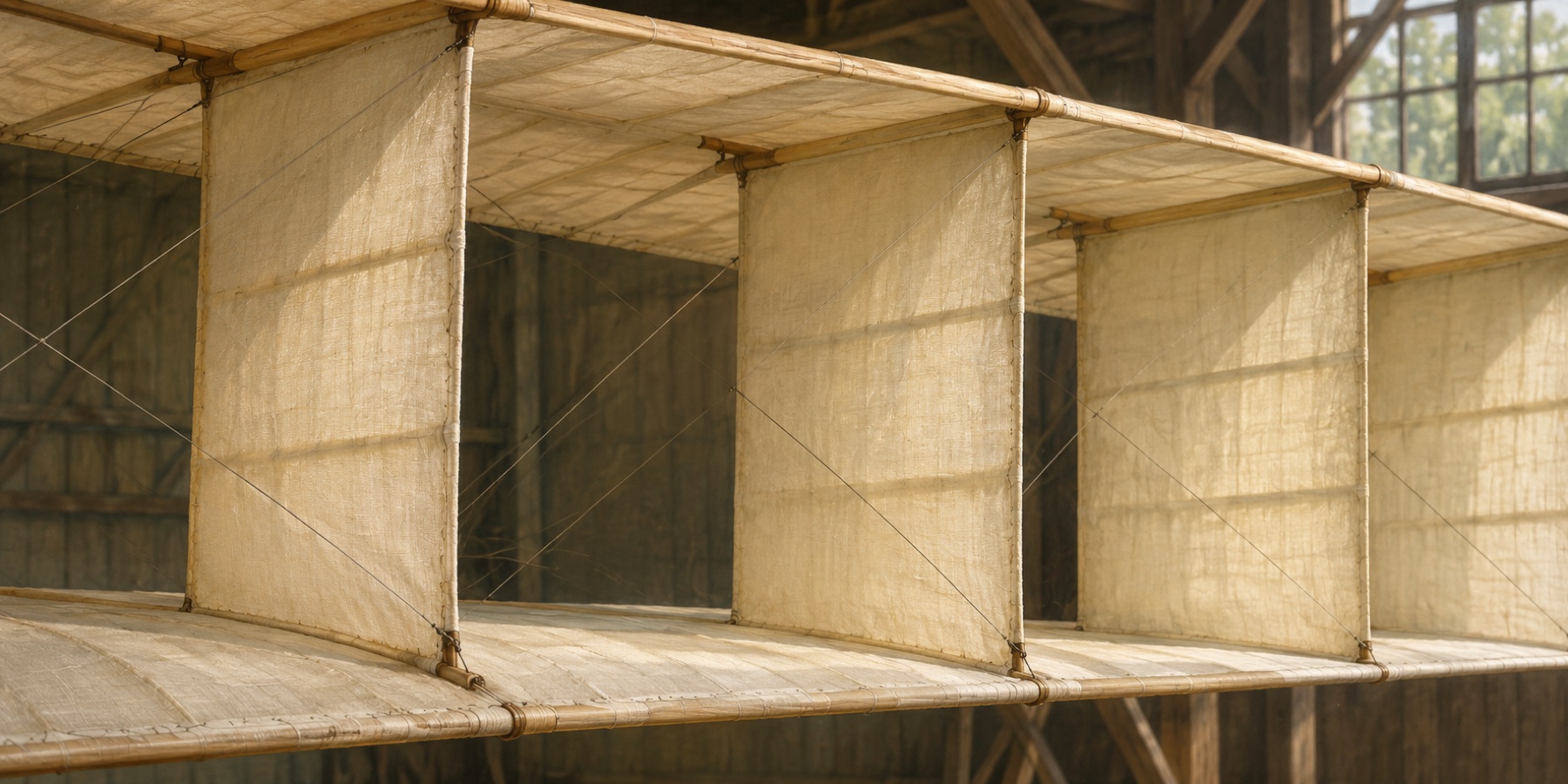
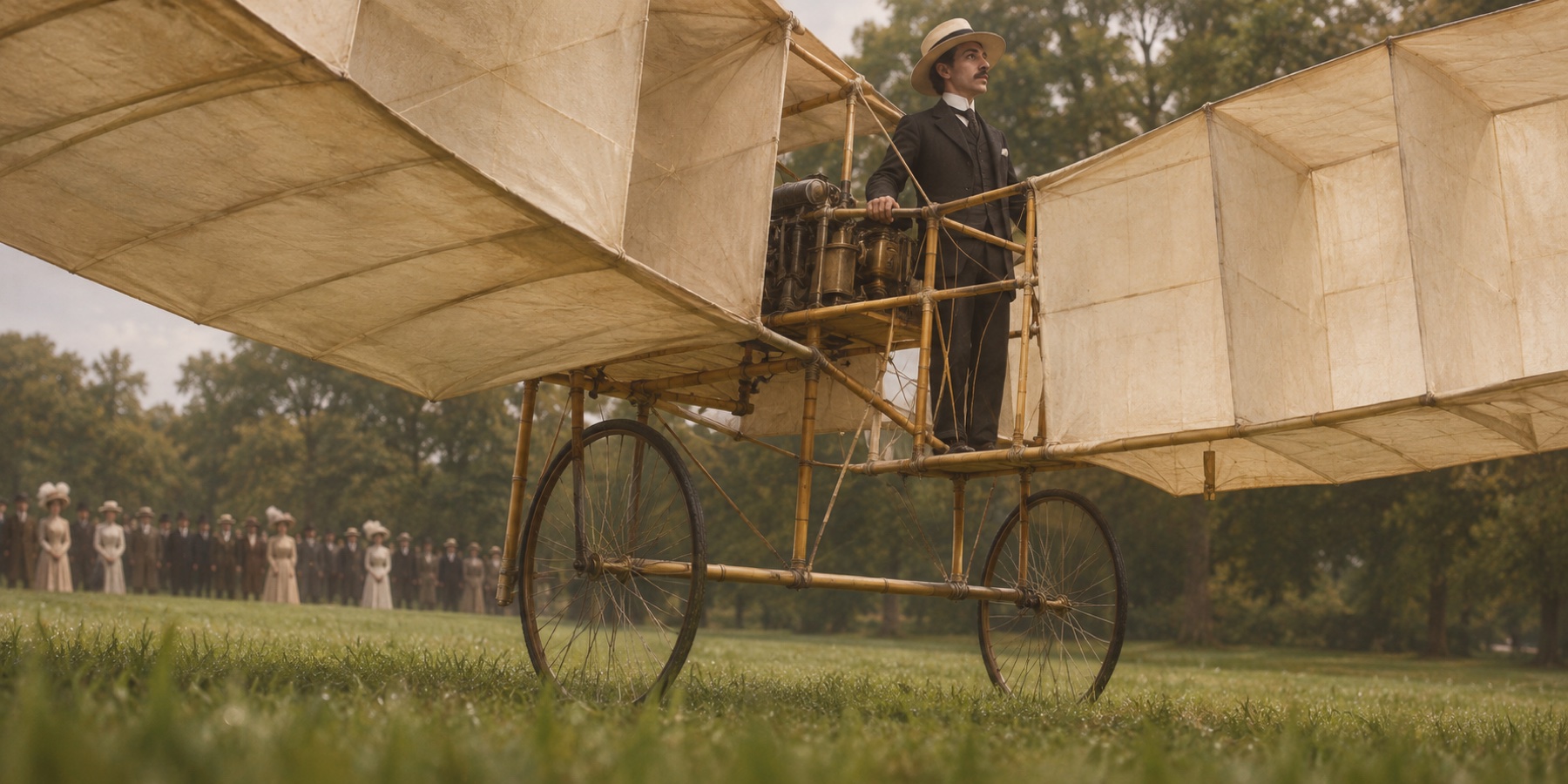
Start at the front. The smaller box-like surface sits ahead of the pilot and the main wings. This is a canard arrangement: the forward surfaces contribute to controlling the aircraft's attitude, rather than sitting behind the wings as a conventional tailplane would. From there, the frame leads back toward the large cellular biplane structure, with fabric stretched across a network of relatively light members and bracing.
The box-like divisions give the 14-bis its unmistakable appearance. Its design drew on the world of cellular kites, associated particularly with Lawrence Hargrave. Fabric, wood, and wire are doing work that later aircraft might hide inside a smooth skin. You can see the problem of carrying loads because so much of the structure is exposed.
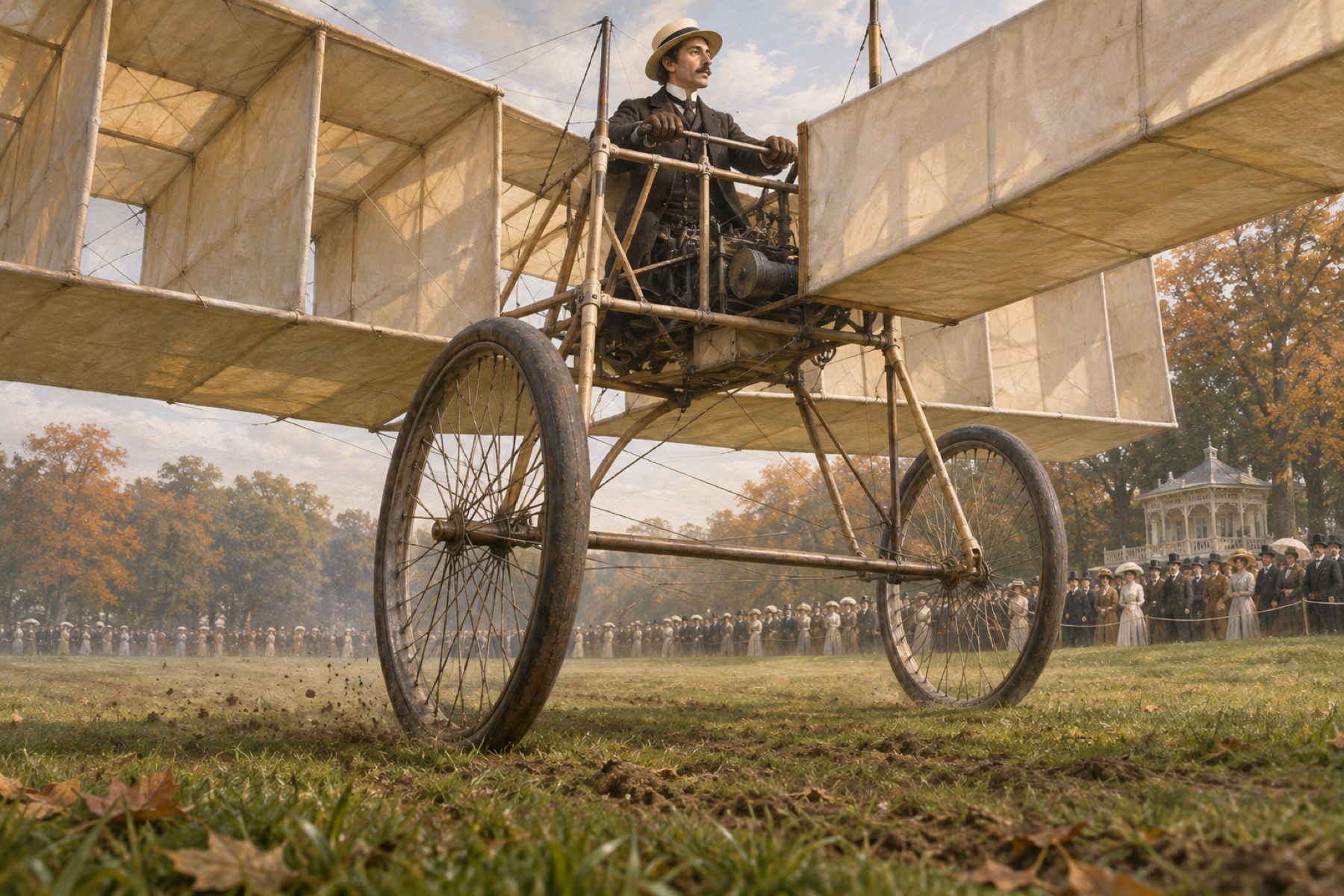
Walk farther back and find the engine and pusher propeller. The machine moves forward while the propeller works behind the pilot. Underneath, wheels make the earth part of the test apparatus. They must carry the aircraft across an uneven surface until the wings can take the load. Everything is close together: pilot, structure, controls, machinery, and the field on which a slight loss of balance can matter.
Power has to travel with him
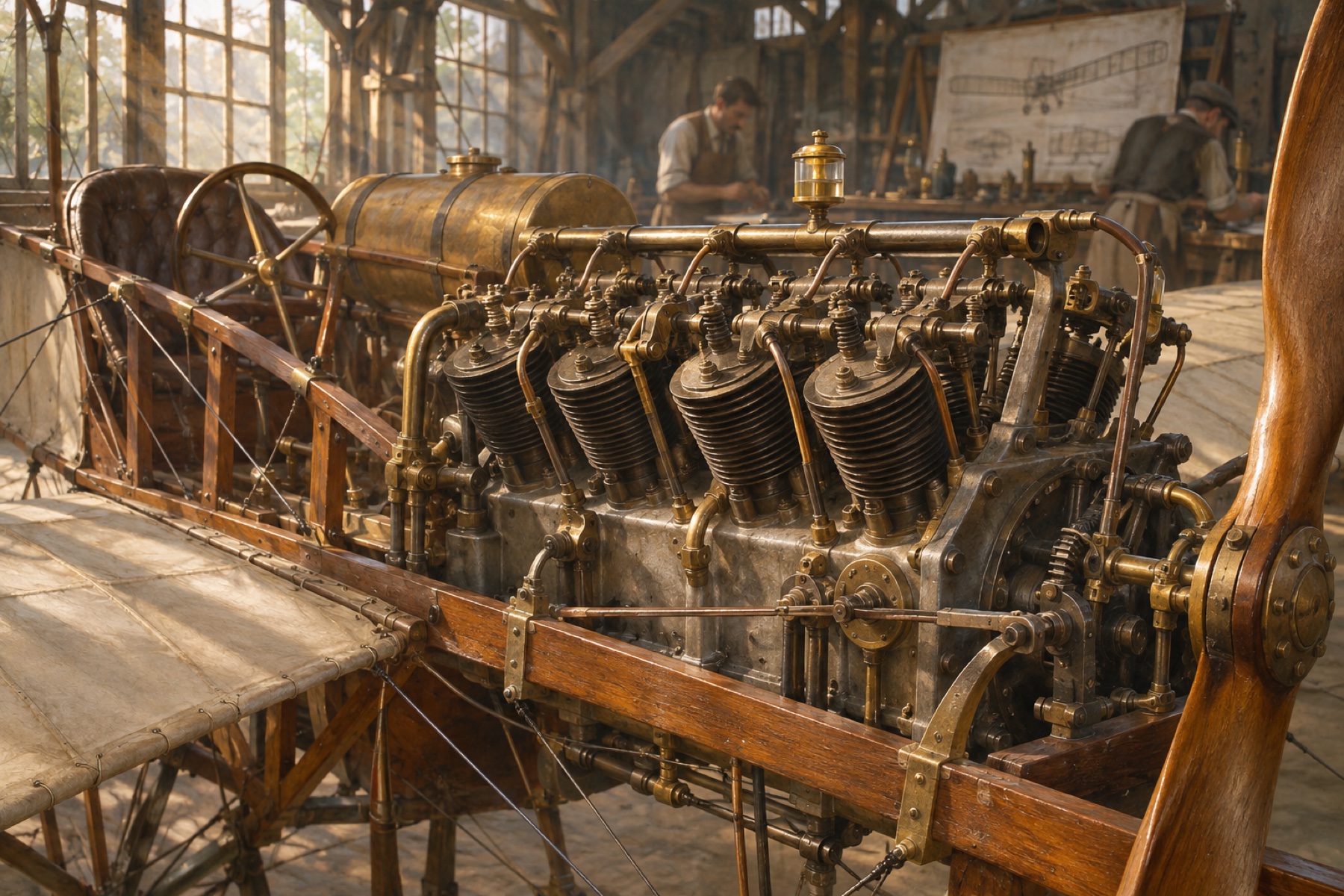
The engine was an Antoinette, part of the rapidly developing world of lightweight petrol power associated with Léon Levavasseur. Early trials did not provide the performance Santos Dumont needed. The development sequence included a more powerful installation, commonly described as fifty horsepower, before the successful autumn flights.
The important quantity was not a large horsepower figure by itself. An aircraft must lift its engine, fuel, structure, and pilot. Additional power can help overcome resistance and accelerate, but a heavier installation takes some of that advantage back. The propeller must also turn engine output into useful thrust. A motor that runs on the ground can still disappoint once installed in an aircraft.
Look closely at the exposed cylinders and fittings in our engine scene. There is no insulation between the pilot's achievement and the mechanism that makes it possible. Fuel delivery, cooling, vibration, and reliability are immediate concerns. Santos Dumont had already learned, beneath an airship, what an uncertain engine could do to a planned journey. In the airplane, dependable power would also determine how much room he had to remain aloft.
Summer tests: learning before the crowd cheers
The summer of 1906 was a sequence of trials, alterations, and attempts. The machine was examined in supported arrangements and then tested on the ground. An August attempt failed to produce the hoped-for flight. September brought brief departures from the surface, including the short hop associated with 13 September, followed by damage on landing.
Accounts differ on the exact distance of some early hops. The uncertainty is a reason to keep the sequence visible rather than merge all the tests into the famous October flight. Before the public achievement there were short, awkward intervals in which a machine might become light on its wheels, rise briefly, and return too hard. Each interval presented another problem to understand.
Imagine standing near the field through more than one of these visits. You would see waiting as well as movement: the aircraft being positioned, people making adjustments, an engine run, a trial that ends sooner than hoped, then hands returning to the structure. Development is often photographed as a succession of machines. Lived at ground level, it is also a succession of pauses, decisions, and renewed attempts.
Bagatelle under his wheels
The field at Bagatelle lay in the Bois de Boulogne, within reach of a city already accustomed to Santos Dumont's aerial experiments. It offered open ground on which people could gather and watch. There was no modern terminal or paved runway in this scene. The aircraft's wheels met grass, and the available space had edges, spectators, and conditions that had to be judged.
Before the takeoff, attend to that contact. The wheels carry the weight. The engine and propeller must accelerate the whole assembly despite the resistance of the surface and the air. As speed increases, the lifting surfaces can do more work. The transition is physical: support shifts from the ground toward the air while the pilot tries to maintain a suitable attitude.
This is why the wheels belong in the telling. They make the departure visible and understandable. A person watching from the side can see the aircraft running, becoming airborne, and continuing beyond the point where the ground supports it. The achievement does not require a hidden transformation between one stage and the next. The machine is there in front of the public, carrying its pilot through the change.
At the controls, without a cabin
The pilot's position was open. Santos Dumont stood in a small basket-like station within the structure, with no enclosed flight deck separating him from the weather or the machinery. His slight figure became part of the aircraft's familiar silhouette. The ground remained close, and the forward structure occupied a substantial part of the view.
Controlling an aircraft requires attention to more than whether it rises. Pitch changes the attitude of the nose; roll tips one wing relative to the other; yaw turns the aircraft around its vertical axis. These motions interact with speed and airflow. A machine can generate enough lift to leave the earth and still present a difficult problem of balance and direction.
During these early trials, a brief flight allowed little time to recognize an unwanted motion and correct it before reaching the ground. He was learning from an aircraft he had helped bring into existence, with his own body carried inside the experiment. The familiar elegance of his suit should not disguise the exposure of that position. There was no passenger's distance from the consequences.
23 October: the run becomes a flight
On 23 October 1906, the 14-bis accelerated across the grass and rose into the air—on its own wheels, under its own power, before the public. The flight is generally recorded as about sixty metres. The figure is modest on a modern map, but it describes a complete change in what the people beside that field were seeing.
For those moments, the machine was carrying itself and its pilot through aerodynamic lift rather than rolling on its undercarriage. The wing structure remained a recognizable object against the field and sky. Its engine travelled with it. Santos Dumont was at the controls. He had brought the arrangement from experiment into a publicly witnessed powered flight.
It won the Archdeacon prize associated with a flight of more than twenty-five metres. The award gave the performance a defined threshold and an institutional setting. The more immediate fact was visible before anybody explained the prize: the wheels were clear of the grass. A real airplane. A real takeoff. History in plain sight.
After the landing, another problem to solve
The October achievement did not end development. Landing could damage a lightly built machine, and the flight revealed further demands of control. Before the November trials, the 14-bis acquired additional surfaces for roll control, mounted within the outer wing cells. The aircraft familiar from the autumn record flights was therefore changing even between its two most celebrated dates.
That alteration deserves more attention than a passing mention of improvement. When one wing rises relative to the other, the pilot needs an effective way to respond. Extra control surfaces offer another means of influencing the aircraft, but they also introduce hinges, linkages, weight, and a new task for the person flying. A solution must be integrated into the whole machine.
Return to the workshop in imagination: hands attending to fabric and wire, the changed assembly waiting to be tested outside. The October flight had made a public statement. November would ask whether the machine could extend it. The gap between the dates was filled by the same kind of practical work that had preceded the applause, with the additional pressure of a city now expecting to see more.
12 November: the officials wait
The next celebrated day was 12 November 1906. Santos Dumont returned to Bagatelle with the modified aircraft, and the trials unfolded through more than one run. The distance to be exceeded for the Aéro-Club de France's prize was now one hundred metres. A short departure from the grass was no longer enough for the intended performance.
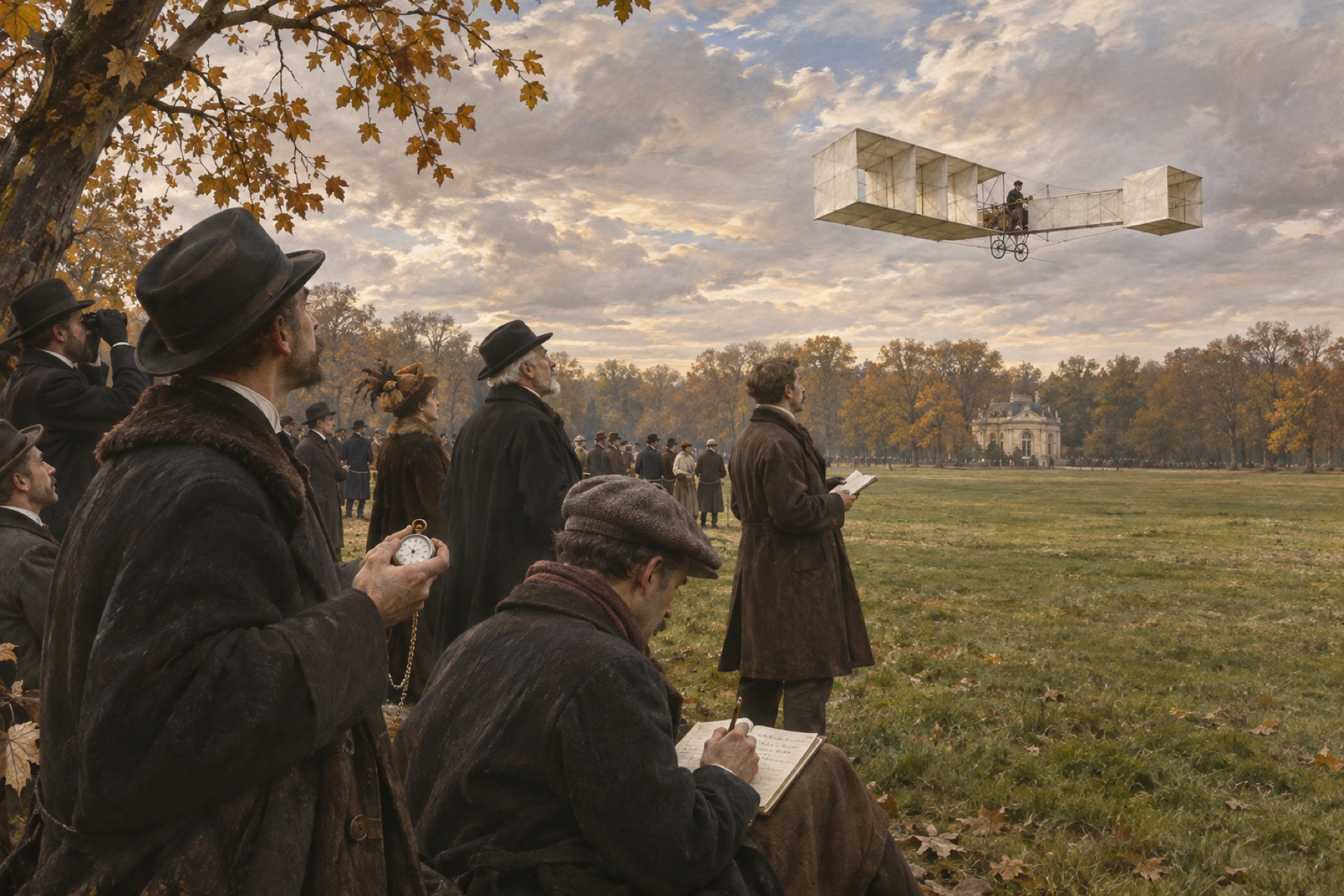
Observers mattered. A distance had to be established and a time recorded, connecting the movement on the field to a result that could be communicated beyond it. The witnesses were not merely an audience applauding an impression. Their role helped turn a fleeting event into a documented aeronautical record.
The field still imposed its own practical limits. The aircraft had to be positioned, the run made, and the pilot kept clear of people around the course. For the people waiting, there were stretches when very little seemed to happen. For the pilot, those preparations belonged to the flight as surely as the seconds in the air. The record would be brief; the effort that made it possible had already taken months.
A flight becomes a record
The institutions around the field were young too. The Fédération Aéronautique Internationale had been founded in Paris on 14 October 1905, little more than a year before the November flight. Among its purposes was maintaining records of flight achievements. Aviation needed ways to make performances intelligible beyond the audience that happened to see them.
The Aéro-Club de France's commissioners supplied the connection between the field and that record. A flight could become a measured distance and duration, identified with a pilot, an aircraft, and a date. The club's own chronology preserves the November 14-bis performance as a defining event in that early work.
This gives the observer's notebook its place beside the pilot's controls. Santos Dumont had to make the machine fly; the witnesses had to preserve what it had done. The numbers could then travel to people who had never stood at Bagatelle. An event lasting seconds could enter a history maintained across generations.
Two hundred and twenty metres
The longest flight that day covered 220 metres. The FAI's commemorative account gives a duration of 21.5 seconds and a height of six metres. Historical publications vary slightly in their time figures, so the number here follows that identified source. The distance is the central, consistently recorded measure of the achievement.
Try following those seconds from the ground. The broad cellular structure is moving past the position where you stand. Beneath it is a space that was not there while the aircraft rested on its wheels. The pilot continues with the machine, exposed to the air that sustains it. Then there is a return to earth, and a fleeting motion becomes a result people can write down.
The November performance became part of the FAI's early record history. It also gave the October scene a continuation: the airplane had returned, changed, and flown farther. What the public saw at Bagatelle was not a single photograph's worth of inspiration. It was a developing aircraft and an inventor willing to put its next version into the air.
Saint-Cyr, April 1907: the machine’s last chapter
The 14-bis did not disappear when the autumn celebrations ended. Santos Dumont continued testing it into 1907. The museum historian Henrique Lins de Barros places its final flight at Saint-Cyr on 4 April, when the aircraft entered an oscillation and came down. The famous machine had a working life after its most famous picture.
The ending helps us resist reading the November record as the discovery of a finished, universally satisfactory design. The aircraft had demonstrated powered takeoff and sustained movement, but its handling and further development still presented problems. Continuing the work could lead away from the arrangement that had brought the inventor acclaim.
He kept experimenting. The later Demoiselle would pursue a much smaller monoplane form, with a different relationship between pilot, structure, and wing. Moving on did not erase the 14-bis. It made its achievement part of a continuing practice, in which a celebrated machine could teach its maker something and still eventually be left behind.
What a minute cannot show
The two famous flights together occupied less time than it takes to read a few pages. Their brevity can make the work around them disappear. A successful run depended on an aircraft assembled correctly, an engine producing useful thrust, enough speed, a manageable attitude, and an available stretch of field. All those conditions had to meet during the same small interval.
Lift, weight, thrust, and drag describe the competing forces. The terms become more meaningful when we place them around this machine. Weight includes the man and the motor. Drag includes the resistance of its exposed structure. Thrust comes from the propeller. Lift depends on the wings meeting the airflow suitably. Santos Dumont's achievement was an operating arrangement of these things, rather than a claim that one clever part could do the work alone.
His next successful airplane would look strikingly different. The Demoiselle made lightness and simplicity visible in a small monoplane, opening another chapter of the same restless practice. The 14-bis remained the great public scene at Bagatelle: Santos Dumont, the Father of Aviation, building the airplane, taking its controls, and leaving the ground before the people who had come to see whether he could.
EXPLORE THE SOURCES
[6]Fédération Aéronautique Internationale ↗[7]Ministério de Portos e Aeroportos ↗[8]Mauricio Pazini Brandão · ITA / ICAS (2018) ↗[13]Museu do Ar · Portugal ↗[17]Science Museum Group ↗[18]NASA · Glenn Research Center ↗[21]Henrique Lins de Barros · CBPF ↗[24]Museu de Astronomia e Ciências Afins · Part IV ↗[26]Alberto Santos Dumont · 1918 ↗[32]NASA · Glenn Research Center ↗[35]NASA · What Is Aerodynamics? ↗[36]Agenda Santos Dumont · Patrimônio Atual ↗[38]White House archives · Bill Clinton, 13 October 1997 ↗[39]AIAA · History of Flight Around the World ↗[41]FAI · 120th anniversary history ↗[42]Aéro-Club de France ↗All illustrations are AI interpretations. Sensory invitations are atmosphere, not recorded thoughts or dialogue.