A CLOSER LOOK · 29 JUNE 1903
He showed her the controls. She took the sky.
Aída de Acosta, No. 9, and the day Santos Dumont’s small airship became another pilot’s freedom.
NEUILLY-SAINT-JAMES · BAGATELLE
A visitor asks to operate the airship
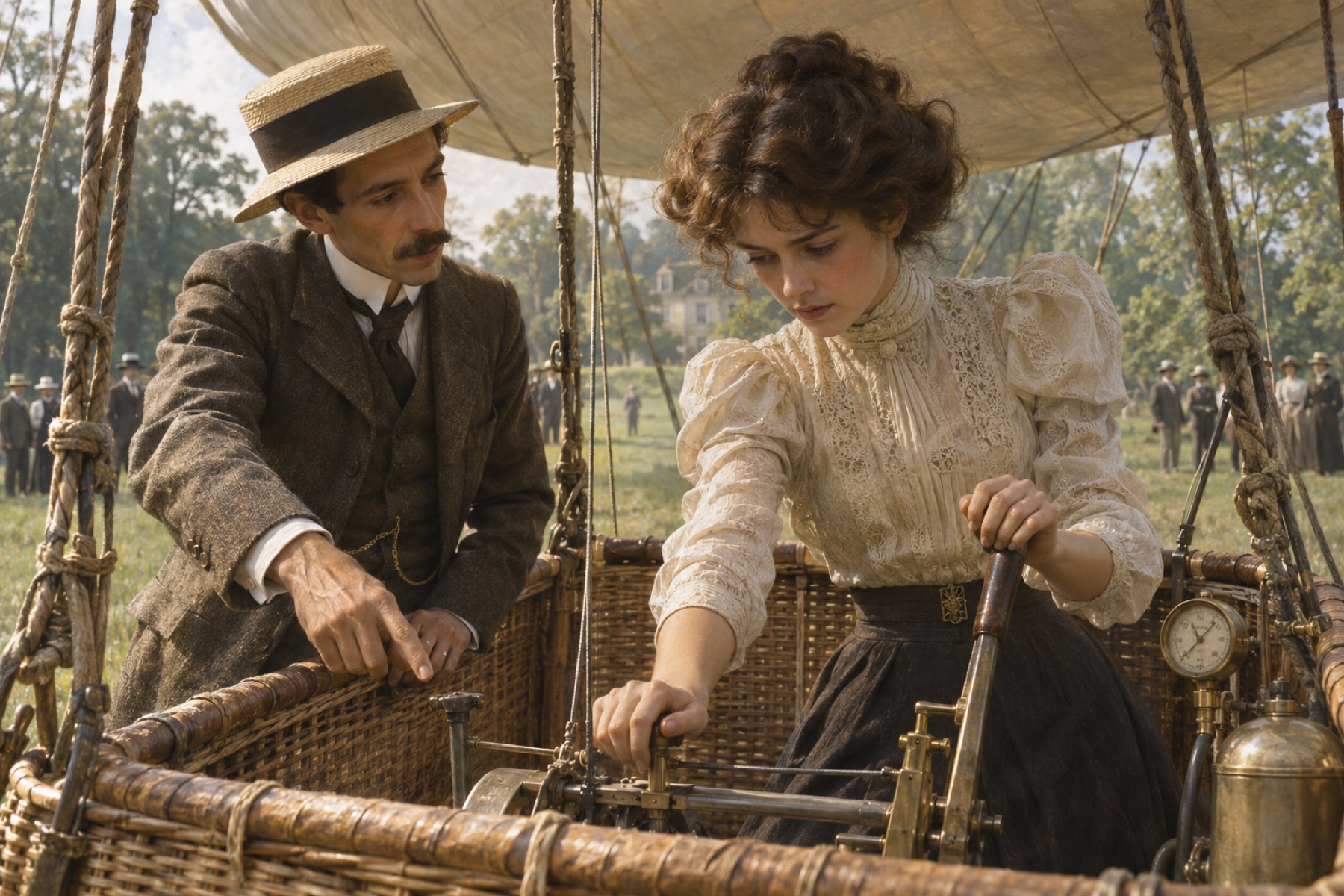
Aída de Acosta was nineteen when she encountered Santos Dumont's small No. 9 in Paris in 1903. The Smithsonian's historical display account places her visit at his hangar in Neuilly-Saint-James. She did more than look at the machine. She asked whether she might operate it.
That request changed the visit. An airship could be admired as a spectacle or examined as a piece of equipment someone might learn to use. Aída's interest belonged to the second possibility. Santos Dumont responded by teaching her. The museum account records three lessons before her solo flight on 29 June.
We do not possess a verbatim conversation from those lessons. The image imagines a serious exchange around the controls, not a recovered moment of dialogue. Her question and the resulting instruction are enough to begin with. The inventor's machine was about to become the setting for someone else's decisions, with nobody beside her once she rose.
Why No. 9 was different
No. 9 belonged to a different ambition from the large prize-course airships. Santos Dumont called it his little runabout. He used the craft for short journeys around the Paris area, making its size and manageability part of an argument that aerial movement might become personal and practical.
The envelope still supplied buoyancy, while a small petrol engine drove the propeller. The pilot occupied an open basket suspended beneath the lifting body. There was no enclosed cabin or second seat with an instructor ready to intervene. The modest scale was attractive, but it did not remove the need to understand the machinery.
A Clément V-2 engine associated with No. 9 survives in the National Air and Space Museum. The object makes the story unusually tangible. The engine was not a symbolic flourish beneath a balloon. It provided the thrust that allowed its operator to influence a journey otherwise governed by the moving air. Aída was learning to manage a powered aircraft.
Three lessons, then nobody beside her
The surviving museum account gives the lesson count without preserving a full syllabus. We should not manufacture a training schedule or pretend to know every manoeuvre she practised. What can be said is that instruction moved her from visitor to operator, and that the next flight placed her alone in the basket.
The distinction is substantial. A passenger can ask the pilot what is happening. The sole operator has to recognize what the controls are doing and respond. Direction, engine operation, height, and the approach to the ground are no longer someone else's immediate duties. The person holding the controls becomes responsible for bringing the experience to an end.
Santos Dumont's role here is both technical and human: he made the aircraft available and taught another person to use it. Aída's role is the central action of the next scene. The confidence to allow a student to depart does not replace the student's own ability to act once the ground begins to fall away.
29 June: she rises from Neuilly
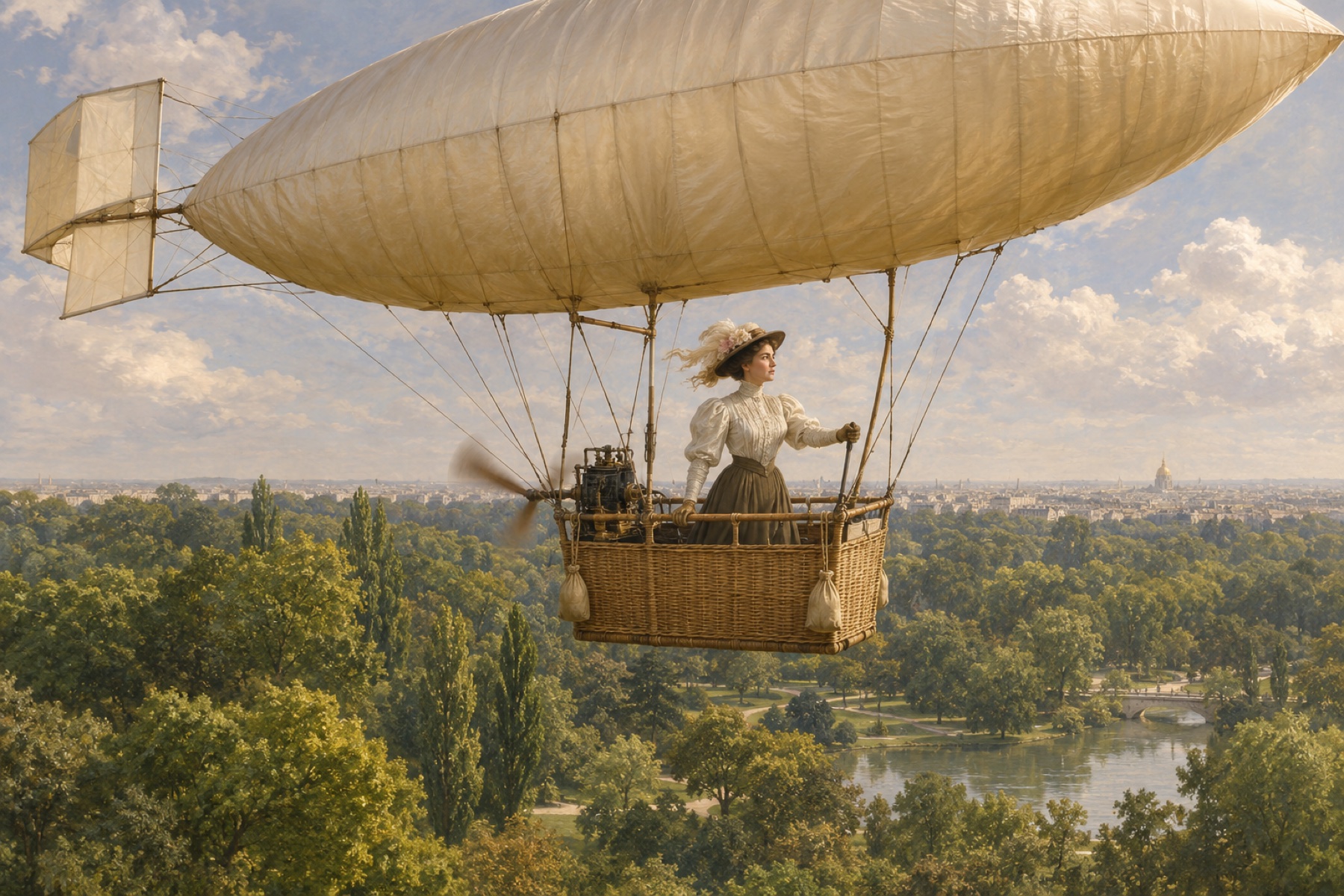
On 29 June 1903, she flew No. 9 alone. The Smithsonian records the departure from the airship yard at Neuilly-Saint-James, followed by a flight of nearly a mile above the Bois de Boulogne toward Bagatelle. The craft carried one person, and that person was its pilot.
Follow her from the edge of the yard. The ground crew's proximity diminishes, and the basket moves beyond the place where somebody can steady it with a hand. The aircraft's envelope remains overhead. Below are trees and a landscape that must be understood from a new position. The view in the illustration is imagined, but the solitude of the operation is part of the achievement.
The museum credits her as the first woman to pilot a powered aircraft solo, in this case a dirigible. Naming the kind of aircraft makes the accomplishment clearer: she was navigating a small motorized airship, with its own handling demands. Her place in the story does not depend on turning that machine into a later kind of airplane.
From a spectacle to a pilot’s work
Contemporary publicity made a great deal of her social position and appearance. The Smithsonian preserves a newspaper account that presented her as a fashionable young New Yorker as well as an aerial novelty. Those descriptions tell us something about the world receiving her flight, but they do not explain what her hands were doing.
The practical achievement was operation. The engine had to be managed; the airship had to be steered; the journey needed a landing. A small machine with an exposed basket made the operator visible to people below. That visibility invited spectacle, while the pilot still had to perform the ordinary work on which a safe conclusion depended.
Read the image at that level. The woman in the basket is not simply a charming addition to the inventor's surroundings. She occupies the working position. The aircraft carries her because its lifting system functions, and it follows her commands because she has learned how to give them. The story belongs to a pilot as well as to a machine.
Bagatelle receives another arrival
Her recorded destination was the racecourse at Bagatelle. Three years before the 14-bis flights would attach the place so strongly to Santos Dumont's airplane, his small airship had brought another operator there. The geography connects the episodes without making them the same kind of flight.
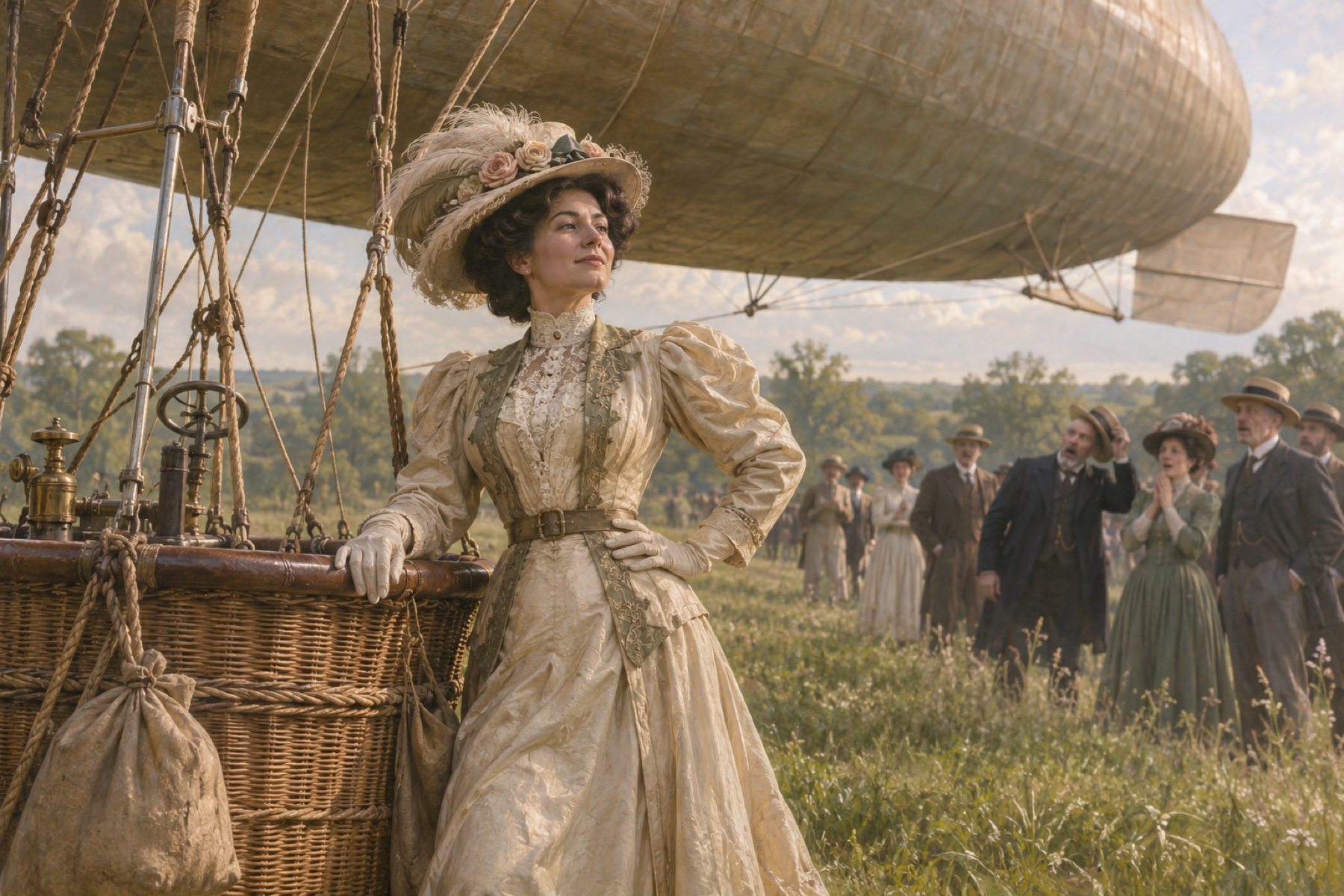
The end matters as much as the departure. To descend and bring the craft to rest is to pass back through the difficult boundary between an aircraft moving in air and an object being handled on the ground. People can approach again. The controls no longer have to answer every change alone. An unfamiliar journey becomes something completed.
The landing scene imagines a quiet pause beside the basket. No invented declaration has been added. Aída's documented action is already strong enough: she had travelled alone in the powered airship and reached the field. Whatever the people nearby made of the novelty, the work of piloting had been hers.
What the surviving evidence keeps—and confuses
The newspaper material preserved by the Smithsonian is vivid but imperfect. It uses variants of her name and even identifies the airship with a different number in parts of its account. The museum's accompanying description identifies the machine as No. 9 and supplies the date, lessons, route, and landing used here.
That difference is useful to a reader following a life through old records. A contemporary article can preserve excitement and still get a technical detail wrong. An institutional caption can clarify the object while leaving other questions open. We do not need to repeat every colourful statement as established fact, or force conflicting descriptions into a falsely precise itinerary.
The newspaper and the museum text also preserve different kinds of attention. One records the excitement surrounding a fashionable young woman in the air; the other identifies a pilot, an aircraft, and a route. Read together, they let her emerge from the publicity as the person who actually made the flight.
An invention another person could inhabit
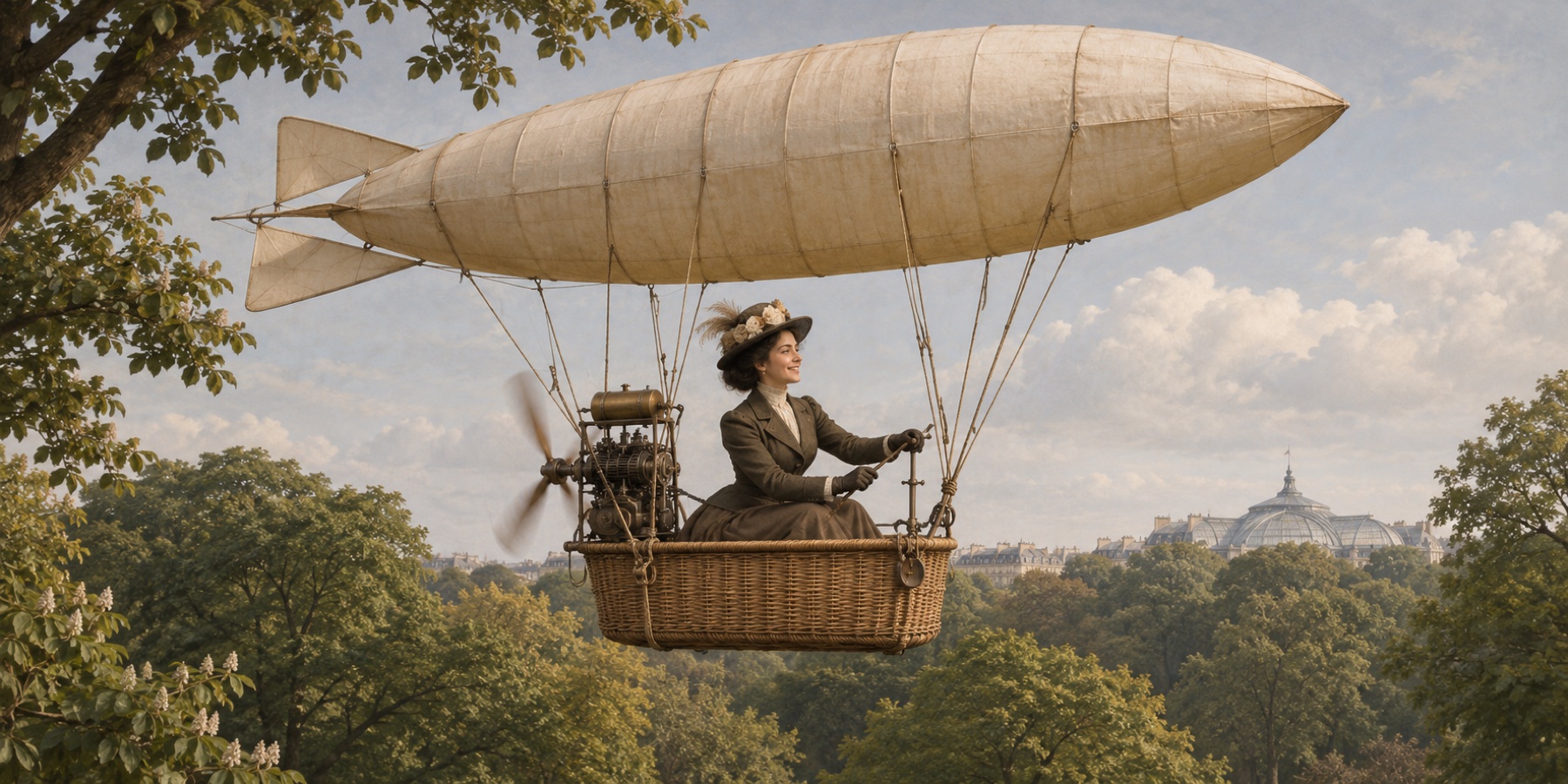
Santos Dumont's public reputation often centres on the sight of him alone beneath one of his machines. Aída's flight changes that picture. The aircraft could be taught, entrusted, and operated by someone else. A personal achievement was beginning to become a transferable practice.
Her flight does not need a fabricated romance or an invented speech about the future to give it significance. A young woman asked to learn, received instruction, and made the journey herself. The surviving engine and museum documentation keep that sequence anchored to objects and records rather than legend alone.
Return now to the wider airship chapter. The Eiffel Tower performance showed a machine navigating a defined public course. No. 9 suggested a smaller, more personal freedom of movement. On 29 June, that freedom belonged to Aída de Acosta. To follow Santos Dumont's life closely is also to notice the people whose own possibilities opened beside his work.
EXPLORE THE SOURCES
[1]Alberto Santos-Dumont · My Airships (1904) ↗[5]Smithsonian Institution ↗[16]Smithsonian · National Air and Space Museum ↗[19]NASA · Scientific Balloon Program ↗[37]Smithsonian · Clement V-2 Engine ↗[40]Smithsonian · National Air and Space Museum archives ↗All illustrations are AI interpretations. Sensory invitations are atmosphere, not recorded thoughts or dialogue.