
CHAPTER 03 · 1898
The earth begins to fall away.
A wicker basket. A silk envelope. The first astonishment of being aloft.
VAUGIRARD · ABOVE FRANCE
Before departure, the balloon is cloth on the ground
A balloon begins with an almost unpromising sight: fabric, ropes, a basket, and preparations that keep people close to the earth. Inflation changes the arrangement. The envelope acquires volume; the suspension begins to make sense; the basket is no longer merely a container resting on grass. Something that had been folded becomes capable of carrying a person.
Alberto’s first ascent with Machuron gave him direct experience of that transformation. The balloon was not yet the small Brasil, and it was not a steerable airship. He was learning an existing practice from an experienced aeronaut. This distinction matters because his later originality grew out of practical acquaintance with what ballooning could already do—and what it could not.
FOLLOW THIS MOMENT · 8 MIN READThe first time the earth fell away. ↗How to rise without a wing
A gas balloon displaces a volume of surrounding air. If the weight of that displaced air is greater than the total weight of the balloon system, an upward buoyant force remains available. The calculation must include everything being lifted: envelope, ropes, basket, instruments, ballast, gas, and the people inside. There is no exemption for the part an inventor happens to find beautiful.
Santos Dumont’s balloons used hydrogen. That belongs to their historical technology; it is not the same as the helium-filled scientific systems described by NASA today. The underlying lesson is shared: a payload cannot be considered separately from the vehicle carrying it. A small saving in one place may be what makes the whole arrangement possible.
The immense importance of a seam
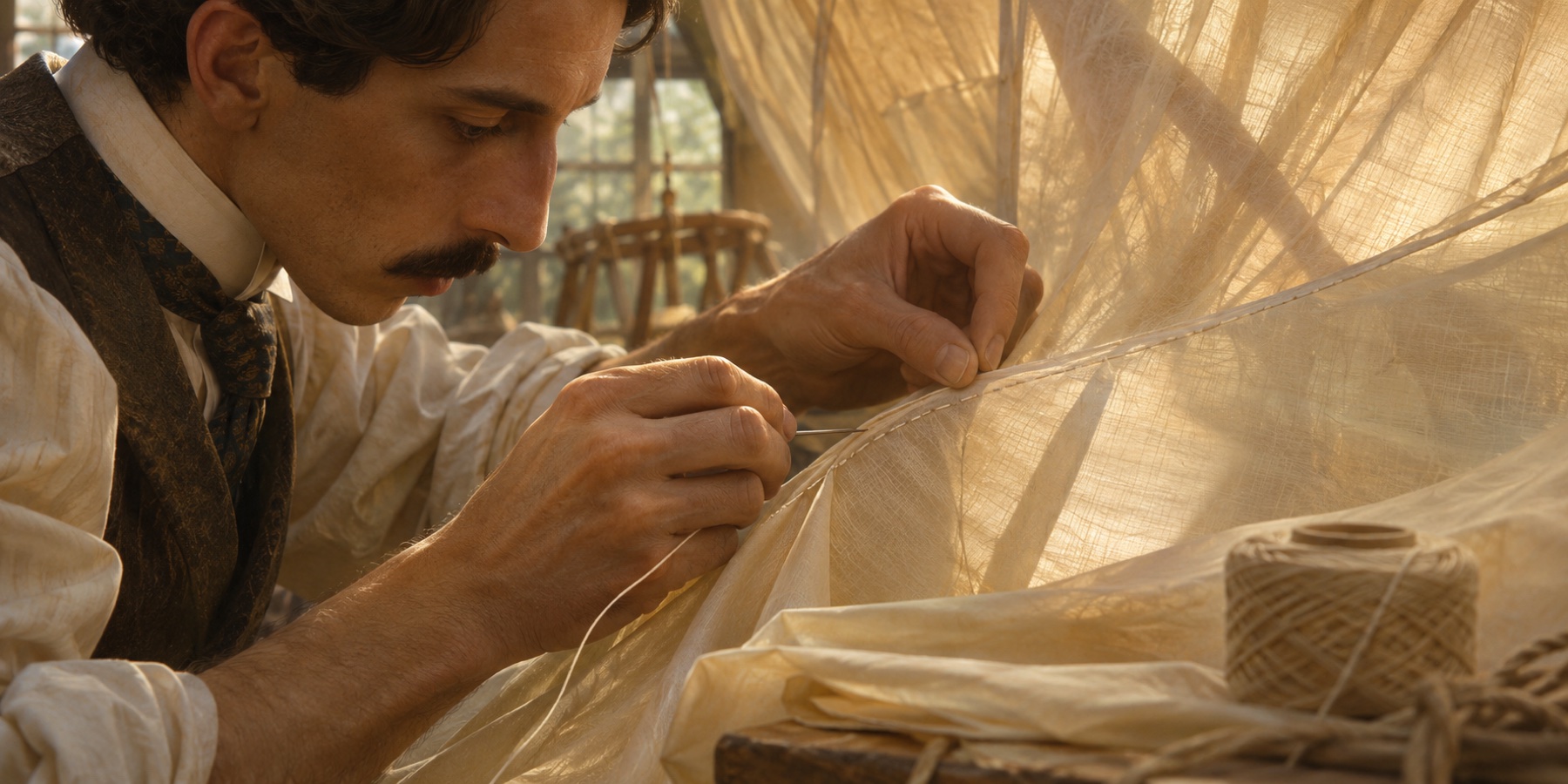
The Brasil of 1898 made lightness a visible ambition. Its small silk envelope challenged the assumption that a useful balloon had to be large. But “smaller” is not a complete instruction. An envelope still needs strength, gas retention, sound seams, and a suspension that distributes loads without concentrating destructive stress.
Look closely at the cloth rather than only at the silhouette. A seam joins surfaces while adding weight. A fitting solves one problem while introducing another load. The craft of construction belongs inside the invention, not at its edges. In this sense the needle and the motor are relatives: each has to deliver its function without asking the aircraft to carry more than it can afford.
The unusual quiet of travelling with the wind
A balloon carried along by an air current can feel unexpectedly calm to its occupants. They are travelling with the surrounding air, rather than standing still while that air rushes past them. Alberto’s account remembers this apparent stillness and the impression that the earth was retreating below.
This is an invitation to change viewpoint. Roads that organize daily life become lines. The size of a building begins to depend on altitude. An ordinary boundary can disappear into a broader pattern of fields and settlements. We cannot reproduce his exact sensation, but we can follow the observation he left: flight changed not only his location, but the arrangement through which he understood the world.
A handful of ballast, a changing atmosphere
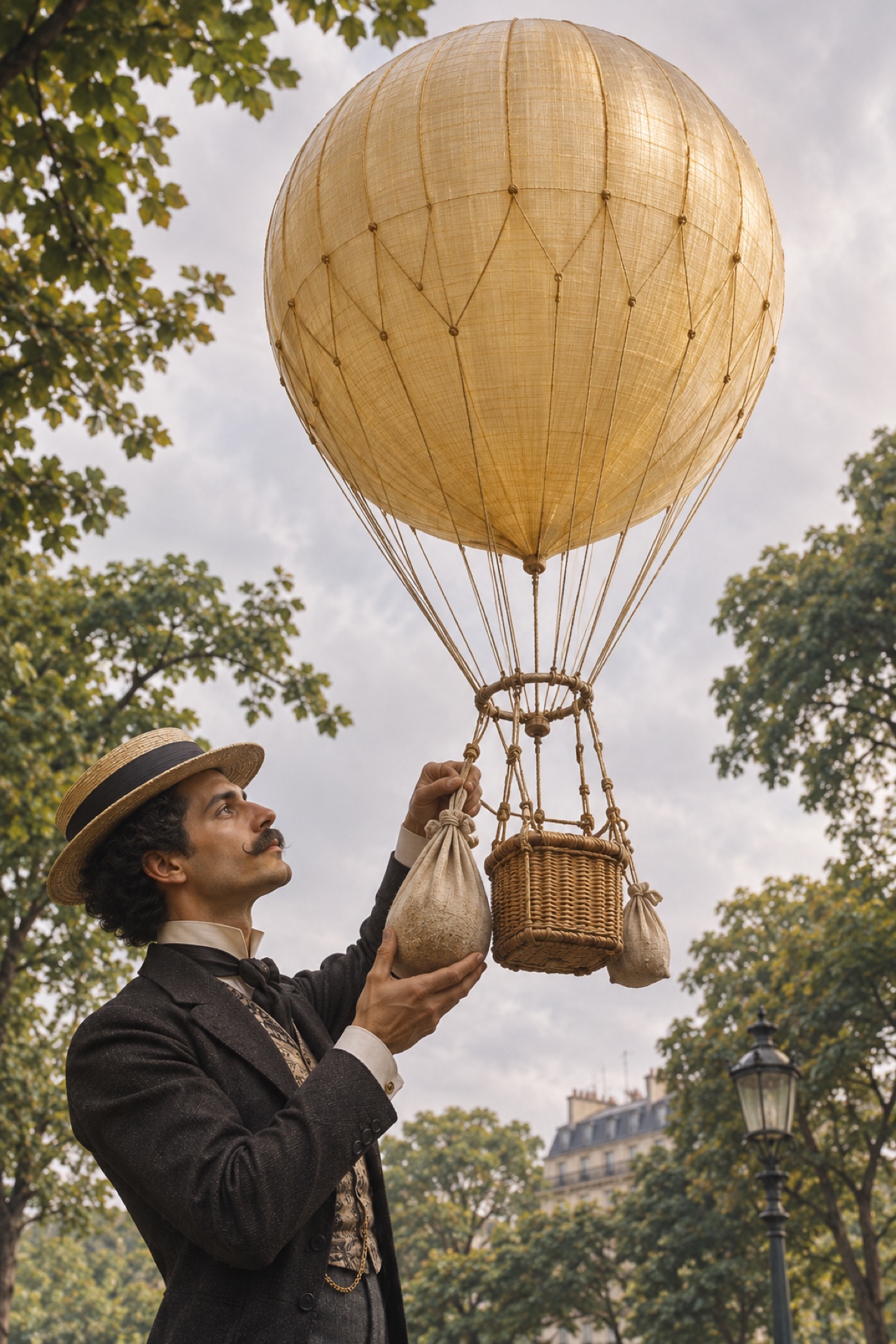
Altitude does not become a permanent possession when a balloon reaches it. Temperature, pressure, gas volume, and the total load continue to matter. Releasing ballast reduces the weight being carried; releasing lifting gas reduces the available buoyancy. Each action changes what will be possible later in the journey.
The important human detail is that a seemingly gentle flight requires attention. A bag of sand is not scenery. Nor are clouds simply decoration. Weather can change the behaviour of the system and the visibility of the ground on which the aeronaut depends for orientation. The beautiful view and the practical problem occupy the same basket.
The freedom to go up was not the freedom to choose a destination
An ordinary free balloon could alter its altitude and sometimes encounter a differently moving layer of air. It could not simply turn toward a chosen address as a driver turns a vehicle. The distinction between drifting and navigating was the opening through which Alberto’s next experiments emerged.
He wanted a return journey, not merely a departure. That ambition changes the design question. A spherical envelope offers buoyancy but considerable resistance when pushed sideways through the air. An elongated form, a motor, a propeller, and a steering surface suggest another kind of machine. None alone is a solution. Together, they create a system that has to be balanced, tested, and made to work in real weather.
What the little balloon taught the future airplane builder
A balloon and an airplane obtain their support in different ways. Yet the habits of work can travel between them: weigh the parts, question an assumption, pay attention to the atmosphere, and learn from the response of a real machine. The Brasil matters because it belongs to that developing education.
The sequence is more interesting than a sudden flash of genius. Alberto first learns how to ascend, then presses against the limits of drifting. The sky that looked like open space reveals itself as a demanding physical environment. To belong to it, he will need more than the courage to let go of a rope. He will need a way to come back.
EXPLORE THE SOURCES
[1]Alberto Santos-Dumont · My Airships (1904) ↗[4]Instituto Cultural Santos=Dumont ↗[8]Mauricio Pazini Brandão · ITA / ICAS (2018) ↗[19]NASA · Scientific Balloon Program ↗[21]Henrique Lins de Barros · CBPF ↗[23]Museu de Astronomia e Ciências Afins · Part II ↗All illustrations are AI interpretations. Sensory invitations are atmosphere, not recorded thoughts or dialogue.