A CLOSER LOOK · 1898
The first time the earth fell away.
Follow Alberto and Alexis Machuron from the inflation yard into the clouds—and through the landing that completed his first lesson.
VAUGIRARD · ABOVE FRANCE
A book leads to a balloon yard
Before the ascent there was a delay, and before the delay there was a price. During his early time in Paris, Alberto had asked about going up in a balloon, only to encounter arrangements he considered prohibitively expensive. His interest survived. A later encounter with a book about the Andrée polar balloon expedition brought him toward the people who actually built the equipment.
The names were Henri Lachambre and Alexis Machuron. Lachambre was an experienced balloon constructor; Machuron was his associate and an aeronaut. Alberto's memoir describes the relief of discovering that a long ascent, including the equipment's return by rail, could be arranged for 250 francs. Rather than continue admiring ballooning from a distance, he could finally become a passenger.
The change of contact mattered. A builder could show him the material thing and explain its operation. It was a relationship he would return to throughout his inventive life: find someone whose practical experience could bring a question out of the realm of speculation. The first journey began with asking the right people.
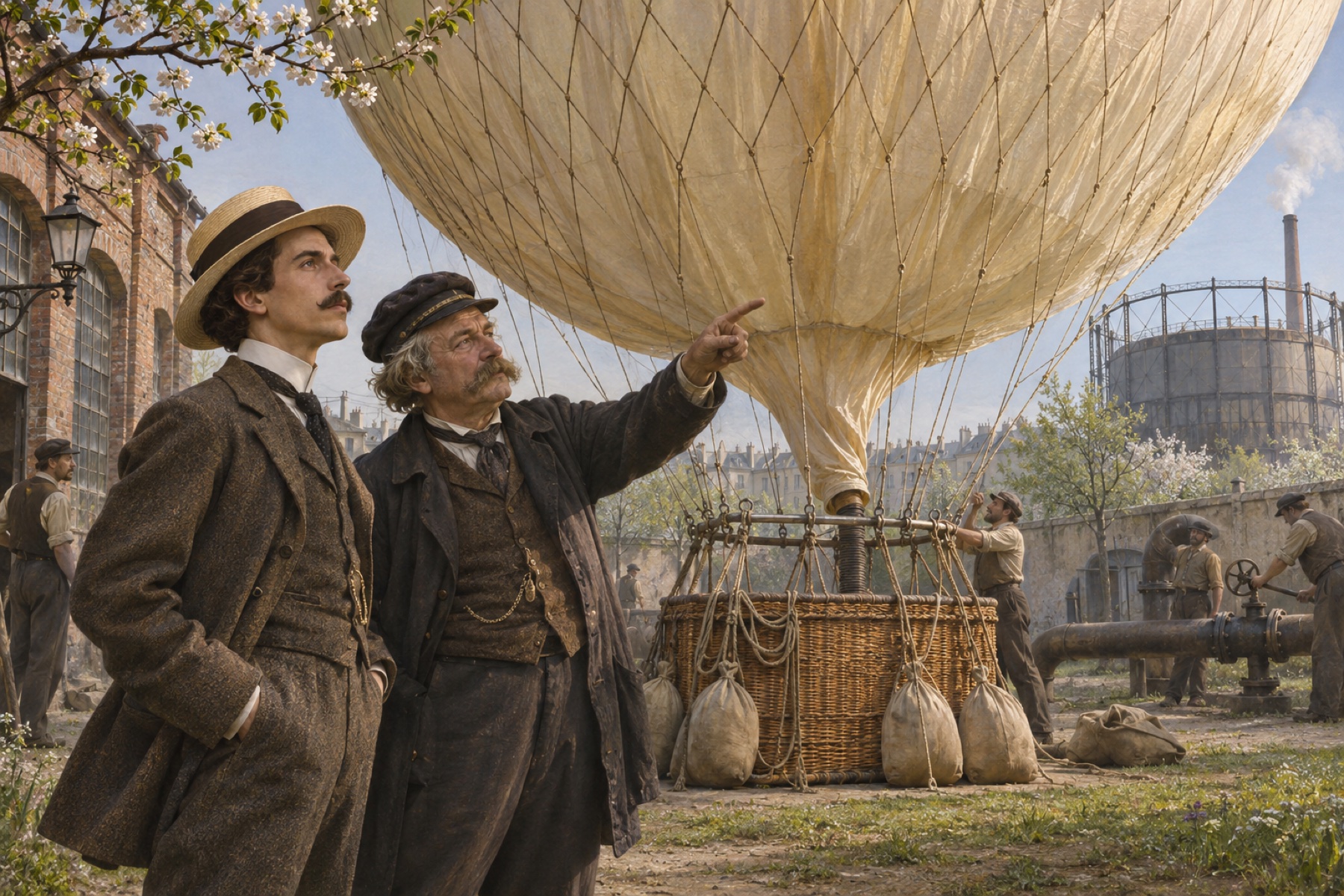
Before eleven: watching it acquire a shape
He arrived early at the aerostation park at Vaugirard because he wanted to see the preparations. The balloon began as fabric on the ground. Gas entering the envelope gradually made it into a sphere. His account gives its capacity as 750 cubic metres, an enormous volume compared with the narrow wicker space in which the two men would stand.
The transformation gives a first-time passenger something extraordinary to watch. A material that can lie folded and apparently lifeless becomes large enough to lift people. Netting distributes the load, ropes connect the envelope to the basket, and ballast waits where it can be used. These are not decorations around the adventure; they make the adventure governable.
Machuron brought experience into the basket. Alberto brought the attentive impatience he later remembered so clearly. At eleven, according to the memoir, they were ready. The people on the ground could release them, but once they had risen, much of the practical responsibility would belong to the two men and the equipment they carried.
The breeze seems to disappear
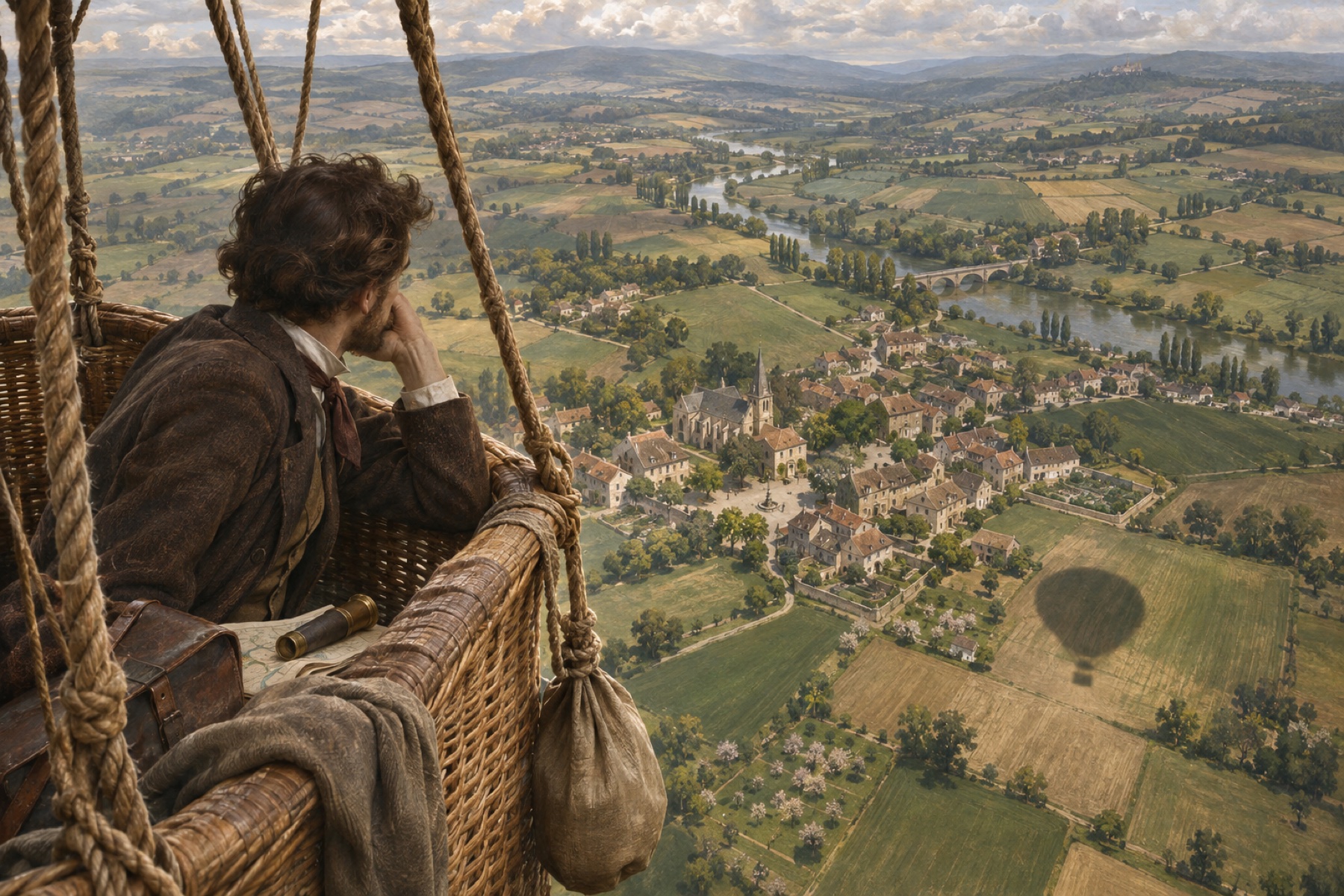
One of his strongest memories was the sudden absence of the wind he had felt at the start. The balloon was travelling with the surrounding air. Relative to the basket, the breeze seemed to have stopped. Instead of feeling an obvious rush forward, he had the impression that the earth was descending beneath him.
Think of the change in the view: first a familiar yard below the basket, then streets and buildings arranged into a pattern, then a landscape that no longer offers the ordinary scale of a person walking through it. The illustration places us near the basket's edge, but the particular route of its shadow is imagined.
He remembered distant sounds, especially the sharp notes of trains and barking dogs. In his telling, everyday human activity became small and difficult to hear while certain sounds still crossed the distance. Flight was changing his experience of the ground before he had acquired any means of steering toward a chosen destination.
A cloud becomes a practical problem
The air was not a passive setting. Sunlight warmed the gas; shade could cool it. Alberto describes a cloud passing in front of the sun and the balloon beginning to descend. Machuron and his passenger used ballast to recover a suitable balance. A bag of sand now had a significance it would never possess in an ordinary room.
Throwing out ballast reduces the weight the balloon has to support. Releasing lifting gas can help bring it down. Both actions use a finite resource. Sand that has fallen away cannot be retrieved in midair, and gas deliberately released will not be available for the rest of the journey. The beautiful view exists alongside a running account of what remains.
This was an education in the behaviour of an aircraft, although the machine had no engine. Altitude demanded decisions. Conditions could change while the men were admiring the landscape. The experienced aeronaut's work was to recognize those changes early enough to retain choices for the landing.
Above the clouds, another kind of horizon
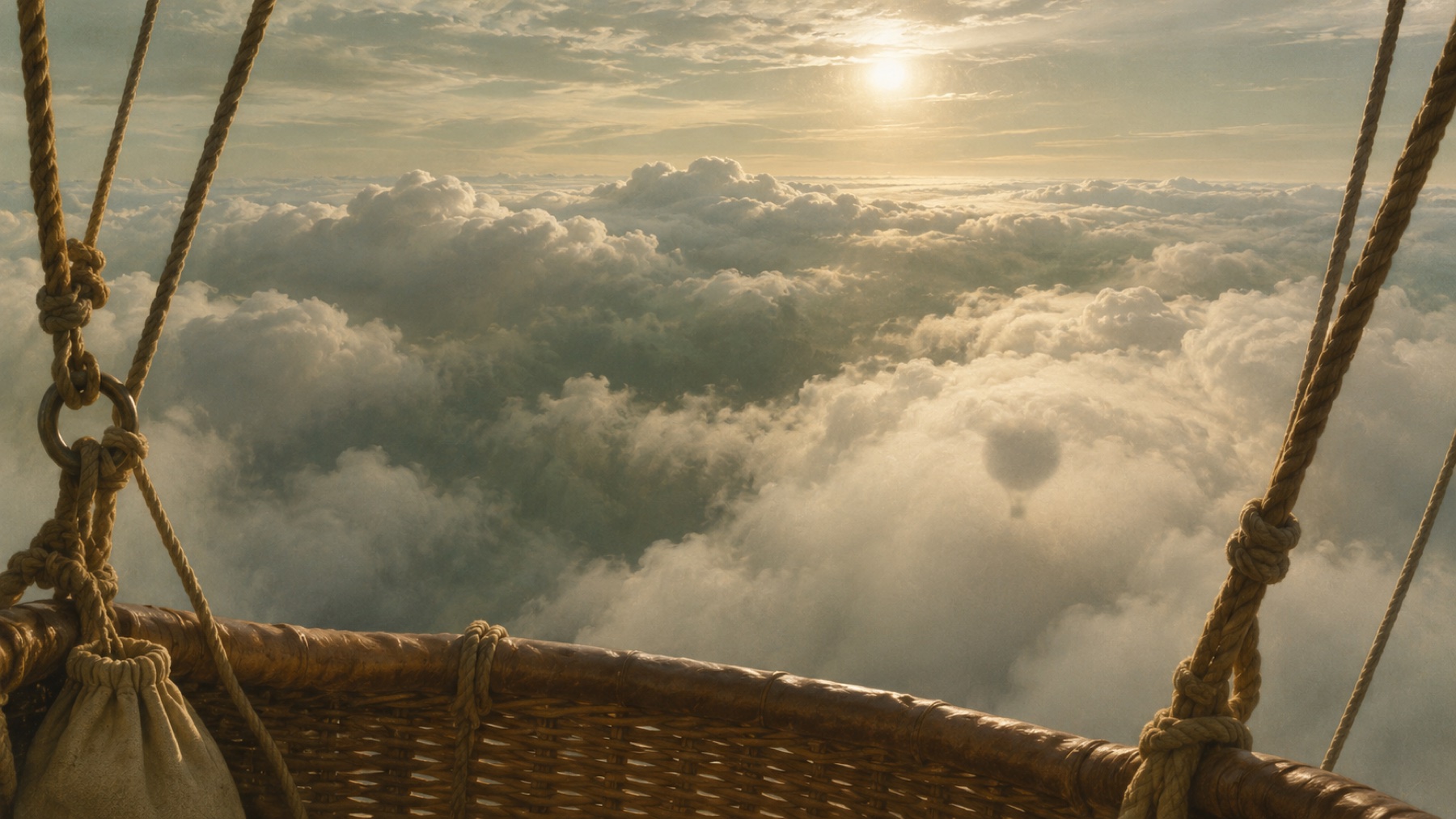
The memoir takes them above a layer of cloud, where Alberto remembered a striking play of light and shadow. Once the land vanished, he could no longer read their horizontal movement from the passing landscape. They might be travelling quickly, yet the basket offered little immediate sensation of that speed.
The account includes an unexpectedly elaborate lunch. The detail is delightful because it brings ordinary appetite into a setting that had recently seemed almost unreachable. Here was someone who wanted the experience to contain pleasure as well as instruction. The basket was a place to look, learn, and eat while the countryside passed out of sight.
Let the image linger on that cloud world without mistaking it for a recovered photograph. The sensations come through Alberto's later account; the light and viewpoint come from an artist's interpretation. What remains securely part of his formation is the contrast between the apparent stillness of the basket and the invisible motion carrying it onward.
The guide rope catches
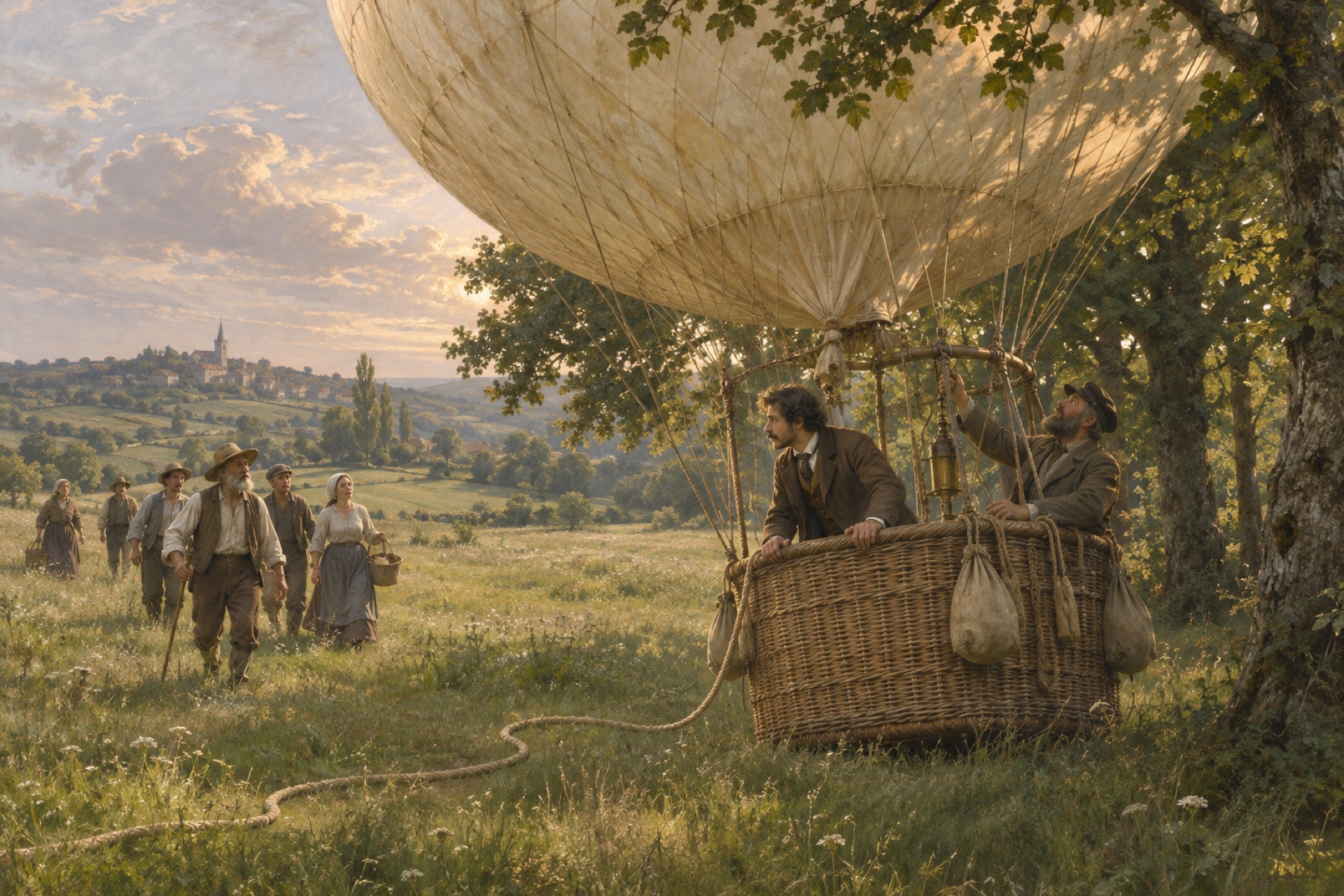
Descending brought the ground back into the operation. The guide rope could trail below and assist near the surface as part of its weight came to rest on the earth. But a rope travelling over a landscape could also catch. On this first journey, Alberto described it snagging in an oak.
The basket's gentle travel became a series of jolts. The balloon was held while the air continued to act on it. They released ballast to free themselves, and when the rope came clear the now lighter balloon climbed sharply. One solution had immediately changed the next problem. They then needed to release gas to descend again.
This is the first flight without the softness of a souvenir. Learning included an uncomfortable encounter with a tree and the consequences of using up ballast. Alberto would later insist on the usefulness of free-balloon landings for anyone hoping to navigate an airship. The lesson was not merely how wonderful it felt to rise. It was how carefully a journey had to be brought to an end.
The balloon returns to fabric
With little ballast left, Machuron and Alberto sought a suitable place to finish. The memoir describes shelter near woodland and a landing on grounds associated with the Château de la Ferrière. They used the anchor and released gas, bringing the basket to earth without a long drag.
Now reverse the morning's transformation. The great round presence lost its volume. The envelope, netting, and basket became equipment that had to be gathered and transported. People working nearby helped arrange a conveyance. The adventure returned to ordinary questions of roads, vehicles, and getting things home.
That practical ending belongs beside the clouds. A flight is not completed when its passenger has seen the most beautiful view. The people and equipment must come down, and the experience must leave something usable behind. Alberto had acquired a memory he treasured and the beginning of knowledge he could act on.
Now he wants a balloon of his own
The first ascent did not satisfy the interest by exhausting it. Alberto continued gaining experience and moved toward owning a balloon built to his requirements. The small Brasil would express an increasingly important preference: reduce weight, understand the materials, and question a convention that seemed unnecessarily cumbersome.
That next step required the same builders whose work had made the first ascent possible. Passenger experience became a better-informed conversation about construction. The basket had taught him what questions to bring back to the workshop: how much volume was needed, what a person could carry, and how fabric and equipment affected the result.
Return to the main balloon chapter with that transition in mind. He has not yet solved the problem of choosing a direction. The wind has carried him through the first journey. But he now knows the air as an environment he can enter, observe, and begin to understand from within.
EXPLORE THE SOURCES
[1]Alberto Santos-Dumont · My Airships (1904) ↗[4]Instituto Cultural Santos=Dumont ↗[19]NASA · Scientific Balloon Program ↗[21]Henrique Lins de Barros · CBPF ↗All illustrations are AI interpretations. Sensory invitations are atmosphere, not recorded thoughts or dialogue.