CHAPTER 02 · 1891 — 1898
A bigger world. An even bigger dream.
Across the Atlantic, the city of light becomes a laboratory.
ACROSS THE ATLANTIC · PARIS, FRANCE
The Atlantic was part of the journey
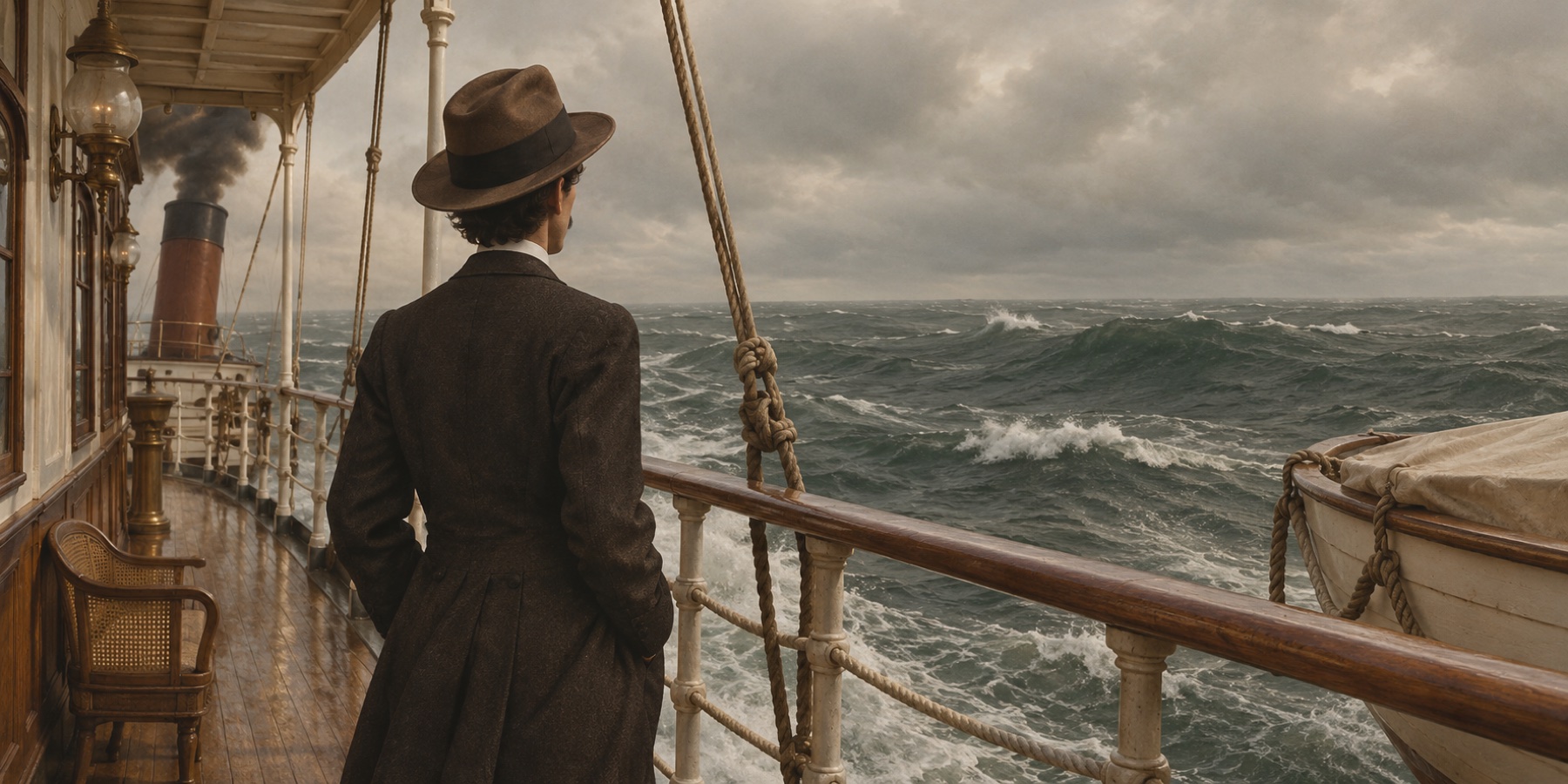
To go from Brazil to France in the 1890s meant living through the distance. Steamship passage, ports, luggage, changing weather, and onward travel by rail belonged to the experience. There was time to feel a familiar coast disappear and an unfamiliar one approach. Our deck scene is an invitation into that scale of travel, not a claim to have recovered a particular moment on a named ship.
The family visited Europe in 1891 as Henrique sought treatment. Further journeys followed. Remembering those repeated crossings matters: Alberto’s relationship with France developed through movement between countries, rather than one tidy scene in which a Brazilian childhood ended and a Parisian life began. Routes connected his two worlds long before his inventions connected the ground to the air.
The city as an immense working demonstration
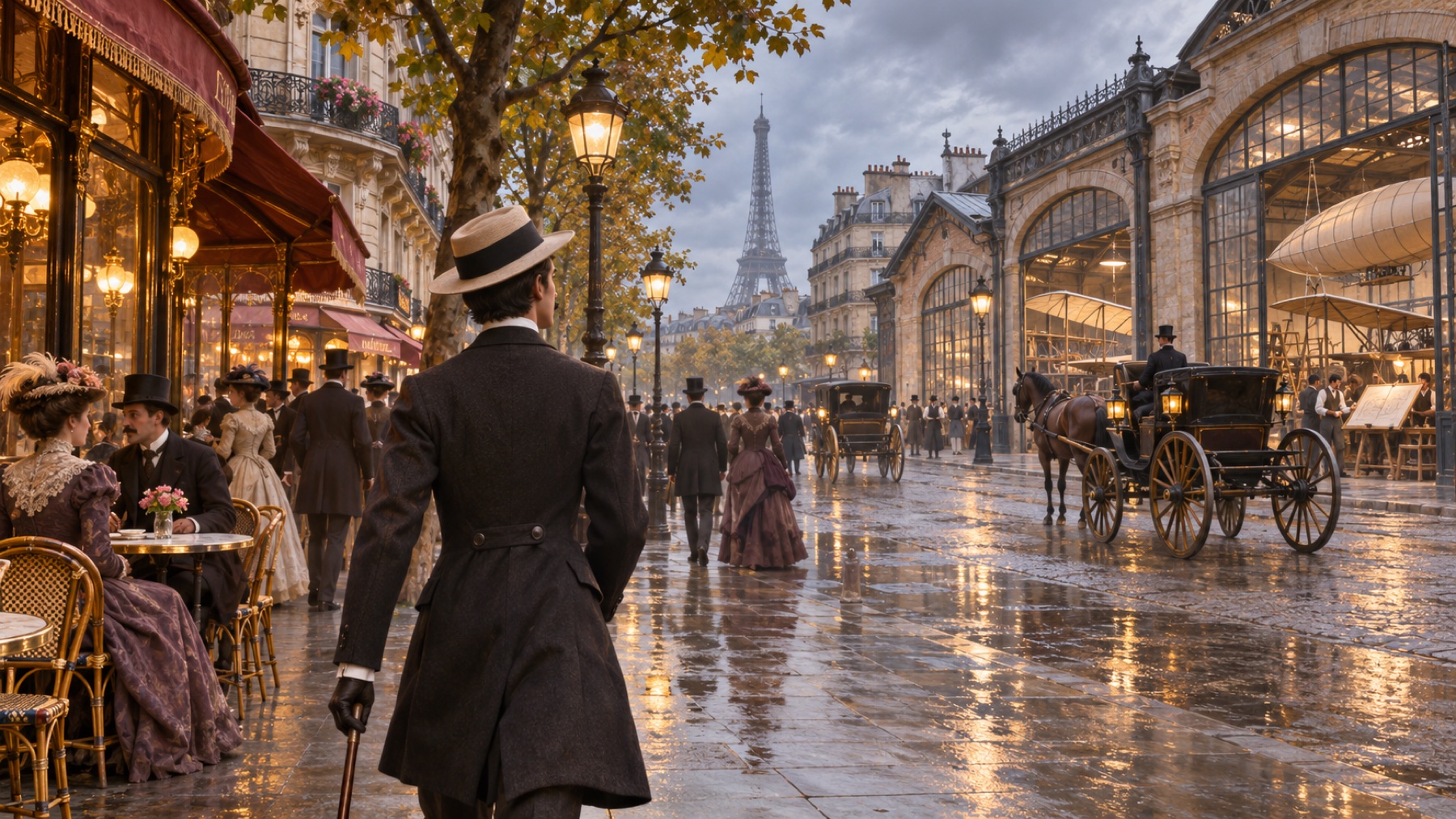
Paris offered more than an impressive skyline. It offered places where new technologies were displayed, discussed, sold, raced, repaired, and judged. A young man interested in machinery could move between an exhibition, a workshop, a sporting event, and a conversation with somebody who knew a supplier. The city made specialized knowledge unusually accessible.
The Eiffel Tower was a particularly forceful presence in this landscape. It was an engineering work that had also become a public spectacle. Later, Alberto would make it a turning point in an aerial course. For now, it stood within a city where people could gather around a technological achievement and argue about what it meant. He was learning the setting in which an invention could become an event.
Henrique’s final gift was room to choose
The money made available to Alberto gave him an unusual degree of independence. Henrique died in 1892. The son’s later freedom to experiment therefore belongs beside a bereavement, not merely beside the glamour of travel and fashionable society. The public record supplies dates and circumstances; it does not let us narrate his grief from inside his head.
Independence changed what a mistake could mean. He could pay to discover that a proposed arrangement did not work. He could return to a specialist with a different design. An experiment could remain an experiment instead of becoming an immediate commercial obligation. That financial breathing space is a concrete part of how an inventive career becomes possible.
Why a small motor could change everything
The developing world of motor vehicles was directly relevant to the problem above the rooftops. A machine intended to leave the ground must carry its source of power. An engine that works beautifully on a heavy industrial foundation can be useless when the foundation has to fly with it.
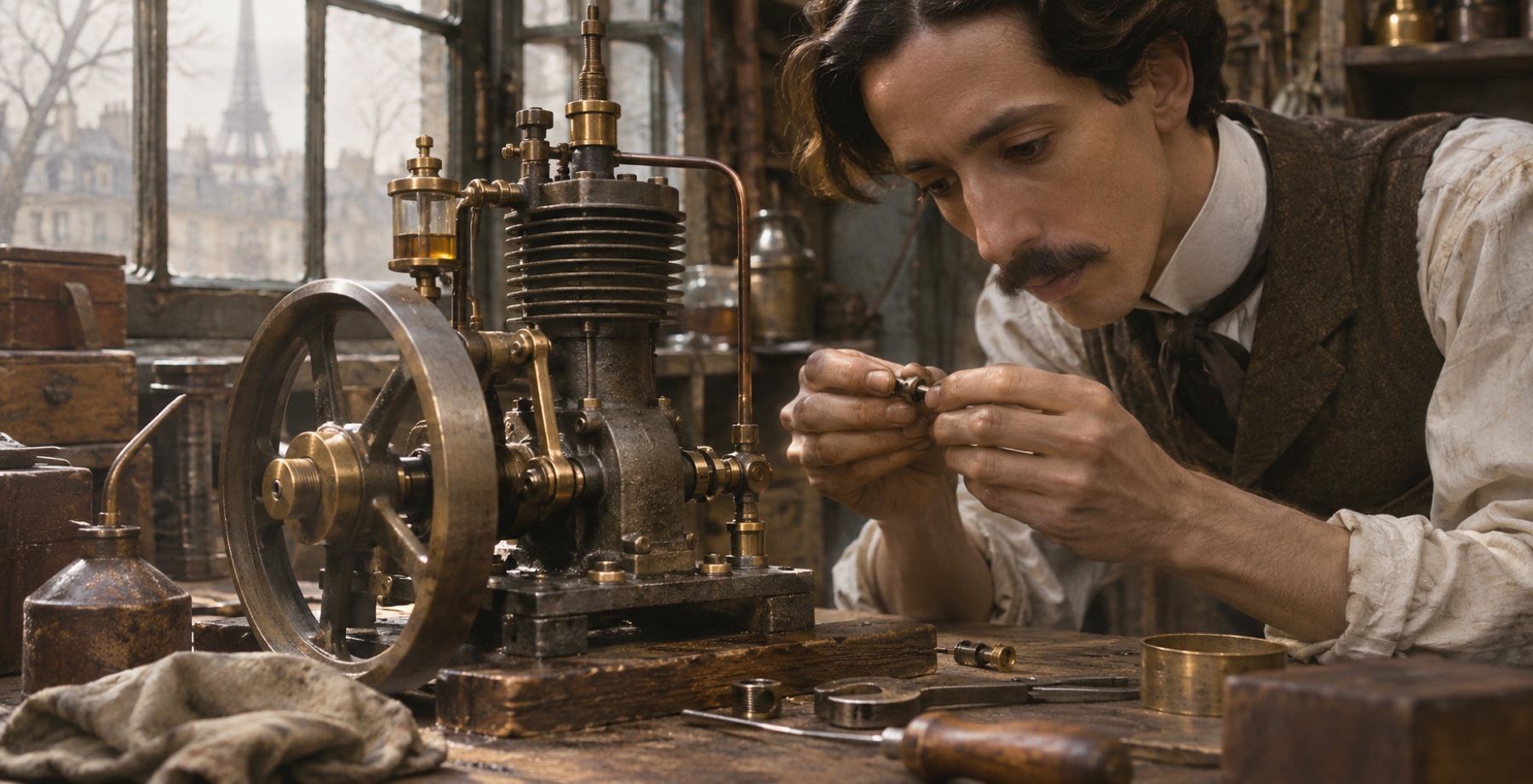
Small petrol engines opened a different possibility. Their attraction was not power alone, but useful power in relation to weight. Even then, the engine was only part of a system: fuel, cooling, transmission, a propeller, controls, and a structure capable of carrying them. The detail of an oily fitting or a small flywheel belongs to the great aerial story because the dream must eventually fit onto a bench.
Learning whom to ask
Henri Lachambre and Alexis Machuron become important names when Alberto turns seriously toward ballooning. These were experienced practitioners and builders, people with knowledge that could not be acquired simply by admiring an ascent. They understood envelopes, baskets, inflation, landing, and the compromises that a customer might not yet know to ask about.
The relationship is worth lingering over. Alberto did not need to pretend that he already possessed every skill. His initiative lay partly in bringing a question to people capable of helping him test it. The resulting work crossed the boundary between the person who proposed an experiment and the people whose craft made its materials behave. Invention often happens at precisely that boundary.
A Brazilian name in French conversation
He spoke French and entered the city’s sporting and social circles, carrying wealth, an interest in machines, and a distinctive public presence. The fashionable clothes and carefully kept appearance were not incidental to how Paris encountered him. The man who might emerge from a workshop was also somebody society recognized.
That visibility would become useful. Experiments need places, collaborators, attention, and sometimes judges. Celebrity could help assemble an audience; it could also compress a complicated technical life into an attractive image. The Panama hat and the little aeronaut would become memorable, while many hands behind the aircraft remained much less visible. Our task is to keep both the striking figure and the working network in the frame.
The question that a city could not answer for him
Paris could offer an engine, a balloon builder, a field, or an audience. It could not substitute for the first bodily experience of leaving the ground. Alberto still had to stand inside a basket and discover the difference between imagining an ascent and being carried through one.
The next step was modest in its form: go up with somebody who already knew how. It was enormous in consequence. From the street, a balloon is an object in the sky. From the basket, the sky becomes the place you occupy, and the ground becomes a changing surface far below. The problem would soon stop being whether he wanted to fly. It would become where he wanted to go.
EXPLORE THE SOURCES
[1]Alberto Santos-Dumont · My Airships (1904) ↗[3]Academia Brasileira de Letras ↗[4]Instituto Cultural Santos=Dumont ↗[16]Smithsonian · National Air and Space Museum ↗[22]Past & Present · Oxford University Press ↗[28]Jornal da USP ↗[36]Agenda Santos Dumont · Patrimônio Atual ↗[37]Smithsonian · Clement V-2 Engine ↗All illustrations are AI interpretations. Sensory invitations are atmosphere, not recorded thoughts or dialogue.