CHAPTER 08 · 1910 — 1932 · AND BEYOND
The sky remembers. So should we.
The man behind the legend, and the world he changed.
BRAZIL · A WORLD TRANSFORMED
The story does not end at the instant of applause
Santos Dumont’s active flying career ended around 1910. A biography that stops there leaves a substantial part of his life outside the frame. There were books, journeys, public occasions, projects, and years of ill health. The later man was living with the consequences of a world that had changed very quickly.
It is tempting to make retirement the closing shot of a triumphant film: an empty field, a machine at rest, a name secured. But a life does not turn into an epilogue simply because its most famous experiment is over. The years afterward ask us to attend to a person whose circumstances and concerns continued to develop.
What he thought flight could connect
In the later book, he argued for aviation as a means of connecting distant American cities, carrying correspondence, and reducing the long separations imposed by geography and sea travel. Mountains, forests, and the cost of ground infrastructure appear in this vision as practical barriers that aircraft might help overcome.
That hope belongs beside the boy who learned about movement through an estate railway and the adult who repeatedly crossed the Atlantic. The future of flight was not only a longer record or a faster machine. It was a different relation between places: a message arriving sooner, a journey becoming possible, a remote community entering more direct contact with others. These are hopes expressed in his writing, not a claim that he foresaw every consequence.
The difficult question of military aviation
The relationship between Santos Dumont and warfare is more complicated than the popular story of an inventor who never considered military uses. His own later writing discusses military applications and the role of aviation in national development. That contemporary voice belongs in the record alongside accounts of his distress at destructive uses of aircraft.
Holding both facts together is not a failure of admiration. It is what allows a historical person to remain a person rather than a lesson polished smooth after death. Attitudes can contain tensions and change over time. His words should be read in their circumstances, especially during a period when aviation was becoming a tool of states as well as individual experimenters.
A name that travelled beyond borders
The Father of Aviation: a title that travelled with Santos Dumont’s reputation beyond the places where he was born and worked. On 13 October 1997, President Bill Clinton used those words in a speech in Brasília. The original transcript, preserved in the White House archives, places Alberto among figures whose contributions reached across national borders.
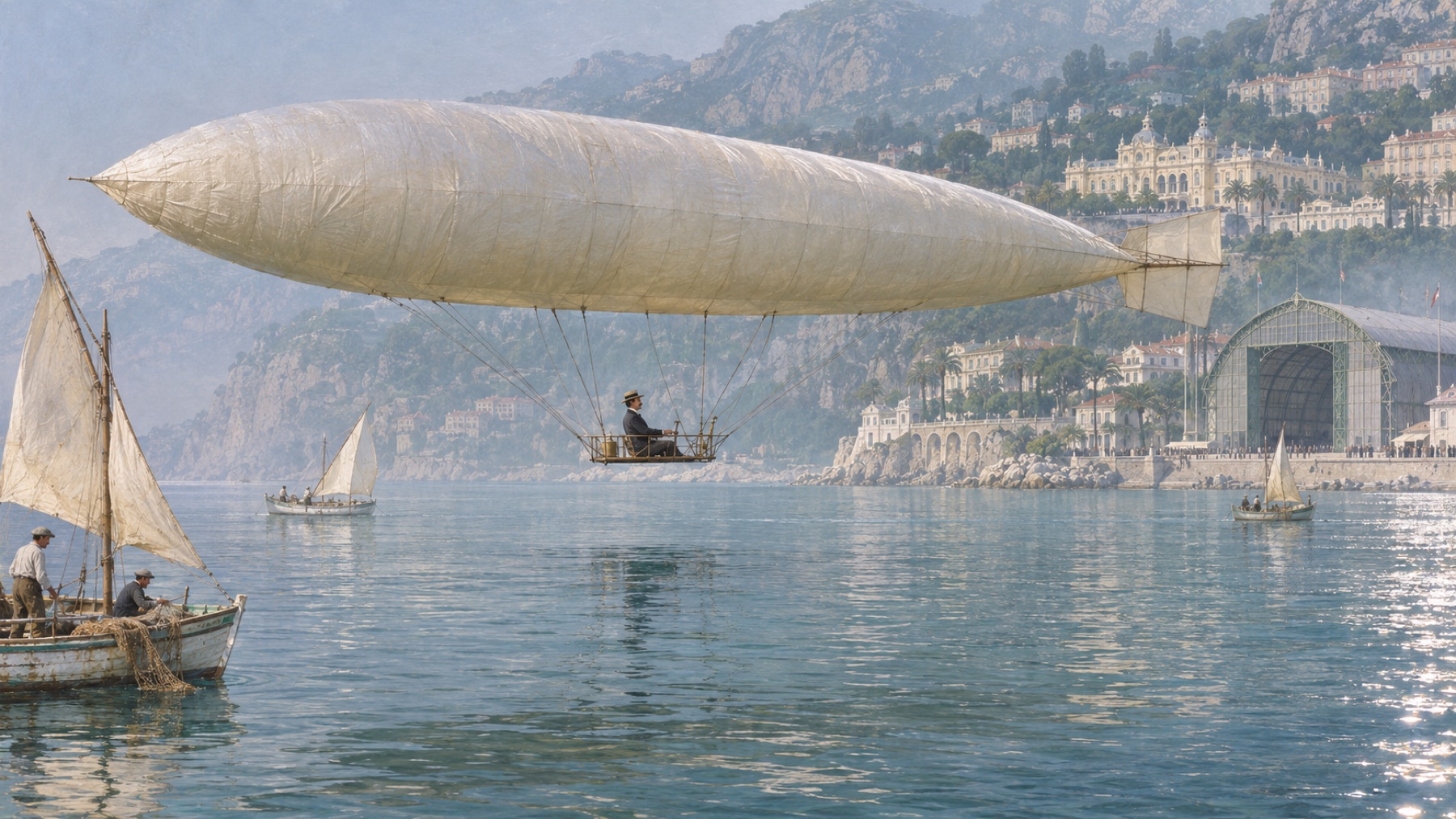
The achievements beneath the title belong to the history of flight: a dirigible completing a return journey around the Eiffel Tower, the 14-bis taking off on its own wheels and under its own power, and the Demoiselle carrying the possibilities of a light airplane into other builders’ hands. These are the events through which the Father of Aviation helped enlarge the world’s imagination.
Guarujá, July 1932
Alberto Santos Dumont died in Guarujá on 23 July 1932, three days after his fifty-ninth birthday, by suicide. He had been experiencing serious ill health. Accounts frequently connect his distress with armed conflict and the military use of aviation, but no single explanation should be made to contain a person’s entire suffering.
This chapter leaves his final moments unpictured. There is no need to imagine them to recognize their gravity. We can give the last years space without treating them as a dramatic device that makes the earlier accomplishments more moving. The person deserves care in the telling, even when the public figure has become a monument.
The country answered with mourning
The decree of 25 July 1932 is a contemporary record of Brazil’s response. Its language honours his inventions and associates his work with human development, relations among nations, peace, and solidarity. It shows how quickly a death can become a public act of remembrance.
A decree tells us how a state chose to speak; it does not give us the private feelings of every citizen. But it is valuable evidence of the meaning attached to his name at that moment. The Father of Aviation was being gathered into the country’s official memory, even as his family and acquaintances faced the loss of someone they had known beyond a headline.
Objects keep a less tidy, more intimate memory
A museum collection preserves things that a single heroic image cannot: clothes, furniture, paper, tools, machines, and objects whose meaning may require new research. Carlos Adriano’s study of a 1901 mutoscope reel in the Museu Paulista collection describes identification and restoration as acts of discovery. A small mechanical object can return a moving image to view.
This changes how we think about remembrance. History is not simply a finished story handed down intact. People identify a fragment, compare records, restore a sequence, and ask again what they are seeing. A wardrobe or a film reel can make the famous figure less remote by bringing him back among the material details of a life.
The work that remains ours
We can honour Santos Dumont by keeping the restless intelligence of the story alive. Look at a mechanism long enough to notice its difficulty. Ask who knows something you do not. Take a failure seriously enough to learn from it. Make room for the people whose skill allows an idea to become material. Share knowledge in a form somebody else can use.
The Father of Aviation left aircraft and records, but also a way of approaching possibility. Between the coffee estate, the Parisian workshop, Bagatelle, and the small house on the hill, the scale keeps changing. The attention remains recognizable. He looked closely at the world he had—and helped make another world imaginable.
EXPLORE THE SOURCES
[3]Academia Brasileira de Letras ↗[8]Mauricio Pazini Brandão · ITA / ICAS (2018) ↗[20]INCAER · Santos Dumont, Father of Aviation ↗[21]Henrique Lins de Barros · CBPF ↗[24]Museu de Astronomia e Ciências Afins · Part IV ↗[26]Alberto Santos Dumont · 1918 ↗[29]Câmara dos Deputados · Decree 21,668, 25 July 1932 ↗[33]Carlos Adriano · Anais do Museu Paulista (2018) ↗[34]Jornal da USP · Museu Paulista ↗[38]White House archives · Bill Clinton, 13 October 1997 ↗All illustrations are AI interpretations. Sensory invitations are atmosphere, not recorded thoughts or dialogue.