CHAPTER 01 · 1873 — 1891
Before the sky, there was a boy.
A childhood among coffee trees, steam engines, and impossible questions.
MINAS GERAIS & SÃO PAULO, BRAZIL
Cabangu, 20 July 1873
Begin in the mountains. Before the boulevards of Paris, before a propeller turns above the Seine, there is a modest house at Cabangu in Minas Gerais. The railway is extending into the interior, and Henrique Dumont is there because the route needs an engineer. On 20 July 1873, his wife, Francisca de Paula Santos, gives birth to Alberto. He is the sixth of eight children. His first connection to the history of transport is a family connection: the work that has brought his parents here.
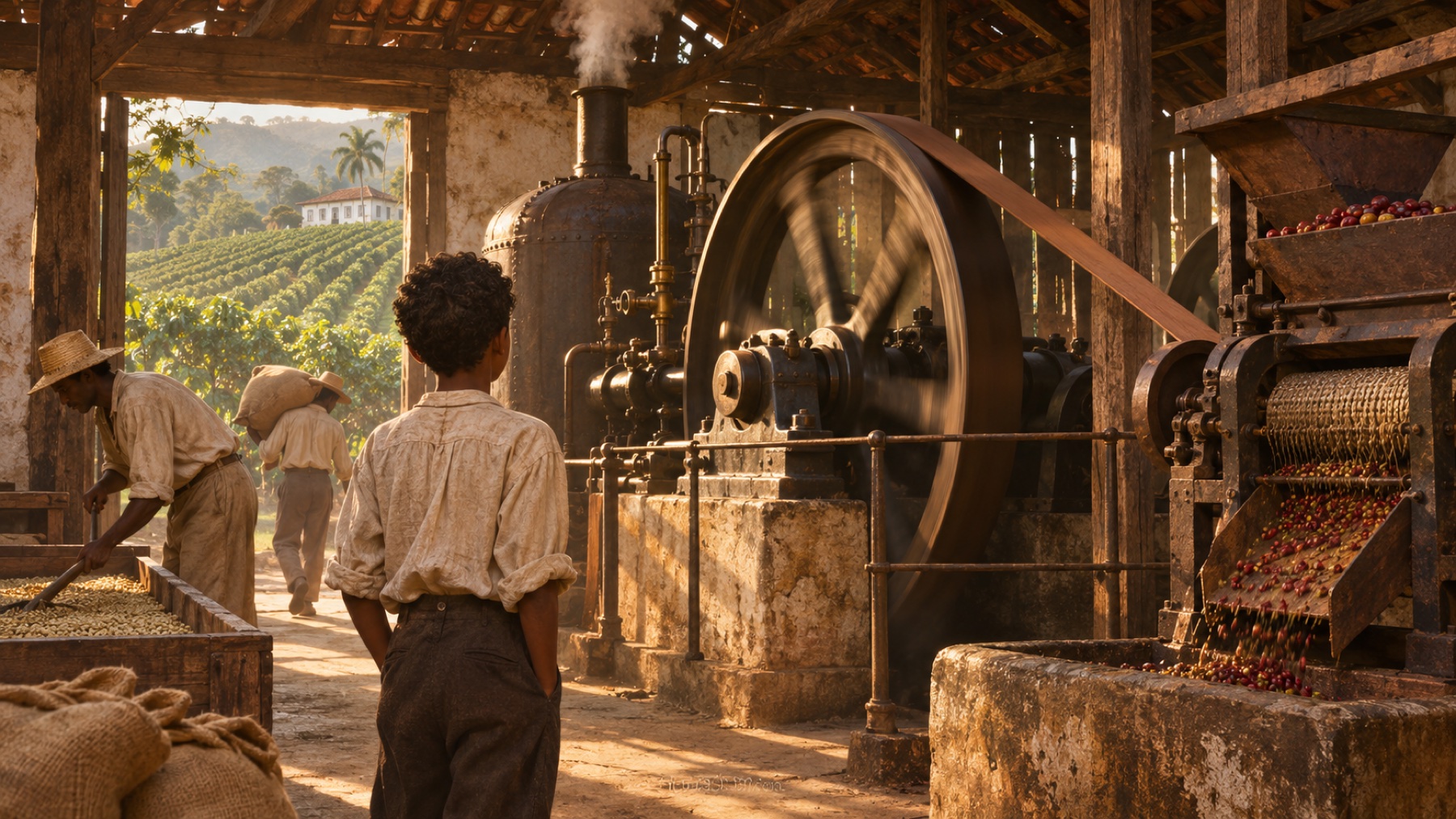
Imagine the morning at the scale of the house rather than the monument it will become: a doorway, the hills beyond, a world whose distances are measured by difficult journeys. The mist and light in our illustration are imagined. The place, the date, and the family are the beginning of the documented story. The house survives as the Museu de Cabangu, where a birthplace can still be encountered as a building rather than an abstraction.
Cabangu must not be confused with the enormous coffee estate of his later childhood. The two settings are connected by Henrique's career, but they belong to different stages. Alberto is born beside a railway project. He grows up among the machinery of an agricultural enterprise. Following that movement lets us see a family changing its circumstances, rather than a famous inventor appearing fully formed in a picturesque landscape.
Francisca, Henrique, and a crowded family
His mother's name comes first in the name he will make famous: Santos. Francisca de Paula Santos and Henrique Dumont married in 1856. By the time Alberto arrives, they have already spent years raising a family through changes of place and work. His brothers and sisters are part of that household; he is neither an only child nor a solitary prodigy growing up without company.
Henrique was born in Brazil to a family of French origin and trained as an engineer in Paris. France therefore belongs to Alberto's family geography long before he crosses the Atlantic himself. His father's education makes engineering a recognizable occupation within the home. It is something a person can study and practise, with bridges, routes, machinery, and an income attached to it.
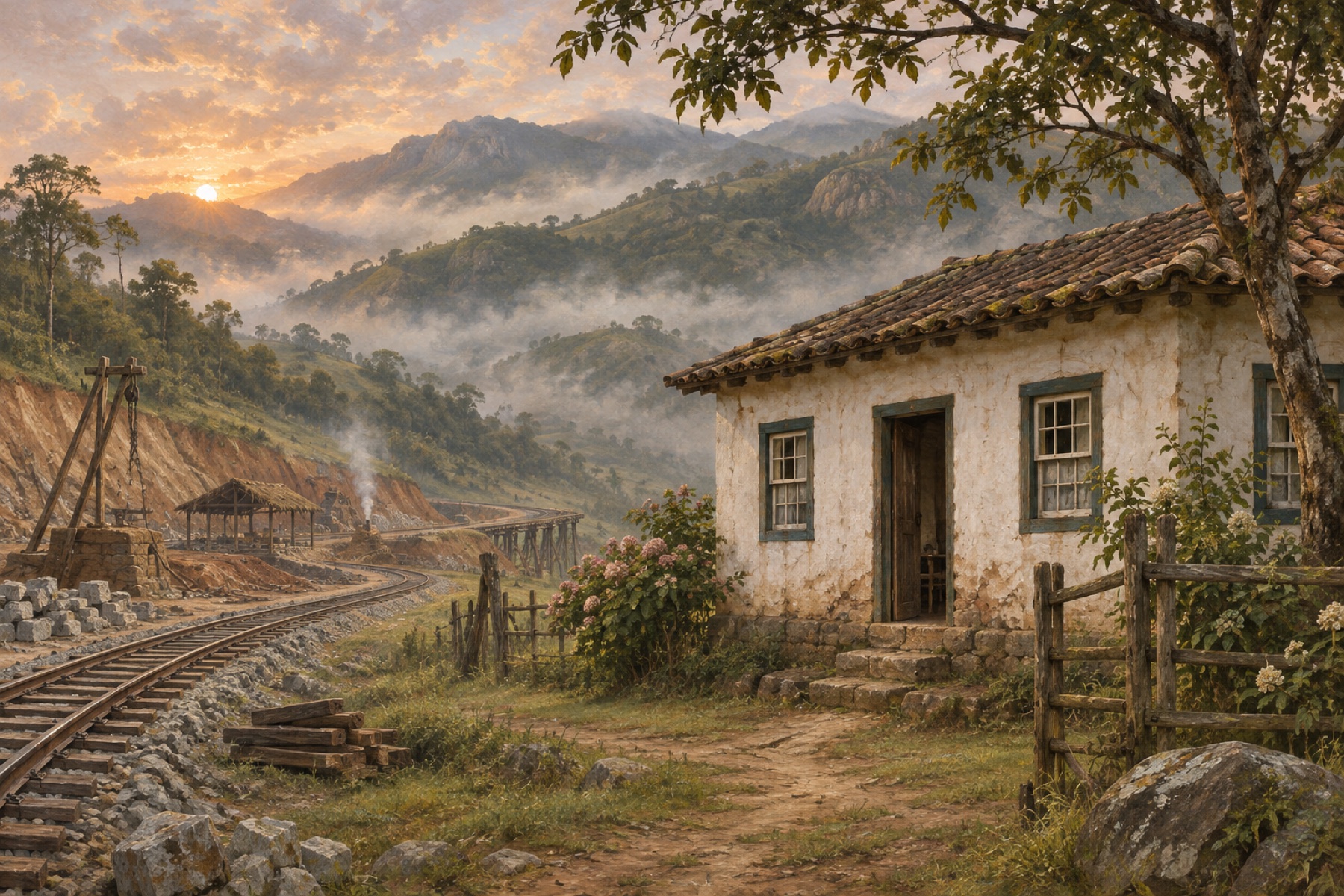
Francisca is less visible in the surviving technical reminiscences. We know her place in the family, but we do not possess a transcript of her ordinary conversations with Alberto. Our imagined family scene gives her a presence without putting invented advice in her mouth. The young man who eventually signs both surnames carries a history made by both parents, even when the documents give one of them much more space.
From the railway to the coffee country
The family's route leads through the region of Valença in Rio de Janeiro and then, in 1879, to the country around Ribeirão Preto in São Paulo. Alberto is still a small boy when Henrique becomes established at the estate associated with the name Arindeúva. Here coffee offers the possibility of wealth on a formidable scale. It also presents a problem well suited to an engineer: how to move and process an enormous crop reliably.
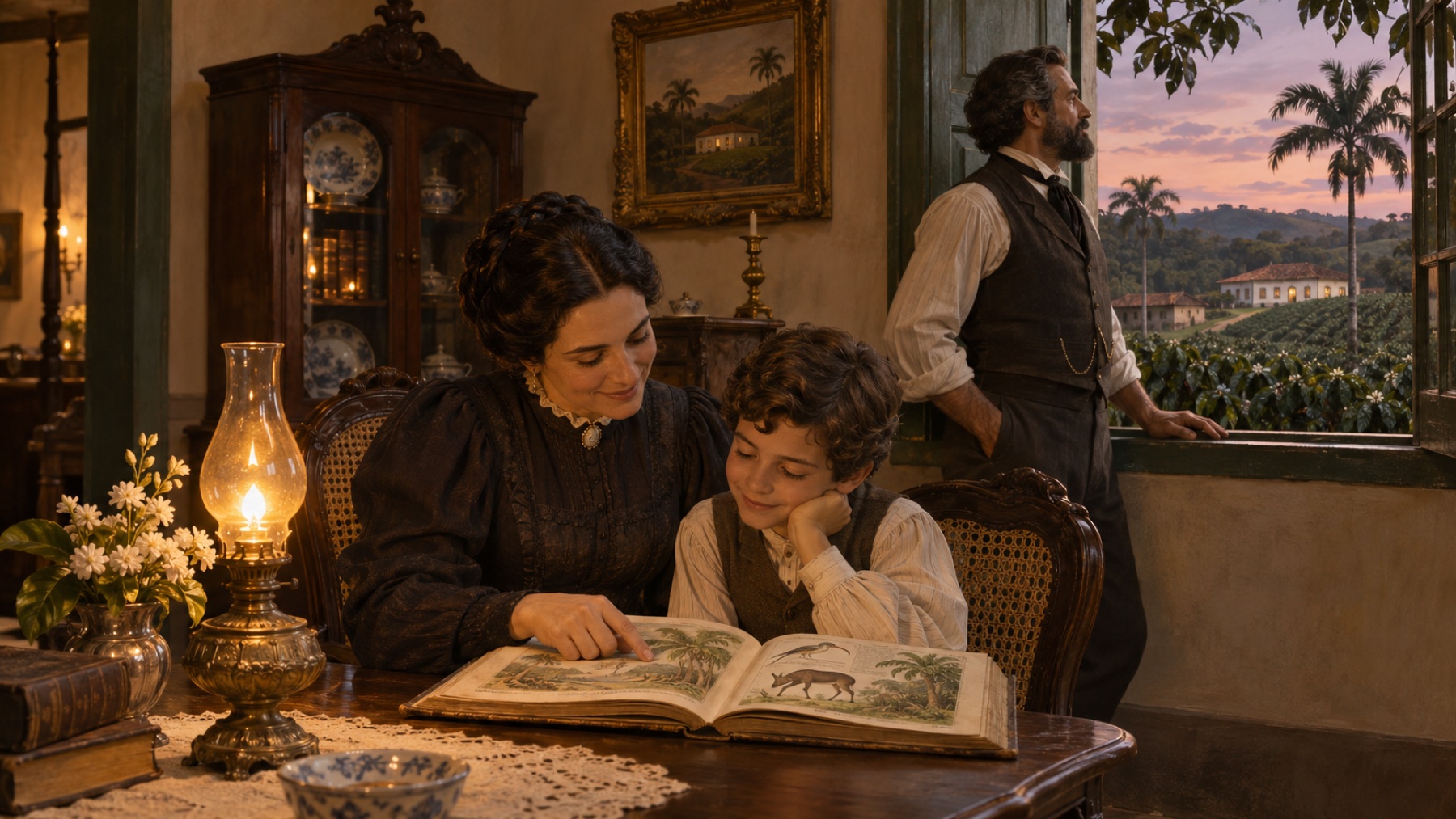
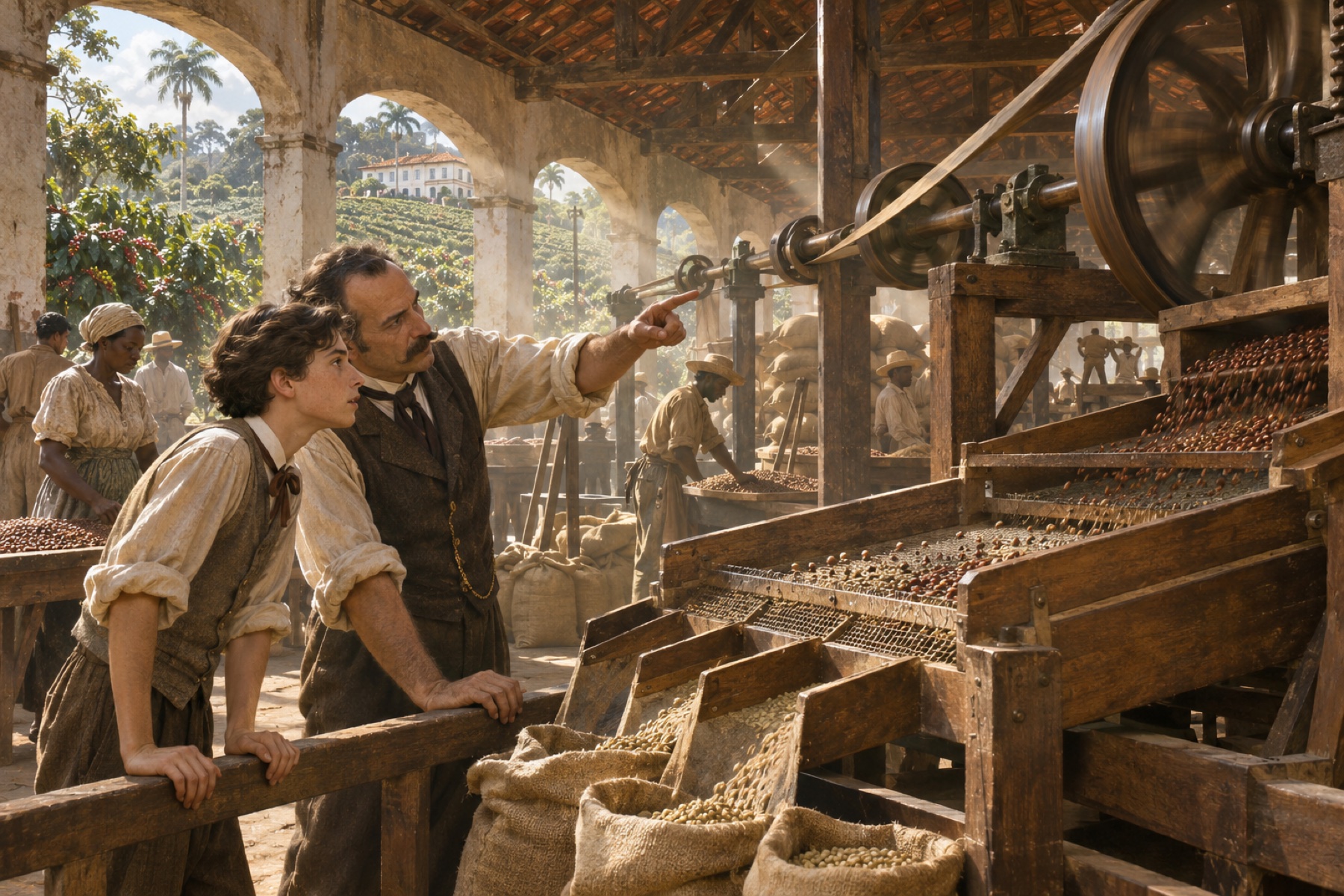
Walk through that setting in the order the crop travels. There are trees and harvesting, then transport toward the works, then successive stages that turn harvested fruit into a product ready for sale. Roads, rails, water, power, storage, and labour connect the stages. The estate is a landscape organized around movement. A locomotive matters because the next operation is waiting for what it carries.
The distance between a coffee tree and a sack prepared for export is an education in systems. Alberto can encounter machinery doing necessary work every day, with consequences when it stops. He does not have to wait for a spectacular exhibition to see power made useful. The demonstration is already going on around him, and it has a sound, a pace, and people responsible for keeping it moving.
At the height of a steam engine
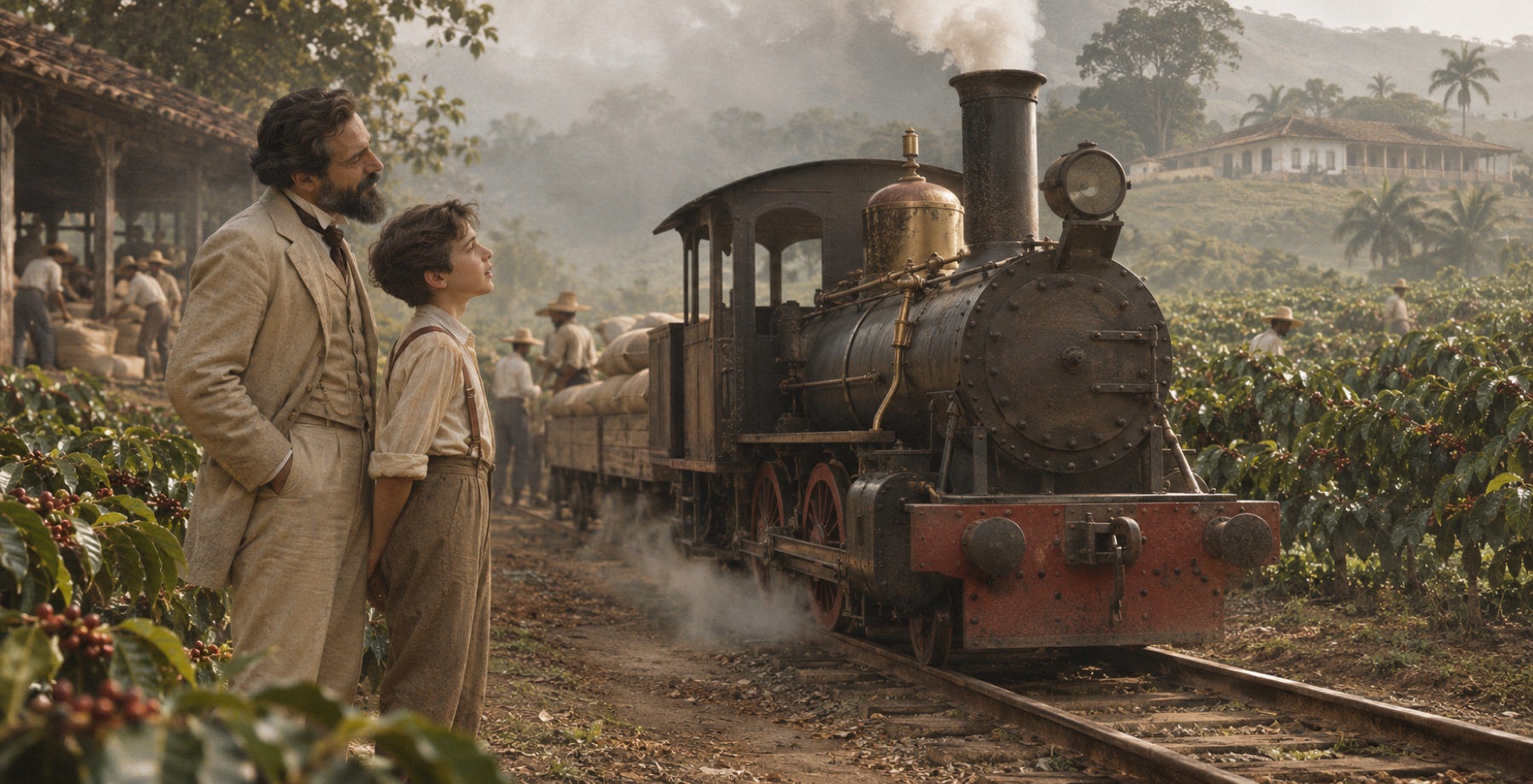
In his 1904 memoir, Alberto places himself beside steam machinery extraordinarily early. He remembers being permitted to drive the estate's steam traction engines at seven and finding a place in locomotive cabs at twelve. Those are his recollected ages, written after his airship successes. They tell us how strongly he associated his formation with practical contact with engines.
The scale matters. A flywheel is enormous when you are small. Motion passes from one part to another; a belt makes the connection visible. A machine can continue doing the same task with an endurance that a child cannot imitate. Yet it also depends on adjustments, fuel, maintenance, and human attention. Its apparent strength is full of conditions.
Henrique's willingness to allow that proximity gave curiosity somewhere to go. The memoir contrasts Alberto's attraction to the works with the riding trips enjoyed by his father and brothers. He gravitated toward the place where power could be watched in operation. Years later, when he would carry an engine into the air, mechanical noise would already be familiar rather than mysterious. The new question would be how much useful work a machine could do for the weight he had to lift.
Inside the works: following a coffee bean
The machinery that interested him did more than haul wagons. His memoir follows coffee through washing, separation, removal of the fruit's outer material, drying, and sorting. He remembered the procession in enough detail to explain it to readers far away from Brazil. Looking back, he wanted them to understand that this childhood landscape contained sophisticated equipment and organized processes.
Stay with a single piece of fruit moving through the works. At one stage, water separates materials that behave differently. At another, a machine removes what must not remain around the bean. Later, size and condition affect sorting. Each operation answers a different question. A mechanism that works beautifully for one task may be unsuitable for the next. A processing line teaches discrimination as much as it teaches admiration for power.
This is one way to approach his later originality. He became unusually attentive to the arrangement of things: what should turn, what should remain still, where a load should hang, and which part was unnecessarily heavy. The farm did not supply a hidden blueprint for the airplane. It offered a long apprenticeship in noticing relationships. Beneath the glamorous aerial photographs lies that ordinary discipline of looking until a mechanism starts to make sense.
What the machines could not do for him
Machinery was one part of his education, alongside schooling and reading. Institutional biographies record study in different Brazilian settings rather than a single uninterrupted technical course. The familiar image of a boy among engines should not make the rest of his childhood disappear. Learning required words, numbers, explanation, and the ability to ask a question somebody else could answer.
There was also much he could not learn by watching a coffee works. The behaviour of a gas envelope, the weight of silk, the handling of a balloon near the ground, and the response of an aircraft in flight would require other teachers. His later career repeatedly brings him into contact with people whose craft he does not yet command. Childhood mechanical confidence helps explain why he approached them; it does not eliminate their contribution.
As he grows older, the useful habit is the willingness to move between observation and experiment. A page can name a principle. A working mechanism shows how that principle meets friction, imperfect materials, and mistakes. Alberto's education would keep crossing that boundary. Paris would eventually offer more specialized instruction, but the impulse to understand through things already had a home.
Jules Verne opens another landscape
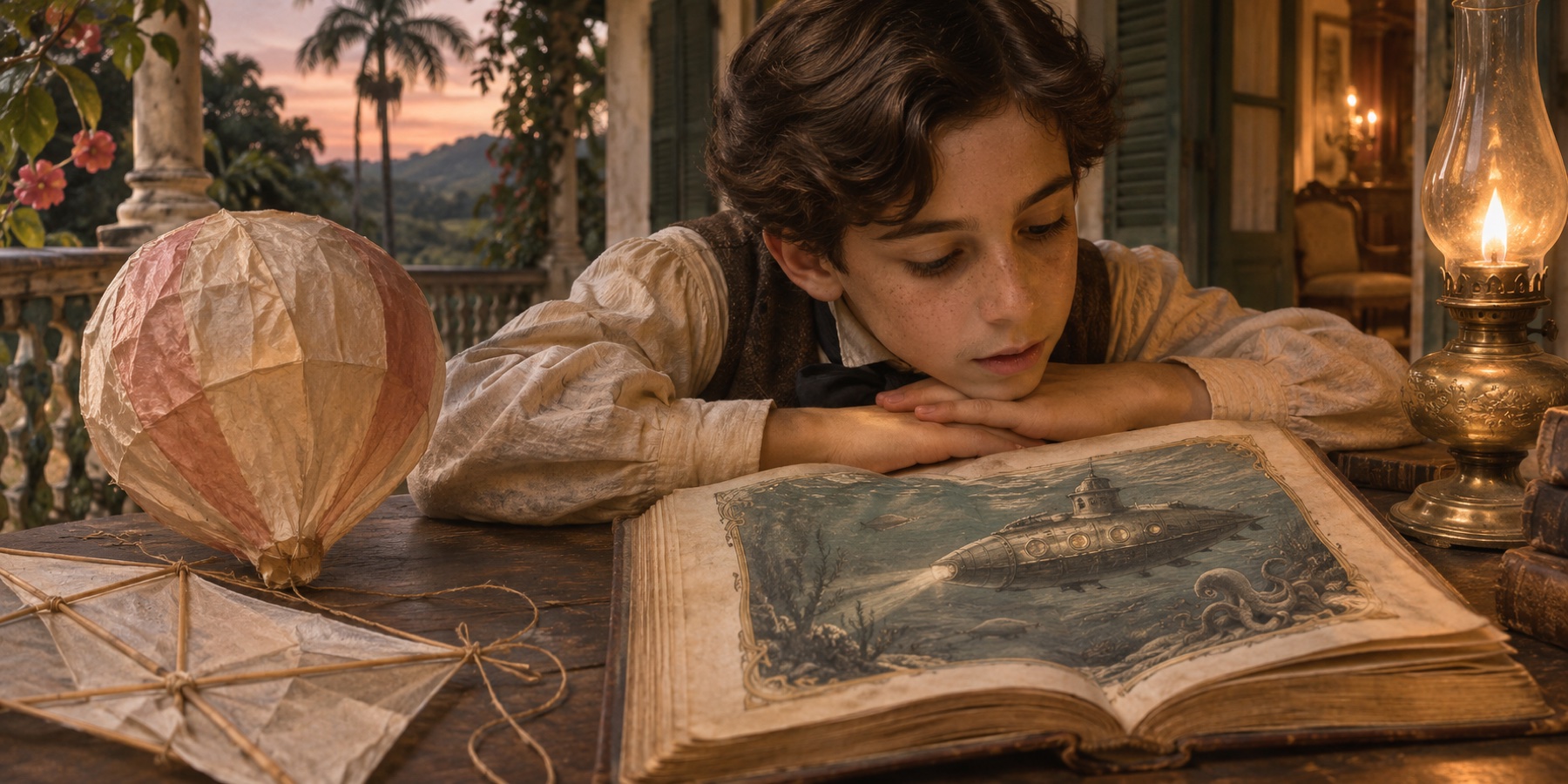
Books let the boy travel farther than the estate railway. He remembered reading Jules Verne with particular intensity. These were adventures in which strange journeys depended on knowledge, machines, preparation, and the nerve to attempt what ordinary experience did not yet allow. An imagined expedition could make an unfamiliar technical question feel urgent.
Picture the change of scale between a lamp-lit page and the distance it describes. One moment the room has walls; the next the reader is following a voyage through air or across an ocean. We cannot recover the precise light on Alberto's childhood desk. We can recognize the importance he later gave these books, and the connection he drew between reading about movement and wanting to attempt it.
The attraction was not a set of construction instructions. Verne made engineering part of adventure. Problems had to be worked through before a journey could continue. That structure would find a real counterpart in Alberto's life: another material to test, another mechanism to repair, another reason to return to the workshop before setting out again. The delight was in the journey, including the work that allowed it to happen.
Small paper balloons against a large sky
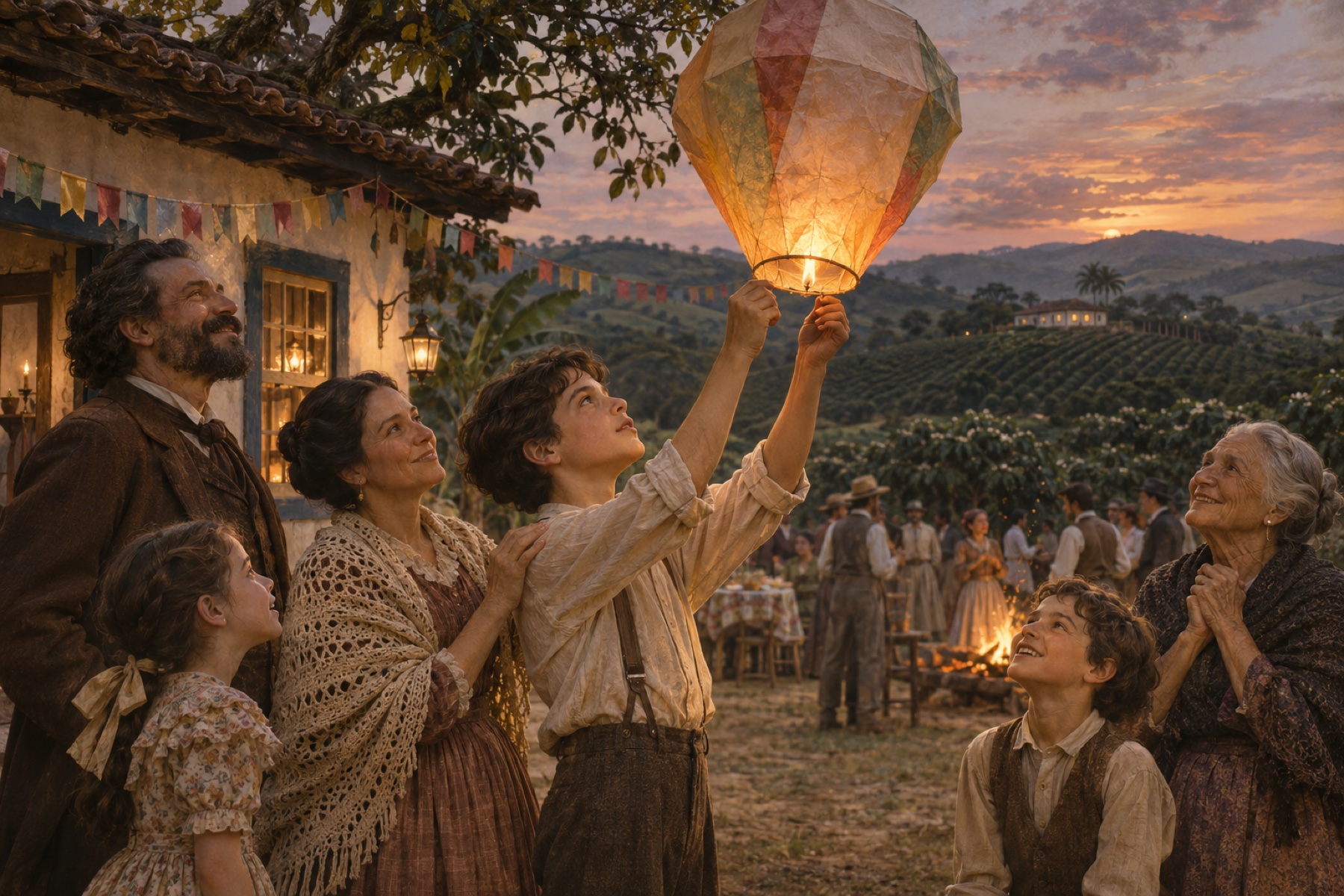
His recollections also place flight among the amusements of childhood: kites, small paper balloons, and games. The paper balloons associated with the June festivities offered a particularly immediate spectacle. Something light, assembled by human hands, could rise into the evening while the people who made it remained below.
For a moment, follow it with the children. Its apparent size diminishes. The direction of its movement belongs to the air rather than the path someone drew on the ground. It is visible and then increasingly difficult to distinguish. This is an imagined viewpoint, but it belongs to the kind of experience he chose to remember when explaining his fascination with flight.
The famous childhood game in his memoir gives that fascination a playful form: children raised a finger when a named creature could fly. Alberto remembered insisting on including a human being. The adult storyteller already knew how the ending of his own story had begun to unfold. Even read with that perspective in mind, the anecdote has charm. Flight was a question he enjoyed refusing to close.
A model small enough to hold
Paper balloons were not his only miniature aircraft. In his memoir, Alberto also remembered making light model aeroplanes from straw, with small propellers driven by twisted rubber. These were objects at the scale of a child's hands. Their power source had to be wound, their structure kept light, and their movement watched before the next attempt.
The attraction is easy to recognize without pretending that a toy is a complete engineering education. A model lets a child change something and see a result. An elegant idea may still refuse to fly. A small alteration can matter more than the amount of effort put into the launch. The sky gives an answer that does not depend on how confidently the maker explains the design.
Hold that scale beside the estate's engines. One world supplies enormous mechanical power; another asks how little material can be persuaded to rise. His later work would join those concerns in machines capable of carrying him. The model in the boy's hands is not a prophecy. It is an early experiment, and an early reason to look closely at what happens after letting go.
São Paulo, 1888: somebody actually goes up
At about fifteen, Alberto saw a full-size balloon ascent in São Paulo. His memoir places it at a public celebration in 1888, followed by the aeronaut descending with a parachute. The flight was no longer a small paper object vanishing above a bonfire. A person had entered the sky and come back from it.
The event brought together ideas he already knew from reading and a spectacle he could see with his own eyes. Ballooning had a history: envelopes, gases, ascents, and the names of people who had taken the first risks. The demonstration made that history present. Someone on the field could prepare equipment and perform an act that had once seemed impossible.
He would not make his own first ascent immediately. Years, journeys, and disappointing inquiries in Paris lay between watching and participating. That interval is part of his upbringing too. Interest could persist without an instant opportunity to satisfy it. By the time he stepped into Machuron's basket, the desire had already survived a long wait.
Who made room for an inventor?
The estate's prosperity becomes essential to what follows. Experiments in balloons and engines cost money. Specialist labour costs money. So do materials that fail, equipment that must be replaced, and the time between a promising idea and a useful result. Alberto would be able to make decisions that most curious young people could not afford.
Keep the people working the estate within the landscape. Coffee production rested on labour as well as on the engineer's arrangements, and the Brazil of his childhood was marked by slavery, abolition, and profound inequalities of opportunity. Those circumstances should not be flattened into an idyllic backdrop. The family had choices that were not equally available to everyone around them.
Recognizing this gives his later experiments a more concrete setting. Independence allowed him to employ experienced builders, change his mind, and begin again after costly damage. It did not tell him what to invent or make a dangerous machine reliable. It gave him room in which to do that work. The boy's curiosity and the circumstances that sustained it belong in the same biography.
A family crisis changes the route
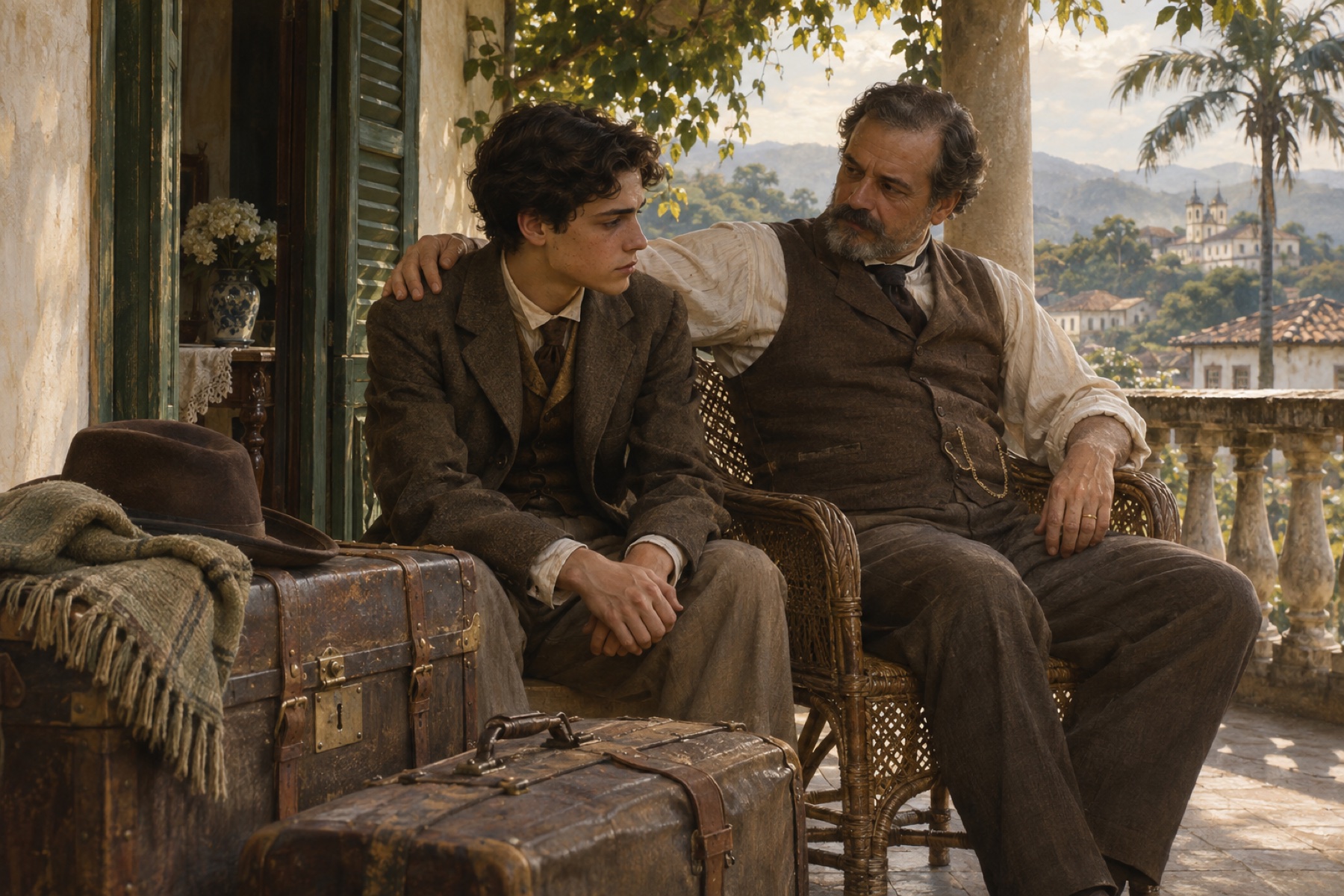
The journey toward France is shaped by Henrique's health after a serious accident. In 1891, the family travels to Europe in search of treatment. Alberto is seventeen for much of that year. What later looks like the natural departure of an aspiring inventor was also a family's response to illness.
The father who had organized routes and machinery now needed care. The son was approaching adulthood, encountering a much wider world while his family's circumstances were changing. We do not have to invent a farewell conversation to understand the weight of that conjunction. Travel, medical hope, and a young person's expanding possibilities could occupy the same trunks.
The Atlantic crossing belongs to the story because it took time. Europe did not appear a few hours after departure. A steamship journey separated familiar places from a destination already present in Henrique's education and family history. Alberto would arrive with memories of machines that moved harvests and trains that crossed the estate. In Paris, machines would offer a different set of possibilities.
Henrique’s death, and the freedom to continue
Henrique died in 1892. The financial independence made available to Alberto in these years therefore sits beside a bereavement. The familiar story of a young man free to experiment has another side: the father whose example helped make engineering familiar would not see the airship around the Eiffel Tower or the 14-bis above Bagatelle.
Alberto's subsequent path was not a straight line from a childhood dream to an airplane. There were returns across the Atlantic, study, automobiles, delayed plans for a balloon ascent, and encounters with practitioners who could teach him. He had room to choose a direction, but he still had to discover which problems he was capable of solving.
Follow him out of this chapter without placing the completed machine in his hands too early. He knows what it is to stand beside an engine. He has read extraordinary journeys. He has seen his family change its place in the world. Ahead are the motor workshops of Paris, and eventually the small basket in which the earth will appear to slip away beneath him.
EXPLORE THE SOURCES
[1]Alberto Santos-Dumont · My Airships (1904) ↗[2]Biblioteca Nacional · BNDigital ↗[3]Academia Brasileira de Letras ↗[12]Secretaria Municipal de Educação · Rio de Janeiro ↗[20]INCAER · Santos Dumont, Father of Aviation ↗[21]Henrique Lins de Barros · CBPF ↗[22]Past & Present · Oxford University Press ↗[30]Instituto Brasileiro de Museus · Visite Museus ↗[31]Prefeitura Municipal de Santos Dumont ↗[36]Agenda Santos Dumont · Patrimônio Atual ↗All illustrations are AI interpretations. Sensory invitations are atmosphere, not recorded thoughts or dialogue.