CHAPTER 07 · 1904 — 1918
An inventor, even on the ground.
Time on the wrist. A small house on a hill. Ingenuity at human scale.
PARIS · PETRÓPOLIS, BRAZIL
A problem small enough to fit on a wrist
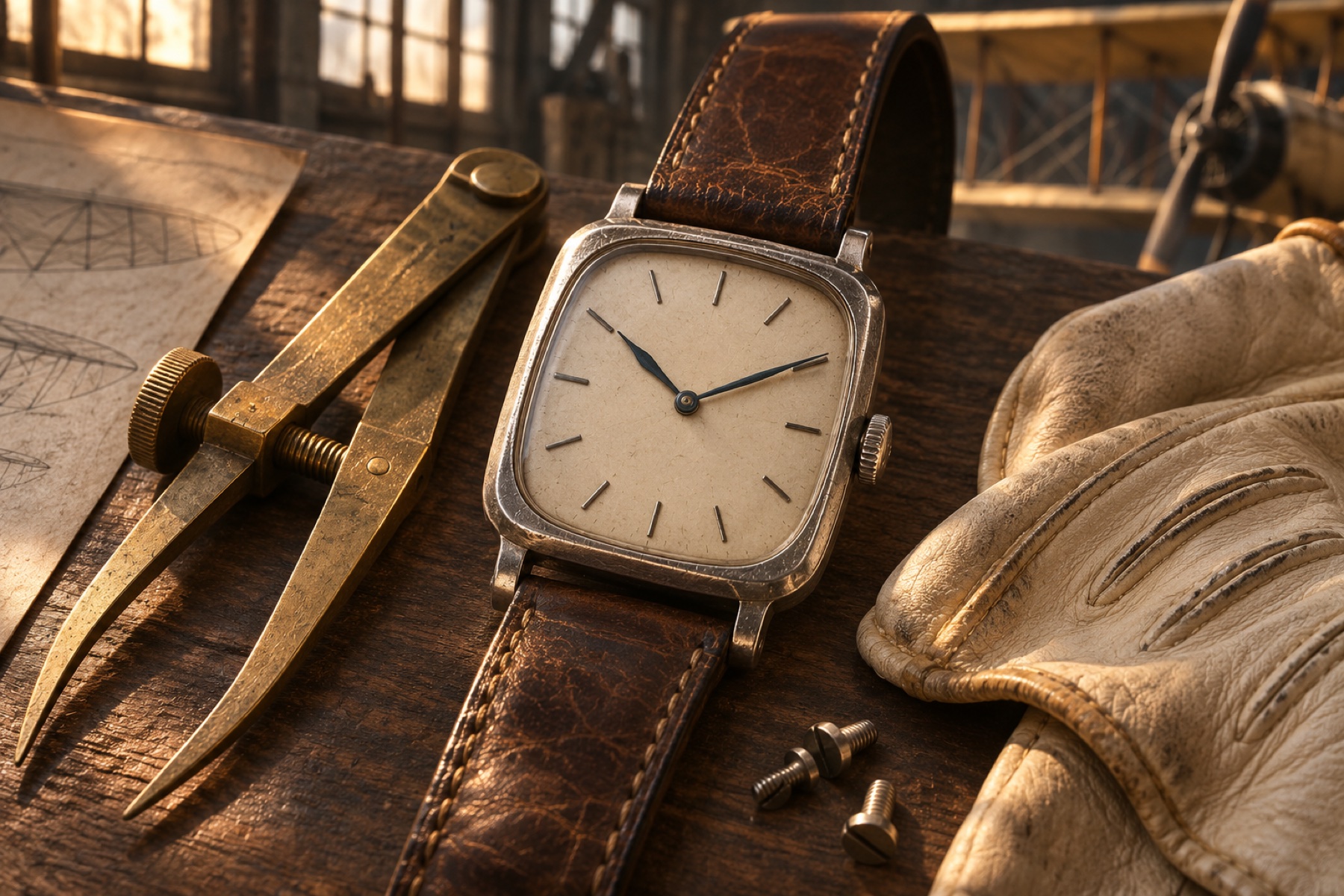
Reading a watch is easy until both hands have other work to do. Cartier’s account of the Santos design begins with that practical situation: an aviator wanted the time within easy view. Louis Cartier made a watch for his friend, and the manufacturer dates the origin story to 1904.
The watch belongs in this biography as a collaboration, not as a claim that Alberto invented wristwatches. The interesting achievement is more specific. A familiar object was reconsidered around a user in a particular situation. The square case and visible screws became part of a lasting design identity, carrying the aviator’s name into a world far beyond the field and the hangar.
Clothes, stature, and the person the public recognized
The public image of Santos Dumont was unusually legible: carefully dressed, slight in stature, with a recognizable hat and manner of presentation. Museum interpretation has explored him as a sportsman and designer as well as an aeronaut. His appearance helped make a technical pioneer into someone readers could recognize at a glance.
Clothes also bring the body back into a history too easily reduced to machines. This was a person who had to dress, travel, work, meet friends, and inhabit rooms. Personal objects do not compete with the airplane for importance; they answer different questions. They remind us that the famous figure continued to exist when the crowd was no longer watching.
The mountain railway, and another kind of arrival
Petrópolis offered a setting different from the Parisian field: a mountain town, a cooler climate, a landscape reached by climbing through the Serra. A historical study by Marisa Guadalupe Cardoso Plum discusses a 1914 interview in which Santos Dumont described the changing air during the railway ascent. Here, travel once again alters the sensory character of the story.
The connection with railways is quietly satisfying. His life began beside railway work, and a later journey into the mountains also belonged to a railway landscape. The means of transport were changing the conditions of his life before and after his own aircraft did so. The Father of Aviation remained a traveller on the ground.
18 April 1918: choosing a small piece of hillside
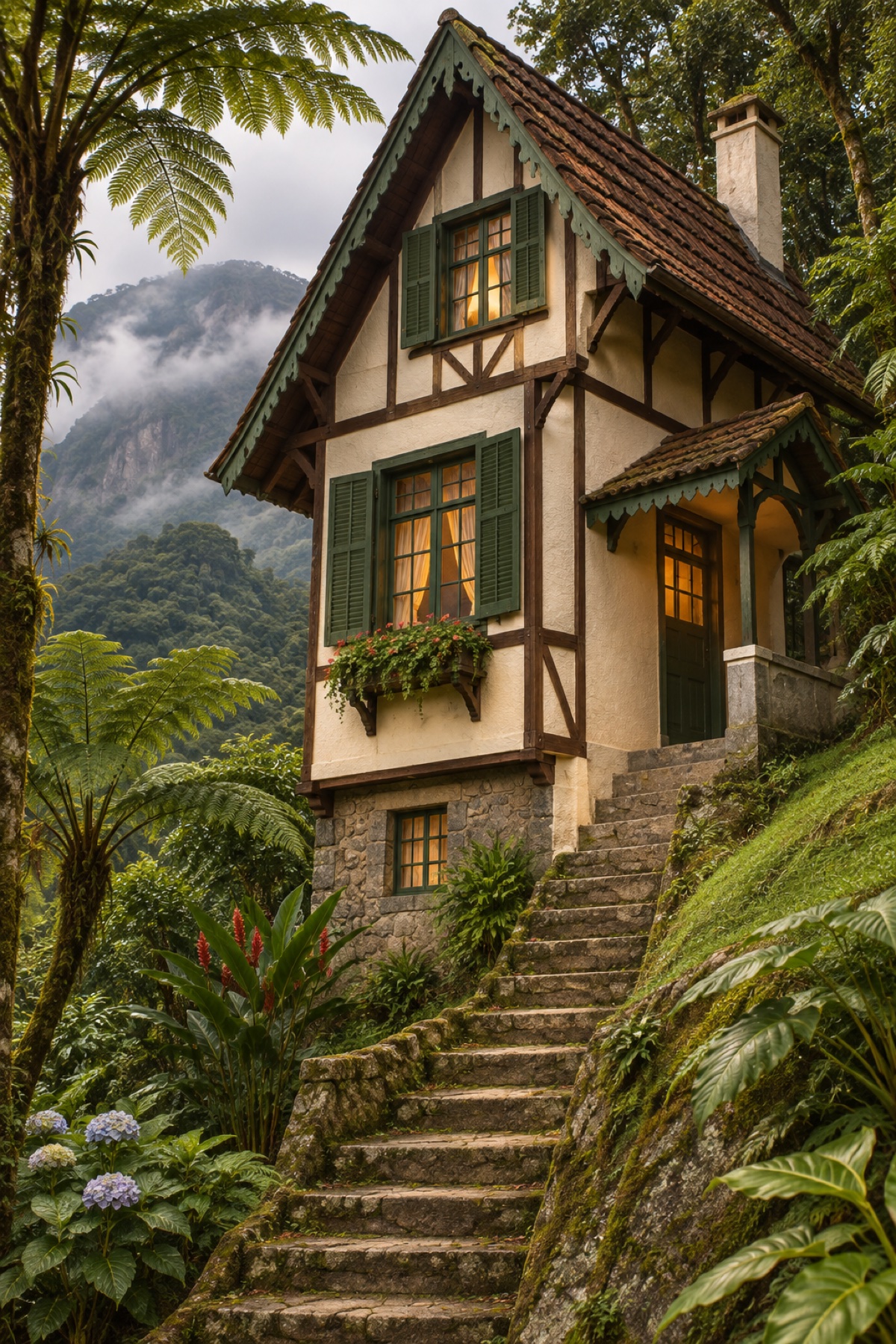
On 18 April 1918, he acquired the hillside plot on which A Encantada would stand. The same historical study records municipal authorization for occupation on 29 August. These ordinary administrative dates are a welcome counterweight to the mythic image of a genius: a house, too, required a site, drawings, assistance, work, and permission.
The museum registry identifies the engineer Eduardo Pederneiras as a collaborator in its construction. That name belongs beside Alberto’s. The little house is often presented as a complete portrait of one mind, but it also emerged from cooperation. A building, like an aircraft, has to pass from intention through other people’s skill into something that can carry a person.
An awkward hillside becomes a design question
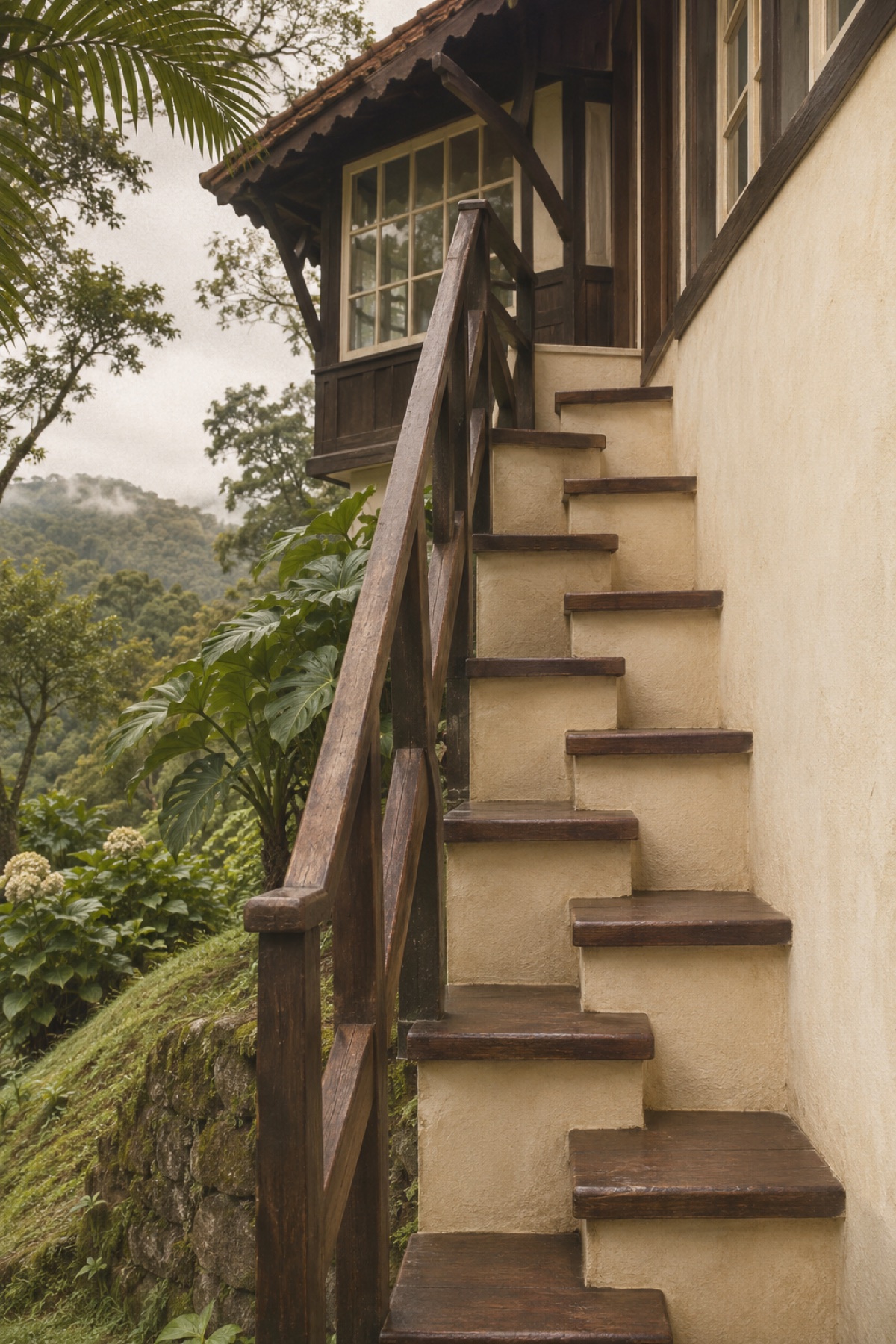
The alternating cutaway steps are the house’s best-known detail. Their rhythm makes a narrow, steep stair easier to negotiate in the available space. The outside stair begins with the right foot because of its geometry. It is a physical arrangement before it is a story about luck.
That detail rewards the same kind of looking as a joint in an airplane. Where will the body move? What occupies the available space? What can be removed without defeating the function? It would be too simple to declare the house a grounded aircraft, but the practical attention is familiar. A small inconvenience becomes something a person can examine, reshape, and build differently.
Hot water, delivered meals, and an economy of living
The museum describes a shower heated with alcohol, another memorable solution within the house. It also records an absence: there was no kitchen. Meals came from a nearby hotel. The domestic arrangement involved deciding what the small building needed to contain and which needs could be met outside it.
These details are richer when we leave them specific. An alcohol-heated shower in this house is not proof that all heated showers began here. A kitchenless dwelling is not proof that its resident wished to live without help. The particular solutions reveal a relationship among convenience, available space, service, and the person using the building. They let ingenuity become human-sized.
A window, a book, and the future beyond the hill
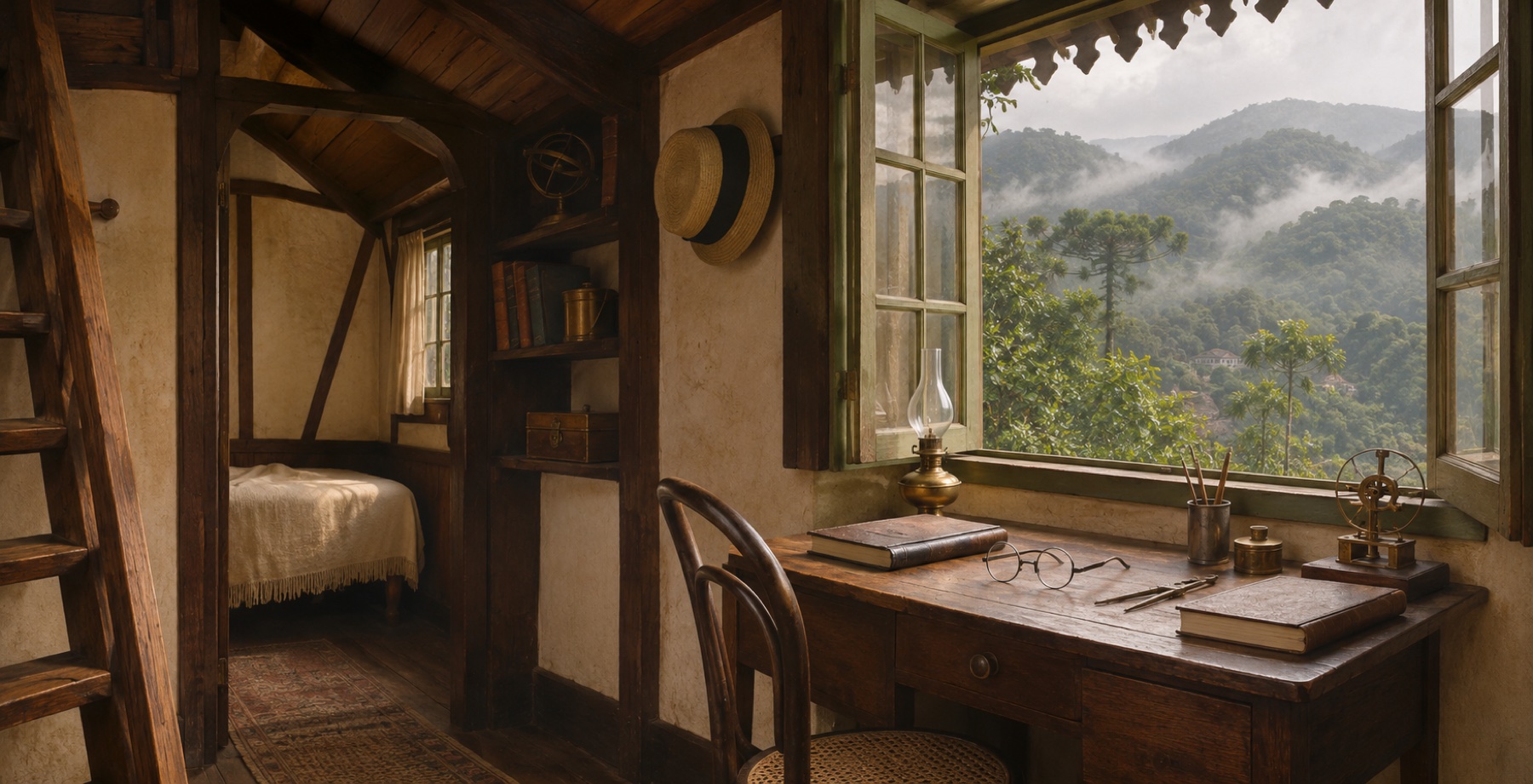
A Encantada is associated with his 1918 book, O que eu vi, o que nós veremos. Its title holds two directions at once: what he had witnessed and what he believed might come next. A man known for visible demonstrations was also trying to persuade readers through writing.
The desk scene does not reproduce a verified arrangement of his possessions. It offers a quieter way into the life: a room, tools, paper, and a view outward. The inventions do not disappear in this setting. They become part of a larger question about how knowledge should enter daily life and what kind of future a country might choose to build.
EXPLORE THE SOURCES
[10]Cartier ↗[11]MuseusBr · Instituto Brasileiro de Museus ↗[21]Henrique Lins de Barros · CBPF ↗[25]Instituto Histórico de Petrópolis · Marisa G. C. Plum ↗[26]Alberto Santos Dumont · 1918 ↗[28]Jornal da USP ↗[34]Jornal da USP · Museu Paulista ↗[38]White House archives · Bill Clinton, 13 October 1997 ↗All illustrations are AI interpretations. Sensory invitations are atmosphere, not recorded thoughts or dialogue.