CHAPTER 06 · 1907 — 1910
Make it lighter. Let it belong to everyone.
The Demoiselle turns an extraordinary experiment into a more intimate possibility.
SAINT-CYR · FRANCE
After the applause, another beginning
The success of the 14-bis did not settle the shape of the airplane for Santos Dumont. Further projects and experiments followed. Some were unsuccessful or remained developmental. The familiar transition from one famous machine to another can conceal this uneven work, as though history had politely removed every inconclusive day.
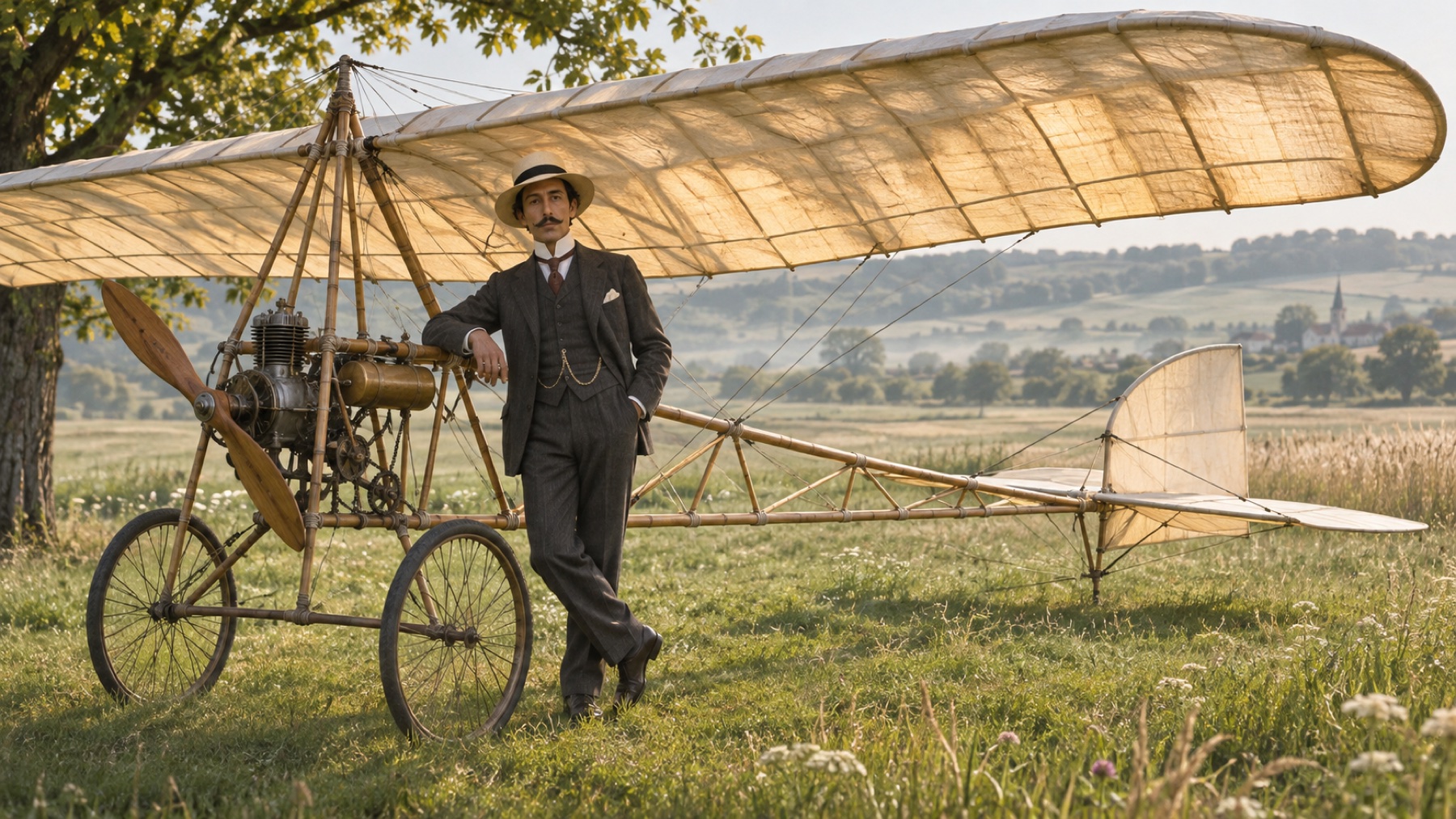
The Demoiselle emerged from a different ambition: make an airplane exceptionally small and light. Where the 14-bis offered a broad cellular structure, the new family of monoplanes pursued a spare frame beneath a high wing. The point was not merely to reduce the dimensions of the earlier design. It was to seek another relationship between a pilot and a flying machine.
Bamboo is a decision, not a decoration
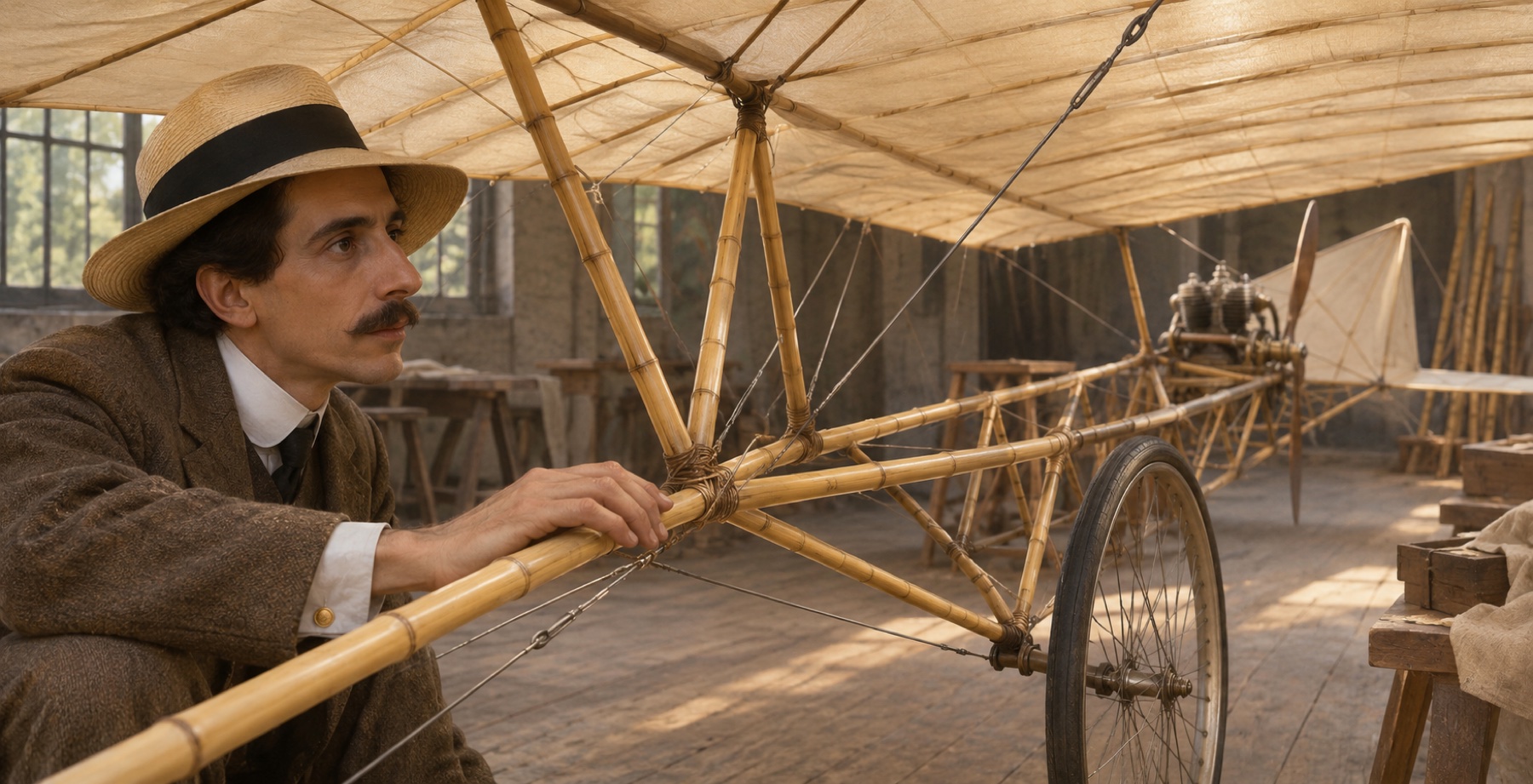
The exposed bamboo structure is among the Demoiselle’s most arresting features. It gives the eye very little to hide behind. Long members, joints, wires, wing, engine, wheels, and seat appear as an economical assembly rather than a solid body. The Science Museum’s model record describes three bamboo poles forming the fuselage.
A light structure still has to carry loads. Each member has a job; each joint must allow forces to pass without making the design unacceptably heavy or unreliable. Simplicity in appearance can therefore be the result of difficult selection. Removing a part is useful only when the remaining arrangement can still do what the airplane needs. Lightness is a discipline, not the absence of engineering.
A body learning to bank a wing
Control could be remarkably physical. The Science Museum describes wing warping operated through a lever connected to the pilot’s jacket: leaning one way or the other helped command the corresponding bank. It also describes a tail arrangement that could move vertically or sideways for elevator and rudder control.
This is a striking invitation to imagine the pilot’s task. There is no sealed modern cockpit isolating the person from the mechanism. Clothing, posture, and attention enter the control arrangement. The body does not merely occupy the airplane; it participates in operating it. That intimacy helps explain why the Demoiselle feels so different from the large, boxlike presence of the 14-bis.
One name, several developing machines
The Demoiselle was a family of aircraft, developed from No. 19 in 1907 through subsequent versions. Treating it as one unchanging object makes conflicting dimensions and engine figures seem like a mystery. Often the more sensible question is which version a writer, drawing, photograph, or museum specimen represents.
The distinction matters for an illustrated biography. An image can communicate the delicate high wing and open frame while still failing to match a specific machine in every detail. Here the scenes are labelled interpretations. For exact dimensions, a plan or a carefully documented museum object is the appropriate place to go. Understanding the sequence is more useful than memorizing one set of numbers stripped of its version.
From a workshop to other people’s hands
The Musée de l’Air et de l’Espace connects the developed Demoiselle with manufacture by Clément-Bayard and emphasizes Santos Dumont’s decision to make the design available. The story therefore extends beyond a single pilot demonstrating a single machine. Other builders could encounter an idea that was simple enough to study and attractive enough to reproduce.
The museum’s own surviving example makes another lesson visible. It identifies an original fuselage, with replacement wings and renewed paint. A preserved aircraft can be an authentic historical object without every visible surface being original. The survival of the idea and the survival of its materials are related, but they are not identical.
A drawing is another way for an airplane to travel
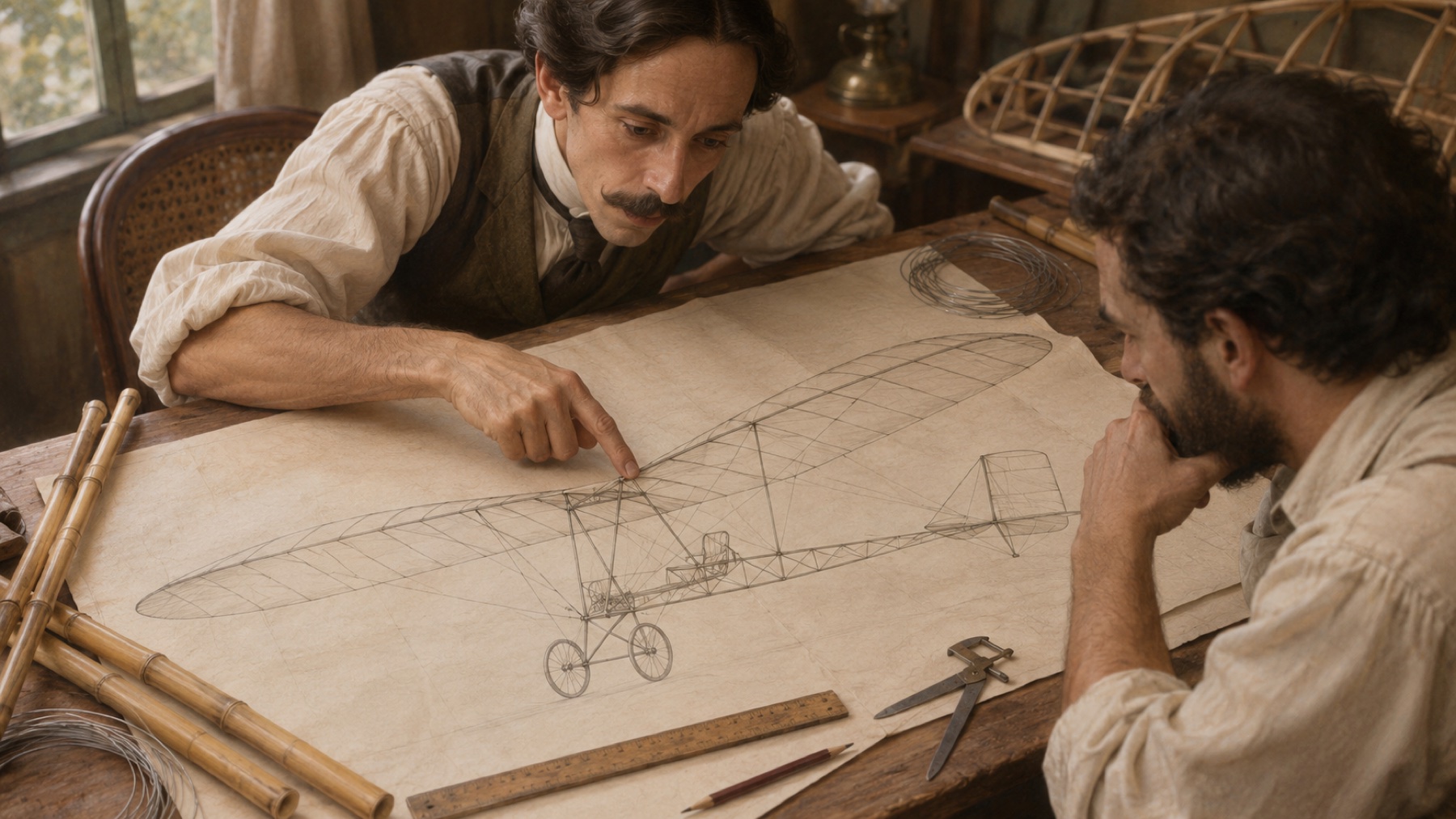
Detailed plans appeared in Popular Mechanics in 1910. An aircraft that could reach only the next field in the hands of one pilot could now reach a distant reader as a set of relationships on paper. A drawing does not eliminate the need for tools or skill, but it changes who can begin to understand the arrangement.
This is one of the most generous strands in the Father of Aviation’s legacy. Knowledge can travel independently of the original machine. Somebody who never met Alberto might study a joint, compare materials, and ask a better question. The drawing-table image celebrates that circulation; its unlettered sheet is an artistic evocation, not a substitute for the published plans.
The experiments that a list should not flatten
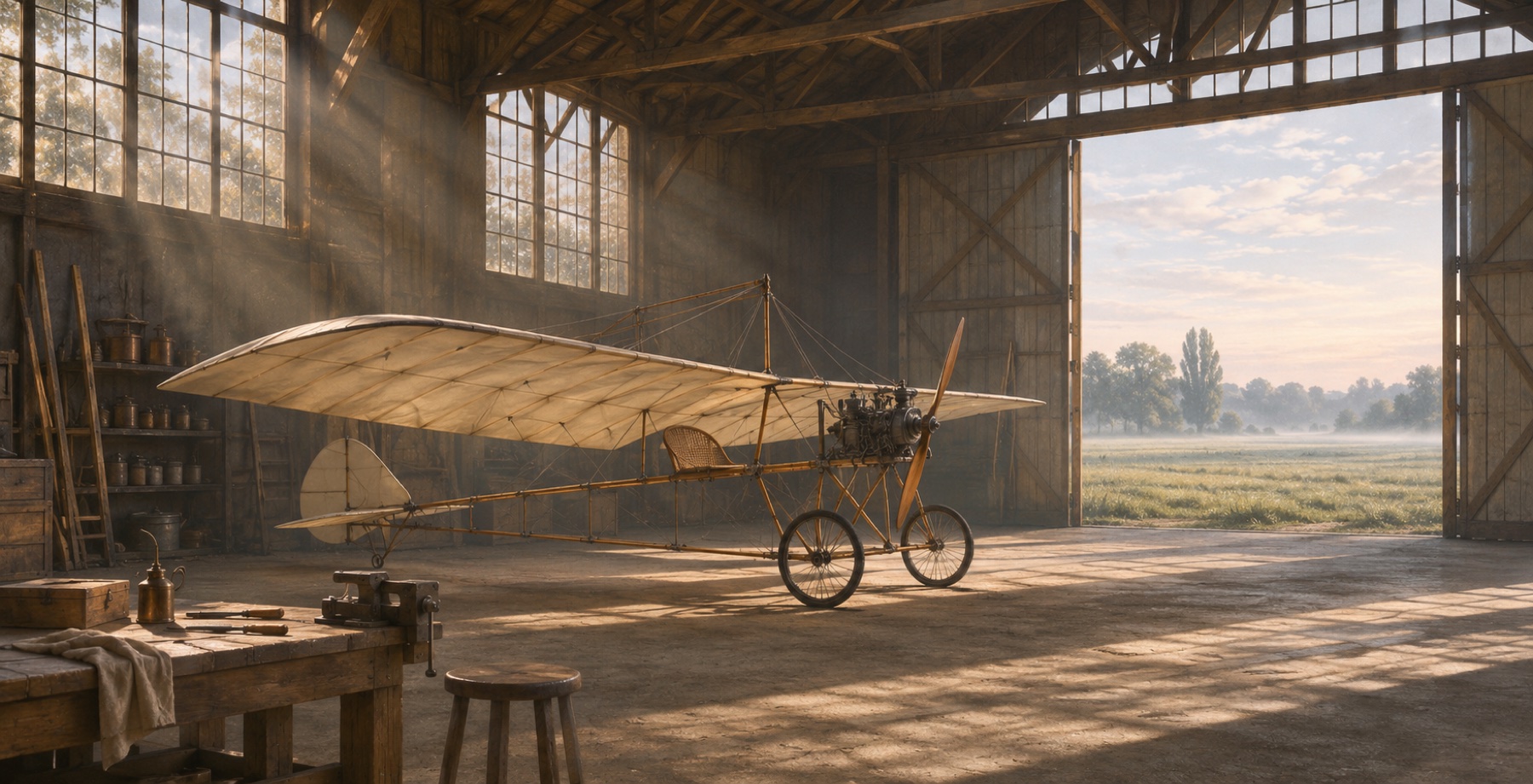
The numbered projects also included attempts beyond the best-known successful aircraft, among them a helicopter experiment. A responsible invention list distinguishes a concept, a prototype, a machine tested on the ground, and an aircraft demonstrated in flight. These are different kinds of achievement and evidence.
Failure does not become meaningless because it lacks a famous photograph. It may explain why an inventor changed direction or stopped investing in a particular arrangement. The Demoiselle is more remarkable when it appears at the end of a sequence of decisions than when it is presented as a tiny miracle. Alberto’s career was a practice of choosing what to keep, what to alter, and what to leave behind.
EXPLORE THE SOURCES
[4]Instituto Cultural Santos=Dumont ↗[9]Museu Aeroespacial · Força Aérea Brasileira ↗[14]Science Museum Group ↗[15]Musée de l’Air et de l’Espace ↗[24]Museu de Astronomia e Ciências Afins · Part IV ↗[32]NASA · Glenn Research Center ↗[36]Agenda Santos Dumont · Patrimônio Atual ↗[38]White House archives · Bill Clinton, 13 October 1997 ↗All illustrations are AI interpretations. Sensory invitations are atmosphere, not recorded thoughts or dialogue.